Oxford Series on Materials Modelling - Böcker
Visar alla böcker i serien Oxford Series on Materials Modelling. Handla med fri frakt och snabb leverans.
13 produkter
13 produkter
987 kr
Skickas inom 7-10 vardagar
Plasticity Theory is characterized by many competing and often incompatible points of view. This book seeks to strengthen the foundations of continuum plasticity theory, emphasizing a unifying perspective grounded in the fundamental notion of material symmetry. Steigmann's book offers a systematic framework for the proper understanding of established models of plasticity and for their modern extensions and generalizations. Particular emphasis is placed on the differential-geometric aspects of the subject and their role in illuminating the conceptual foundations of plasticity theory. Classical models, together with several subjects of interest in contemporary research, are developed in a unified format. The book is addressed to graduate students and academics working in the field of continuum mechanics.
Del 2 - Oxford Series on Materials Modelling
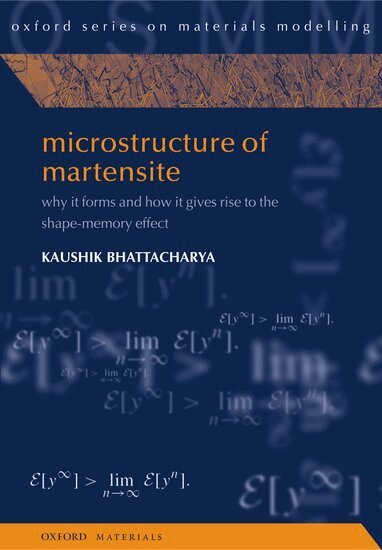
Microstructure of Martensite
Why it forms and how it gives rise to the shape-memory effect
Inbunden, Engelska, 2003
1 735 kr
Skickas inom 7-10 vardagar
Martensites are crystalline solids that display dazzling patterns at the microscopic scales. This microstructure gives rise to unusual macroscopic properties like the shape-memory effect. Starting with the crystalline structure, this book describes a theoretical framework for studying martensites and uses the theory to explain why these materials form microstructure. The macroscopic consequences of the microstructure are subsequently discussed. Complete with a piece of shape-memory wire and numerous examples from real materials, this book represents a successful case study in multiscale modelling, giving a clear understanding of the link between microstructure and macroscopic properties. Beautifully written, in a most clear and pedagogical manner, it holds appeal for a broad audience. On the one hand, it introduces modern modelling techniques to those trained in materials science, mechanics and physics, and shows how these techniques can be used in real-world problems. On the other hand, it introduces physical phenomena to those trained in mathematics, and demonstrates how such phenomena give rise to interesting mathematical problems.
Del 1 - Oxford Series on Materials Modelling
Interatomic Forces in Condensed Matter
Inbunden, Engelska, 2003
2 040 kr
Skickas inom 7-10 vardagar
There is a continuing growth of interest in the computer simulation of materials at the atomic scale, using a variety of academic and commercial computer programs. In all such programs there is some physical model of the inter-atomic forces, which may be based on something as simple as a pair interaction, such as the Lennard-Jones model, or as complex as a self-consistent, all-electron solution of the quantum mechanical problem. For a student or researcher, the basis of such models is often shrouded in mystery. It is usually unclear how well founded they are, since it is hard to find a discussion of the physical assumptions that have been made in their construction. The lack of clear understanding of the scope and limitations of a given model may lead to its innocent misuse, resulting either in unfair criticism of the model or in the dissemination of nonsensical results. In the present book, models of inter-atomic forces are derived from a common physical basis, namely the density functional theory. The interested reader will be able to follow the detailed derivation of pairwise potentials in simple metals, tight-binding models from the simplest to the most sophisticated (self-consistent) kind, and various ionic models. The book is self-contained, requiring no more background than provided by an undergraduate quantum mechanics course. It aims to furnish the reader with a critical appreciation of the broad range of models in current use, and to provide the tools for understanding other variants that are described in the literature. Some of the material is new, and some pointers are given to possible future avenues of model development.
1 409 kr
Skickas inom 5-8 vardagar
The strengthening of metals by a variety of means has been of interest over much of history. However, the elucidation of the actual mechanisms involved in the processes of alloying and work hardening, and the related processes of metals as a scientific pursuit, has become possible only through the parallel developments in dislocation theory and in definitive experimental tools of electron microscopy and X-ray diffraction. The important developments over the past several decades in the mechanistic understanding of the often complex processes of interaction of dislocations with each other, with solute atoms and with precipitates during plastic flow have largely remained scattered in the professional literature. This has made it difficult for students and professionals to have ready access to this subject as a whole. While there are some excellent reviews of certain aspects of the subject, there is presently no single comprehensive coverage available of the central mechanisms and their modelling. The present book on Strengthening Mechanisms in Crystal Plasticity provides such a coverage in a generally transparent and readily understandable form. It is intended as an advanced text for graduate students in materials science and mechanical engineering. The central processes of strengthening that are presented are modeled by dislocation mechanics in detail and the results are compared extensively with the best available experimental information. The form of the coverage is intended to inspire students or professional practitioners in the field to develop their own models of similar or related phenomena and, finally, engage in more advanced computational simulations, guided by the book.
Del 5 - Oxford Series on Materials Modelling
Dislocations, Mesoscale Simulations and Plastic Flow
Inbunden, Engelska, 2013
1 635 kr
Skickas inom 5-8 vardagar
In the past twenty years, new experimental approaches, improved models and progress in simulation techniques brought new insights into long-standing issues concerning dislocation-based plasticity in crystalline materials. During this period, three-dimensional dislocation dynamics simulations appeared and reached maturity. Their objectives are to unravel the relation between individual and collective dislocation processes at the mesoscale, to establish connections with atom-scale studies of dislocation core properties and to bridge, in combination with modelling, the gap between defect properties and phenomenological continuum models for plastic flow. Dislocation dynamics simulations are becoming accessible to a wide range of users. This book presents to students and researchers in materials science and mechanical engineering a comprehensive coverage of the physical body of knowledge on which they are based. It includes classical studies, which are too often ignored, recent experimental and theoretical advances, as well as a discussion of selected applications on various topics.
1 905 kr
Skickas inom 7-10 vardagar
This book presents a broad collection of models and computational methods - from atomistic to continuum - applied to crystal dislocations. Its purpose is to help students and researchers in computational materials sciences to acquire practical knowledge of relevant simulation methods. Because their behavior spans multiple length and time scales, crystal dislocations present a common ground for an in-depth discussion of a variety of computational approaches, including their relative strengths, weaknesses and inter-connections. The details of the covered methods are presented in the form of "numerical recipes" and illustrated by case studies. A suite of simulation codes and data files is made available on the book's website to help the reader "to learn-by-doing" through solving the exercise problems offered in the book.
Del 8 - Oxford Series on Materials Modelling
Theory and Application of Quantum-Based Interatomic Potentials in Metals and Alloys
Inbunden, Engelska, 2023
1 227 kr
Skickas inom 5-8 vardagar
Atomistic computer simulations are often at the heart of modern attempts to predict and understand the physical properties of real materials, including the vast domain of metals and alloys. Historically, highly simplified empirical potentials have been used to provide the interatomic forces needed to perform such simulations, but true predictive power in these materials emanates from fundamental quantum mechanics.In metals and alloys especially, a viable path forward to the vastly larger length and time scales offered by empirical potentials, while retaining the predictive power of quantum mechanics, is to course-grain the underlying electronic structure of the material and systematically derive quantum-based interatomic potentials from first-principles. This book spans the entire process from foundation in fundamental theory, to the development of accurate quantum-based potentials for real materials, to the wide-spread application of the potentials to the atomistic simulation of structural, thermodynamic, defect and mechanical properties of metals and alloys.
Del 6 - Oxford Series on Materials Modelling
Physics of Elasticity and Crystal Defects
Inbunden, Engelska, 2020
817 kr
Skickas inom 5-8 vardagar
This textbook is a modern take on an old subject at the heart of materials physics. Properties of crystalline materials are almost always controlled by structural defects within them. Until relatively recently these defects were studied theoretically using continuum elasticity theory which ignores the atomic structure of the host material. This book introduces the concepts of elasticity in the traditional continuum way and also in terms of atomic interactions. It goes on to present point (impurities, missing atoms), line (dislocations) and planar (faults, cracks) defects at both the continuum level and the atomic level. This novel approach will be new to most engineers and it will appeal to physicists. There are exercises for the student to work through, with complete solutions free to course instructors from the OUP website.
Del 6 - Oxford Series on Materials Modelling
Physics of Elasticity and Crystal Defects
2nd Edition
Inbunden, Engelska, 2024
909 kr
Skickas inom 5-8 vardagar
Properties of crystalline materials are almost always governed by the defects within them. The ability to shape metals and alloys into girders, furniture, automobiles and medical prostheses stems from the generation, motion and interaction of these defects. Crystal defects are also the agents of chemical changes within crystals, enabling mass transport by diffusion and changes of phase. The distortion of the crystal created by a defect enables it to interact with other defects over distances much greater than the atomic scale. The theory of elasticity is used to describe these interactions.Physics of Elasticity and Crystal Defects, 2nd Edition is an introduction to the theory of elasticity and its application to point defects, dislocations, grain boundaries, inclusions, and cracks. A unique feature of the book is the treatment of the relationship between the atomic structures of defects and their elastic fields. Another unique feature is the last chapter which describes five technologically important areas requiring further fundamental research, with suggestions for possible PhD projects. There are exercises for the student to check their understanding as they work through each chapter with detailed solutions. There are problems set at the end of each chapter, also with detailed solutions. In this second edition the treatment of the Eshelby inclusion has been expanded into a chapter of its own, with complete self-contained derivations of the elastic fields inside and outside the inclusion.This is a textbook for postgraduate students in physics, engineering and materials science. Even students and professionals with some knowledge of elasticity and defects will almost certainly find much that is new to them in this book.
Del 9 - Oxford Series on Materials Modelling
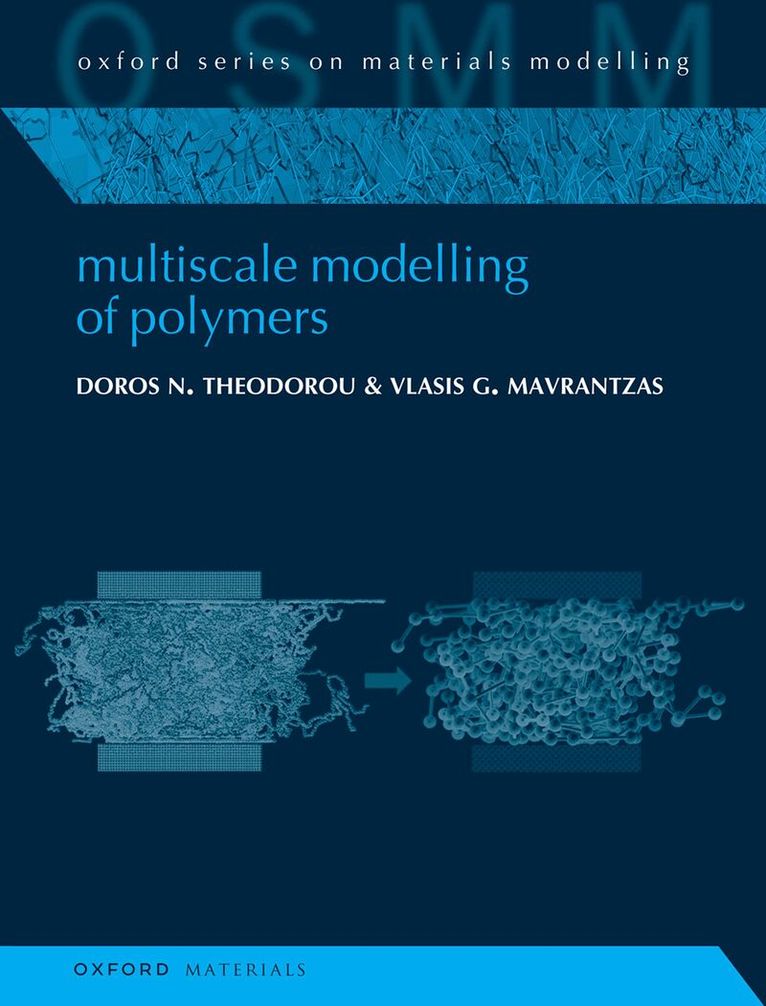
Multiscale Modelling of Polymers
Inbunden, Engelska, 2025
1 118 kr
Skickas inom 5-8 vardagar
The last twenty years have seen an extraordinary development and application of new modelling concepts and powerful simulation tools in the field of polymers, which have dramatically extended our understanding of structure-property relationships and impacted the design of these materials. This book provides a comprehensive overview of the theory and practice of polymer multiscale modelling methods with a balanced combination of breadth and depth. After introducing the key methods for modelling polymeric materials computationally at the atomistic and mesoscopic levels, the text discusses how bridges between different levels of modelling can be built with minimal loss of predictive ability. It presents the statistical mechanical foundations of these methods and explains how they should be implemented in order to understand and reliably predict structure and dynamics in systems of chain molecules. The book also covers the multitude of real world applications of these methods in polymer science ranging from chain conformation and packing, equilibrium volumetric behaviour, segmental dynamics and terminal relaxation in polymer melts to elastic constants, plasticity, and structural relaxation in polymer glasses, phase equilibria of polymer-solvent systems and miscibility of blends, microphase separation and morphology development in block copolymers and viscoelasticity of unentangled and entangled melts.
Del 1 - Oxford Series on Materials Modelling
Interatomic Forces in Condensed Matter
Häftad, Engelska, 2010
778 kr
Skickas inom 7-10 vardagar
There is a continuing growth of interest in the computer simulation of materials at the atomic scale, using a variety of academic and commercial computer programs. In all such programs there is some physical model of the inter-atomic forces, which may be based on something as simple as a pair interaction, such as the Lennard-Jones model, or as complex as a self-consistent, all-electron solution of the quantum mechanical problem. For a student or researcher, the basis of such models is often shrouded in mystery. It is usually unclear how well founded they are, since it is hard to find a discussion of the physical assumptions that have been made in their construction. The lack of clear understanding of the scope and limitations of a given model may lead to its innocent misuse, resulting either in unfair criticism of the model or in the dissemination of nonsensical results. In the present book, models of inter-atomic forces are derived from a common physical basis, namely the density functional theory. The interested reader will be able to follow the detailed derivation of pairwise potentials in simple metals, tight-binding models from the simplest to the most sophisticated (self-consistent) kind, and various ionic models. The book is self-contained, requiring no more background than provided by an undergraduate quantum mechanics course. It aims to furnish the reader with a critical appreciation of the broad range of models in current use, and to provide the tools for understanding other variants that are described in the literature. Some of the material is new, and some pointers are given to possible future avenues of model development.
Del 4 - Oxford Series on Materials Modelling
Strengthening Mechanisms in Crystal Plasticity
Häftad, Engelska, 2012
883 kr
Skickas inom 7-10 vardagar
The strengthening of metals by a variety of means has been of interest over much of history. However, the elucidation of the actual mechanisms involved in the processes of alloying and work hardening, and the related processes of metals as a scientific pursuit, has become possible only through the parallel developments in dislocation theory and in definitive experimental tools of electron microscopy and X-ray diffraction. The important developments over the past several decades in the mechanistic understanding of the often complex processes of interaction of dislocations with each other, with solute atoms and with precipitates during plastic flow have largely remained scattered in the professional literature. This has made it difficult for students and professionals to have ready access to this subject as a whole. While there are some excellent reviews of certain aspects of the subject, there is presently no single comprehensive coverage available of the central mechanisms and their modelling. The present book on Strengthening Mechanisms in Crystal Plasticity provides such a coverage in a generally transparent and readily understandable form. It is intended as an advanced text for graduate students in materials science and mechanical engineering. The central processes of strengthening that are presented are modeled by dislocation mechanics in detail and the results are compared extensively with the best available experimental information. The form of the coverage is intended to inspire students or professional practitioners in the field to develop their own models of similar or related phenomena and, finally, engage in more advanced computational simulations, guided by the book.
Del 3 - Oxford Series on Materials Modelling
Computer Simulations of Dislocations
Häftad, Engelska, 2013
922 kr
Skickas inom 7-10 vardagar
This book presents a broad collection of models and computational methods - from atomistic to continuum - applied to crystal dislocations. Its purpose is to help students and researchers in computational materials sciences to acquire practical knowledge of relevant simulation methods. Because their behavior spans multiple length and time scales, crystal dislocations present a common ground for an in-depth discussion of a variety of computational approaches, including their relative strengths, weaknesses and inter-connections. The details of the covered methods are presented in the form of 'numerical recipes' and illustrated by case studies. A suite of simulation codes and data files is made available on the book's website to help the reader 'to learn-by-doing' through solving the exercise problems offered in the book.