Quantum Theory Chemical Reactions – serie
Visar alla böcker i serien Quantum Theory Chemical Reactions. Handla med fri frakt och snabb leverans.
4 produkter
4 produkter
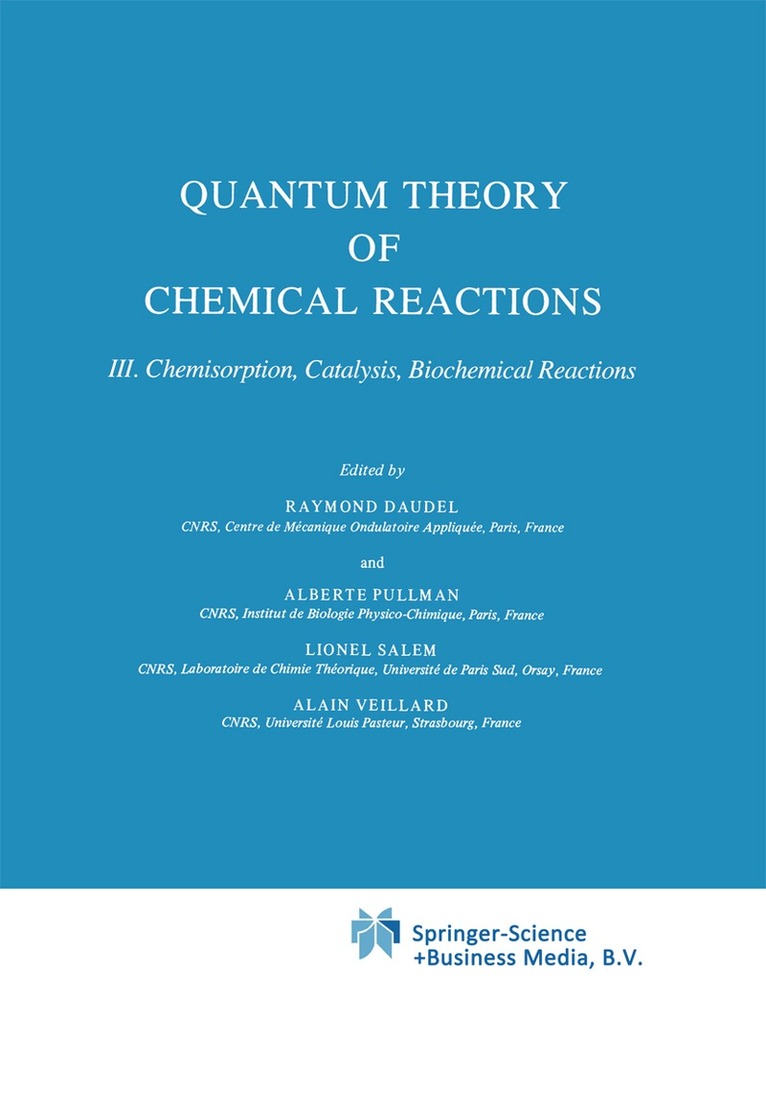
Quantum Theory of Chemical Reactions
Chemisorption, Catalysis, Biochemical Reactions
Inbunden, Engelska, 1982
1 062 kr
Skickas inom 10-15 vardagar
The third and last volume of this treatise IS concerned with important applications of the quantum~theory of chemical reactions to chemisorption, catalysis and biochemical reactions. The book begins with an important paper devoted to the theoretical background of heterogeneous catalysis. It is followed by two papers showing typical applications of wave mechanics to the analysis of chemisorption. Catalysed gas-solid reactions are chosen to illustrate gas, organic solid state reaction and some aspects of the mechanism of the FISCHER-TROPSCH synthesis are presented. The second part of the book is devoted to biochemical applications of quantum chemistry. Two papers are concerned with the quantum theory of enzyme activity. Two others present recent progress of quantum pharmacology. Finally an important contribution to the theory of intermolecular forces is made in the view of possible applications to biochemical problems. vii R. Daudel, A. Pullman, L. Salem, and A. Viellard reds.), Quantum Theory o/Chemical Reactions, Volume III, vii. Copyright (c) 1982 by D. Reidel Publishing Company. THEORETICAL BACKGROUND OF HETEROGENEOUS CATALYSIS J.E.Germain Laboratoire de Catalyse Appliquee et Cinetique Heterogene L.A. 231 du Centre National de la Recherche Scientifique Universite Claude Bernard Lyon I, E.S.C.I.L. 43 Boulevard du 11 Novembre 1918, 69622 Villeurbanne Cedex. Heterogeneous Catalysis is a surface Kinetic phenomenon by which a chemical reaction between molecules of a fluid phase is accelerated (activity) and oriented (selectivity) by contact with a solid phase (catalysts, without change of the solid.
Del 1 - Quantum Theory Chemical Reactions
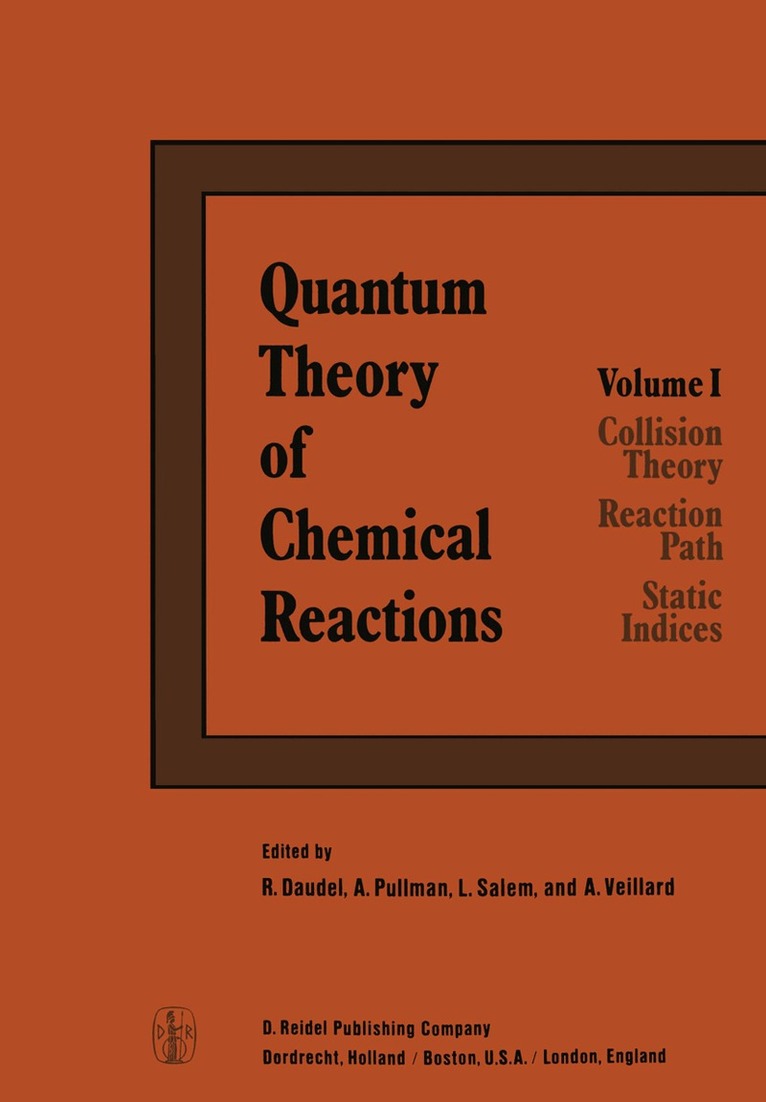
Quantum Theory of Chemical Reactions
1: Collision Theory, Reaction Path, Static Indices
Häftad, Engelska, 2011
534 kr
Skickas inom 10-15 vardagar
This treatise is devoted to an analysis of the present state of the quantum theory of chemical reactions. It will be divided into three volumes and will contain the contributions to an international seminar organized by the editors. The first one, is concerned with the fundamental problems which occur when studying a gas phase reaction or a reaction for which the solvent effect is not taken into account. The two first papers show how the collision theory can be used to predict the behaviour of interacting small molecules. For large molecules the complete calculations are not possible. We can only estimate the reaction path by calculating important areas of the potential surfaces. Four papers are concerned with this important pro cess. Furthermore, in one of these, the electronic reorganization which occurs along the reaction path is carefully analyzed. ~~o papers are devoted to the discussion of general rules as aromaticity rules, symmetry rules. The last two papers are concerned with the electrostatic molecular poten tial method which is the modern way of using static indices to establish relations between structure and chemical reactivity. Volume II will be devoted to a detailed analysis of the role of the solvent and volume III will present important applications as reaction mechanisms, photochemistry, catalysis, biochemical reactions and drug design. SOME RECENT DEVELOPMENTS IN THE MOLECULAR TREATMENT OF ATOM-ATOM COLLISIONS.
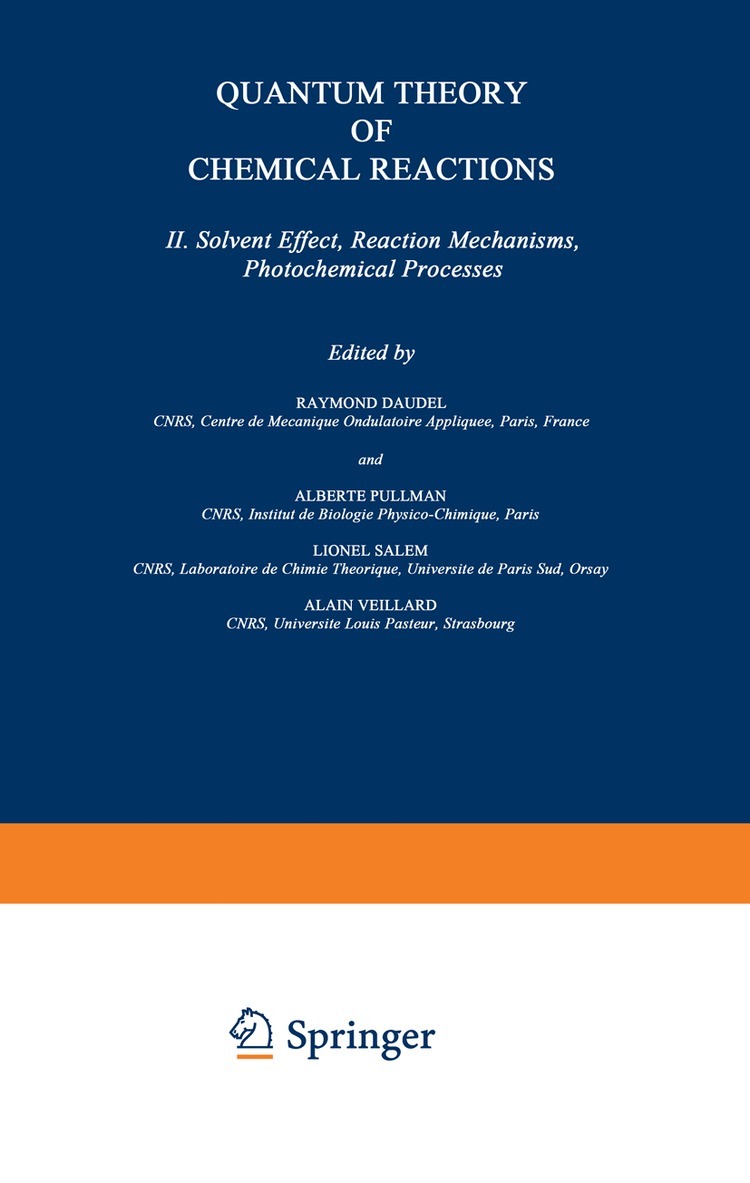
Quantum Theory of Chemical Reactions
II: Solvent Effect, Reaction Mechanisms, Photochemical Processes
Häftad, Engelska, 2012
1 062 kr
Skickas inom 10-15 vardagar
The second volume of this treatise lS concerned with three important problems: a) environmental effects b) reaction mechanisms c) photochemical processes An important paper is devoted to the solvation problem. The local field representation of surrounding medium effect is analyzed and an application is made to the study of ambident reaction. A paper is devoted to the study of chemical reactivity in inert matrices and a theory of the effect of rare gas matrices on molecules is presented. Six papers are concerned with chemical reactions mechanisms. They are related to migration reactions, nucleophilic additions and electrophilic additions, and homogeneous catalytic reactions. Finally, some aspects of the photochemical processes are discussed. The evolution of electronically excited molecules is analyzed and the natural correlation method is presented. The role of Rydberg states' is photochemistry is suggested, we believe, for the first time. The sudden polarization in olefins is described in a critical way and a new phenomenon is presented: the pho- tochemical attachment of aliphatic hydrocarbons to polynuclear aromatic hydrocarbons. vii R. Daudel, A. Pullman, L. Salem, and A.Veillard (eds.;, Quantum Theory of Chemical Reactions, Volume II, vii. Copyright (c) 1980 by D. Reidel Publishing Company. THE SUPERMOLECULE APPROACH TO THE SOLVATION PROBLEM A. PULLMAN Institut de BioLogie Physico-Chimique Laboratoire de Biochimie Theorique, associe au C.N.R.S.
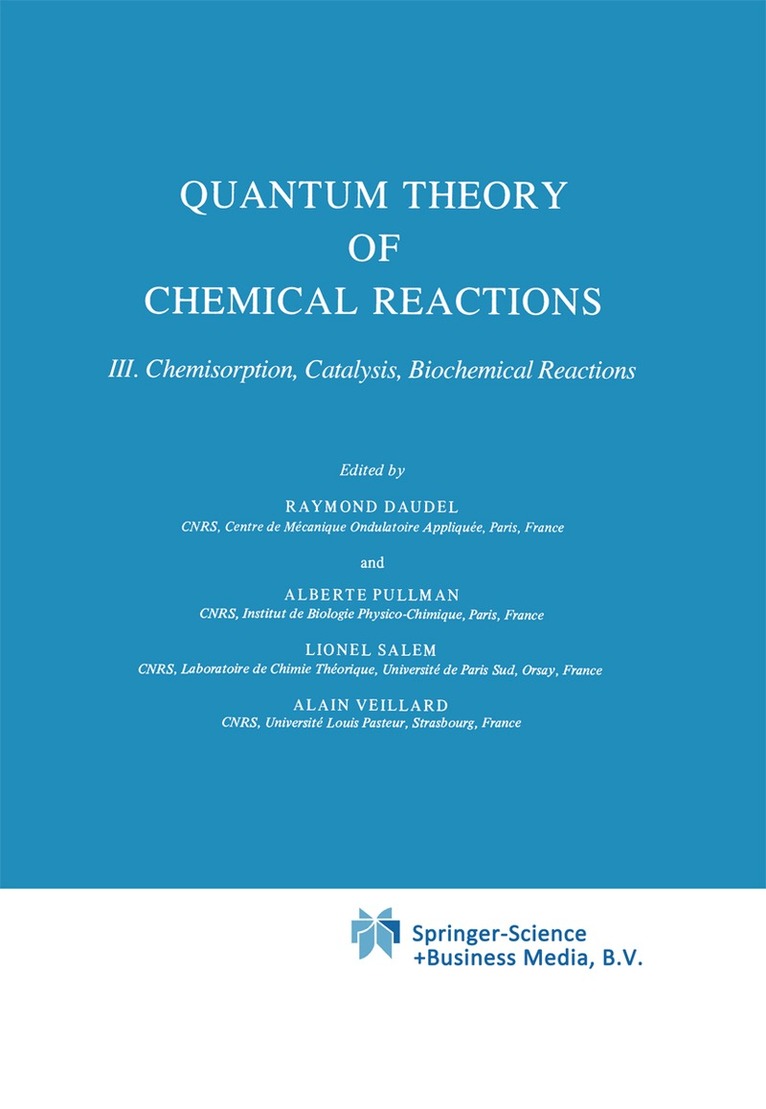
Quantum Theory of Chemical Reactions
Chemisorption, Catalysis, Biochemical Reactions
Häftad, Engelska, 2012
1 062 kr
Skickas inom 10-15 vardagar
The third and last volume of this treatise IS concerned with important applications of the quantum~theory of chemical reactions to chemisorption, catalysis and biochemical reactions. The book begins with an important paper devoted to the theoretical background of heterogeneous catalysis. It is followed by two papers showing typical applications of wave mechanics to the analysis of chemisorption. Catalysed gas-solid reactions are chosen to illustrate gas, organic solid state reaction and some aspects of the mechanism of the FISCHER-TROPSCH synthesis are presented. The second part of the book is devoted to biochemical applications of quantum chemistry. Two papers are concerned with the quantum theory of enzyme activity. Two others present recent progress of quantum pharmacology. Finally an important contribution to the theory of intermolecular forces is made in the view of possible applications to biochemical problems. vii R. Daudel, A. Pullman, L. Salem, and A. Viellard reds.), Quantum Theory o/Chemical Reactions, Volume III, vii. Copyright (c) 1982 by D. Reidel Publishing Company. THEORETICAL BACKGROUND OF HETEROGENEOUS CATALYSIS J.E.Germain Laboratoire de Catalyse Appliquee et Cinetique Heterogene L.A. 231 du Centre National de la Recherche Scientifique Universite Claude Bernard Lyon I, E.S.C.I.L. 43 Boulevard du 11 Novembre 1918, 69622 Villeurbanne Cedex. Heterogeneous Catalysis is a surface Kinetic phenomenon by which a chemical reaction between molecules of a fluid phase is accelerated (activity) and oriented (selectivity) by contact with a solid phase (catalysts, without change of the solid.