SAGE Masters in Modern Social Thought series - Böcker
Visar alla böcker i serien . Handla med fri frakt och snabb leverans.
10 produkter
10 produkter
7 887 kr
Tillfälligt slut
These volumes bring together major critical responses to, and engagement with, the work of Manuel Castells. Arguably the leading analyst of the current age, Castells′ magnum opus, The Information Age, has been compared to the work of Karl Marx and Max Weber. His concept of `the network society′ has influenced much recent social science and his ideas have been adopted in political and policy circles.The volumes provide an unparalleled guide to the work of Castells. They demonstrate the roots of his thinking in Marxism and the shifts in his perspective. The selection if based along two principles: the chronological development of his thought and the sequence of his major publications.Included here are critical engagements with Castells′ work on the urban question, the city and grassroots; Marxism; the Information Age; the network society; power and identity; the new economy; and the sociology of social movements.Volume 1: Marxism, France and `The Urban Question′ to `The City and the Grassroots′This volume addresses Castells′ engagement with the study of urban social movements; protest in urban politics; collective consumption; states, markets and welfare; urban sociology; and classVolume 2: From the Informational City to the Information AgeThis volume examines the theorizing of new industrial-urban space; the dynamics of urban change; the roots of the network society; the failure of social theory; resisting globalization; the development of global thinking; globalization and identity.Volume 3: The Information AgeThis volume addresses the character of information technologies; the political economy of network society; inequality and modernization in the information age; the self and the net; space flows and timeless space; contested power; grassroots environmental movements; cognitions, emotions and identities; digital commerce; and technology and cultural power.The collection provides the best available concentration of writings on the work of Manuel Castells. It will be of interest to readers in sociology, urban studies, political science and affiliated fields.
9 357 kr
Tillfälligt slut
Derek Robbins provides the first complete assessment of the sociological achievements of one of the key European sociologists of the 20th century. Bourdieu has made decisive contributions to theory, method and professional practice. All are discussed here, providing an unparalleled distillation of Bourdieu′s work. The collection: offers a systematic understanding and evaluation of Bourdieu′s sociology; demonstrates the relation of Bourdieu to wider research traditions in the social sciences; faithfully represents Bourdieu′s multidisciplinarianism; explains why Bourdieu is a key 20th century sociologist.The collection is edited by one of Europe′s leading commentators on Bourdieu. The four volumes stand as the benchmark work on a sociologist who has left an indelible mark on the 20th century and whose legacy will be intensively debated into the next millenium.
10 652 kr
Skickas inom 11-20 vardagar
Jean Baudrillard is one of the most important and provocative writers in the contemporary era. Widely acclaimed as the prophet of postmodernism, he has famously announced the disappearance of the subject, meaning, truth, class and the notion of reality itself. Although he worked as a sociologist, his writing has enjoyed a wide interdisciplinary popularity and influence. He is read by students of sociology, cultural studies, philosophy, literature, French and geography. Organized into eight sections, the volumes provide the most complete guide to Baudrillard currently available:Section 1: Theoretical IssuesIn this section the central themes informing Baudrillard′s work are defined and discussed. Baudrillard′s place in contemporary social thought is examined through considerations of how his work has been received. The importance of signs and the sign economy in Baudrillard′s analysis is highlighted. The case for treating Baudrillard as a seminal theorist in contemporary social thought is elucidated.Section 2: PostmodernismBaudrillard is reluctant to regard himself as a postmodernist. Nonetheless, it is as the leading theorist of postmodernism that he is widely celebrated and generally known. This section explores Baudrillard′s relation to postmodernism and demonstrates his specific contribution. Questions of Baudrillards relation to capitalism, commodification, fatalism, Lyotard, Jameson and politics are explored.Section 3: CultureIt is now commonplace to refer to the period since the late 1980s as `the cultural turn′. Baudrillard′s work provided a leading exponent of the significance of culture in understanding contemporary life. Included here are reflections on Baudrillard and corporate culturalism, power, ideology, simulation, mass media, Disney, hyperreality and leisure.Section 4: WarIn the 1990s Baudrillard became famous for the thesis that `the gulf war did not happen′. For some critics, it revealed the poverty of Baudrillard′s approach. For others it showed more profoundly why his thought is an indispensable tool in grappling with the complexities of contemporary society. At all events, Baudrillard′s treatment of the war represented a climacteric in critical responses to Baudrillard. In this section the various range of responses to Baudrillard′s intervention are precisely delineated, providing the reader with the essential data required to decide if Baudrillard′s thesis is right or wrong.Section 5: AmericaAmerica dazzles and appalls Baudrillard. In America and of Cool Memories 1&2, he documents his violent responses to America as an idea; a physical space. Included here are reflections on Baudrillard, America and postmodernism; Baudrillard′s significance as an ethnographer of US life; Baudrillard and American film; Baudrillard and Reagan′s America; and Baudrillard, America and the politics of simulation.Section 6: SeductionBaudrillard′s theory of seduction is, like much else in his work, controversial. This section examines how the theory has been interpreted and criticized. The relationship between Baudrillard and feminism is examined. Applications of his theory to art and work are explored.Section 7: Fiction and ArtBaudrillard is an unusual contemporary thinker, in as much as his writing is taken seriously by artists. Baudrillard himself has responded to this, by becoming more interested in photography in the last ten years. This section aims to provide an essential guide to the relationship between Baudrillard and art. Included here are enquiries into Baudrillard and science fiction, the relationship between Baudrillard and J G Ballard′s `Crash′; Baudrillard and abstract painting; Baudrillard and Francis Bacon; Baudrillard, Benjamin and Lichtenstein; Baudrillard, Barthes and photography; and Baudrillard′s theory of communication.Section 8: Baudrillard and Other Social TheoristsThe concluding part of the collection aims to situate Baudrillard in the field of contemporary social theory. Interestingly, Baudrillard himself has never attempted to compare and contrast his theoretical ideas with those of others. The 14 contributions included in this section, seek to rectify this shortcoming. The contributions cover Baudrillard and Marx; Baudrillard, Durkheim and Rousseau; Baudrillard and psychoanalysis; Baudrillard and Bataille; existentialism, postmodernism and Baudrillard; Baudrillard and McLuhan; Baudrillard and Critical Theory; Baudrillard and Habermas; Baudrillard and Deleuze; Baudrillard and de Certeau; and the fictional Baudrillard, as dreamt up by Alan Sokal and Jean Bricmont.The contributions are selected and introduced by Mike Gane, Reader in Sociology at the University of Loughborough. With publications like Baudrillard′s Bestiary, Baudrillard: Critical & Fatal Theory and Baudrillard Live, Gane is widely recognized as the leading secondary commentator on the work of Baudrillard. No-one else matches him in the appreciation and critical understanding of Baudrillard. In a full length ′Introduction′ to the volumes, written with verve and penetration, Gane shows exactly why Baudrillard is a key thinker of our times.Mike Gane is Professor of Sociology at University of Loughborough
10 652 kr
Skickas inom 11-20 vardagar
By a wide measure of assent, Edward Said was one of the most important scholars examining society, politics and culture. A Palestinian-American, his life had been shaped by the cross-currents of race, globalization and nationalist violence. Said emerged as a leading figure in the dialogue between occidentalism and orientalism, making seminal contributions to our understanding of colonialism, postcolonialism and the responsibilities of criticism. He was one of the figures cited most frequently in the Social Science Citation Index, and one of the few, genuinely global, public intellectuals.This exhaustive and unparalleled collection draws together the essential writings on Said′s thought in a collection which any serious student of contemporary social thought will find indispensable. Planned and produced with a view to provide an accessible and reliable survey of all aspects of Said′s voluminous writings, the collection is divided into four sections.Section 1: Intellectuals and Critics: Positions and PolemicsIncluded here are reflections on some of the master-themes in Said′s thought: the question of the displacement of the intellectual critic; the metaphysics of critical `homelessness′, the challenges of exile; Said′s relation to post-colonialism; and the important debates between Said, Aijaz Ahmad and Walzer. The challenging and controversial nature of many of Said′s ideas are fully explored and the originality of his position on intellectual criticism and post-colonialism is properly acknowledged.Section 2: Versions of OrientalismSaid′s study of orientalism was arguably a break-through work, rapidly establishing him as a central cultural critic of modern times. Said′s study was instrumental in opening up postcolonialism as an area of analysis. In this section the relevance of orientalism to the study of culture is examined, and the antinomies of orientalism are surveyed. Said was fully aware that he was writing about a contested subject when he published Orientalism. Here, the axes of contestation are brought together, and their power is compared and contrasted. The section includes discussions of the relevance of orientlaism to the study of Japan; Barthes and orientalism; China and orientalism; orientalism and the Third World; feminism, imperialism and orientalism; orientalism, the West and Islam and orientalism and technology. Section 3: Cultural Forms, Disciplinary BoundariesSaid′s interest in the politics of power and domination is richly explored in his thought on disciplinary boundaries. His work can be partly understood as an attack on certain forms of institutionalized epistemology, but always, with a conviction that the necessity of truth is the sine quo non of academic debate. This section provides readers with insights into the breadth and quality of Said′s writings. It includes reflections on Said′s Culture and Imperialism; nationalism, colonialism and post-colonialism; music, literature and emotion; Said and the study of history; Said, anthropology and ethnography; language and war; representations of domination through aesthetic forms; and multiculturalism, geography and postcolonial theory. What comes through most powerfully is the sheer expanse and inspired relevance of Said′s thought to understanding the present and the relationship between history and the present.Section 4: Theory and PoliticsThe questions that Said devoted himself to studying have very wide implications into the organization of self and society. Indeed, Said was an exemplary political writer, in as much as he never stints on his attempt to demonstrate the relevance of theory for practice. This section fully explores these aspects of Said′s work. It includes discussions of colonialism and discrimination; the cult of theory; the politics of nonidentity; the power of the word; the relationship between Jameson and Said; Said and cultural relativism; Fanon and Said; Chomsku and Said; the relevance of Said′s thought to understanding minority culture; Palestine and the betrayal of history; and the psychology of nationalism.
9 357 kr
Tillfälligt slut
Zygmunt Bauman is widely acknowledged as the most interesting and consistent of postmodern sociologists. Yet his work is widely dispersed across a number of fields and his critical interpretation is scattered across a wide array of disciplines. This major four-volume collection draws together these important materials for the first time. The contributions in the four-volume set are organized around themes, as follows:- biographical- communism and Eastern Europe- Modernity and the Holocaust- Marxism, class and political economy- sociology: Weber, bureaucracy, Durkheim, the stranger, consumption, work and welfare- postmodernism- ethics- death and dying- intellectuals and power- extensions and applications of Bauman′s ideas by others, from Japan to Latin America and Scandinavia.The collection features the work of key commentators and is edited by Peter Beilharz, Professor of Sociology at La Trobe University and Director of the Thesis Eleven Centre for Critical Theory. He is the author of Zygmunt Bauman: Dialectic of Modernity (SAGE Publications, 2000) and editor of The Bauman Reader (Blackwell, 2000).
9 357 kr
Tillfälligt slut
This is the first systematic assessment of the work of Jürgen Habermas - the key theorist of the later Frankfurt School, whose writing has had a major impact on social theory and sociology. These four volumes comprise the key secondary literature on Habermas. Edited by David Rasmussen and James Swindal, leading commentators on Habermas′s work, this will be the standard reference work on one of the canonical theorists of the 20th century. VOLUME ONE: THE FOUNDATIONS OF HABERMAS′S PROJECTHabermas as a Critical Theorist \ Habermas, Hermeneutics and Critical Theory \ The Modernity/Postmodernity DebateVOLUME TWO:LAW AND POLITICSLaw and Democratic Theory \ The Public Sphere \ Culture and SocietyVOLUME THREE: ETHICSDiscourse Ethics \ Rethinking Discourse Ethics \ Autonomy and Authenticity VOLUME FOUR: COMMUNICATIVE RATIONALITY, FORMAL PRAGMATICS, SPEECH ACT THEORY AND TRUTHCommunicative Rationality \ Formal Pragmatics and Speech Act Theory \ Nature, History and the Logic of Development \ Truth
10 652 kr
Skickas inom 11-20 vardagar
Norbert Elias (1897-1990) is now widely regarded as one of the greatest sociologists of the 20th century. The challenge and profundity of his work are still being assimilated. Some have suggested that in time, he will be regarded as the Copernicus or Darwin of sociology, the man who set the subject on its scientific course.These four volumes provide a comprehensive and penetrating survey of Elias′s life and work. They pinpoint the main fields of research which Elias and his followers have explored: the civilizing process; state-formation; knowledge, religion and science; informalization; power; established-outsider figurations in fields such as class, gender and race; the sociology of the body; the sociology of the emotions; the sociology of leisure, sport and the arts; the sociology of the professions; medicine and psychoanalysis; crime and punishment; drug use and abuse. The collection also explores the various critiques of Elias′s `figurational′ or `process′ sociology and counter-critiques by Elias′s followers.The volumes successfully locate the work of Elias and his followers in the context of modern sociology, especially in relation to writers such as Mannheim, Adorno, Parsons, Goffman, Foucault and Bourdieu. In the penetrating, original and informative Introduction, Eric Dunning and Stephen Mennell elucidate Elias′s sociological contributions and the bearing his life experiences had on his work. The collection is an invaluable resource for anyone interested in the sociological contribution of Norbert Elias.The collection is organized in the following 4 volumes:Volume 1Focuses on Elias′s work in the context of his life and career, and reviews his place in the contemporary social sciences, especially in relation to such figures as Michel Foucault and Pierre Bourdieu. Also discussed in this volume are Elias′s pathbreaking contributions to such issues as: the ′agency-structure′ dilemma; habitus; power; involvement and detachment; knowledge and the sciences; time; and the relations between history and sociology.Volume 2Addresses Elias′s major empiricallybased contributions to sociological theory, especially the theories of the civilizing process, state formation and established-outsider figurations. Also discussed are informalization and de-civilizing processes, and the applications of the established-outsider theory to such fields as race, gender and sexuality.Volume 3Examines figurational contributions to special areas of sociology such as: the sociology of the body; the sociology of the emotions; the sociology of everyday life, sport, leisure, lifestyles, taste, music and the arts; deviance and crime; the sociology of health and illness; psychiatry, psychoanalysis, and psychology; death and dying; and drugs and tobacco use.Volume 4Focuses on criticisms of Elias′s work and the responses of Elias and his sociological followers. Key themes are: civilization and the Holocaust; sports violence, especially soccer hooliganism; the meanings and value of concepts like ′development′, ′evolution′ and ′change′; and the relative merits of long-term and short-term approaches. The end of the volume returns to the issue of Elias′s place in contemporary sociology and the growing worldwide recognition of the significance of his contribution.Eric Dunning is Professor Emeritus of Sociology at the University of Leicester; Stephen Mennell is Professor of Sociology, University College Dublin
9 357 kr
Tillfälligt slut
Born in 1917, Harold Garfinkel is one of a handful of sociologists to have founded a major sociological research programme, and he is perhaps the only one to have done so in the 20th century. Unlike many major theorists, whose individual contributions have become part of the sociological canon, Garfinkel′s contribution is identified with a distinctive empirical approach that continues to be taken up in sociology and a number of other social science fields. He coined the term ethnomethodology - to describe a unique orientation to the production of social order. This term became established to describe the approach he founded. His book Studies in Ethnomethodology (1967) was a landmark publication that articulated the ethnomethodological programme and illustrated it with a number of studies. Much of Garfinkel′s contribution is embodied in a research programme, consisting of studies written by his students who took up his research agenda.The four volumes include an introduction by Lynch and Sharrock that discusses Garfinkel′s intellectual biography and reviews his contribution. The 80 selections included in the set of volumes consist of basic position statements, critical discussions, methodological writings, discussions of the problem of social reality, comparisons between ethnomethodology and other perspectives, and studies exemplifying Garfinkel′s influence at different phases of his long and distinguished career. The result is an unparalleled resource in understanding Garfinkel′s achievement and the extraordinary wealth of his sociological ideas and methods.The four volumes are organized in seven sections:1.Position StatementsThis section provides: a guide to the meaning of ethnomethodology; the ethnomethodological programme; the relationship between Garfinkel and classical sociology; an assessment of the significance of the ethnomethodological movement; and evaluations of the contribution of ethnomethodology.2. Criticisms and ReactionsGarfinkel′s work provides a number of challenges and opportunities for sociologists. Some have found it very liberating, others have questioned its durable contribution. Included here are criticisms and reactions from some of the leading figures in the discipline, notably Anthony Giddens, Ernest Gellner, Alvin Gouldner, John Goldthorpe, Louis Coser and J rgen Habermas.3.Ethnomethodology and Other PerspectivesEthnomethdology both drew on other established perspectives and revitalized them. The editors single out four perspectives here for special consideration: phenomenology; symbolic interactionism; conversation analysis; and constructionism.4.Methods as Topics and ResourcesThis section explores: ordinary and scientific measurement as ethnomethodological phenomena; evidence and inference in ethnomethodology; and quantitative practice and ethnomethodology.5.From the Problem of Reality to the Production of RealityThis section addresses: questions of objectivity and realism; the anatomy of factual accounts; the anatomy of reality; and reflexivity of actors and accounts.6.Studies of Organizations and InstitutionsOne of the distinctive features of ethnomethodology is the productiveness of the approach as an instrument of research. This section conveys the wealth of ethnomethodological studies by focusing on investigations of practices in legal, medical, educational, and other organizations. 7.Studies of Work in the Professions and SciencesThe final group of studies exemplifies the influence of Garfinkel′s programme in ′studies of work in the sciences and professions′. These studies focus on practices of scientific research, mathematical proving, and technological design. The studies develop upon Garfinkel′s insights about the relationship between formal accounts and the ′lived-work′ of producing accountable actions.
9 357 kr
Tillfälligt slut
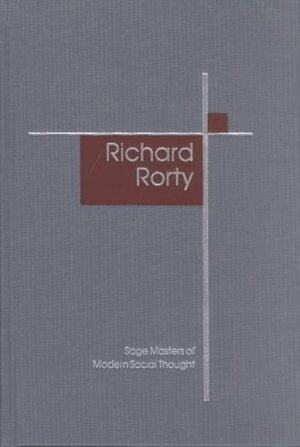
This is the first systematic assessment of the work of Richard Rorty - one of the most provocative and influential thinkers writing today. It will be an essential reference for academics and students in philosophy, social theory, sociology, cultural studies and literary theory.Rorty′s fertile writings have challenged not just the assumptions behind the relatively narrow analytic tradition he was first trained in, but those concerning the very nature of social thought itself. The critical articles collected in these four volumes follow the trajectory of Rorty′s whole career, from his early work in analytic philosophy to his later writings on pragmatism, continental philosophy, literature, culture, and liberal politics.The collection is divided into four volumes: - Philosophy: this volume looks at how Rorty′s contribution to the analytic tradition was assessed by his peers at the time and then examines how his later, more explicitly post-analytic, writings relate to traditional philosophical topics such as `truth′ and `realism′.- Post-Analytic Pragmatism: Volume Two examines Rorty′s `post-analytic pragmatism′. It begins by considering how Rorty prepared for a shift into this territory, and then looks more closely at the kind of pragmatism he sought to establish; the volume contains discussions of the kind of pragmatism that emerges from both Philosophy and the Mirror of Nature (1979) and Consequences of Pragmatism (1982). - Politics, Irony and Solidarity provides an assessment of Rorty′s account of irony and examines its relationship to his liberal politics.- Culture, Interpretation and Conversations: this final volume examines Rorty′s views on philosophy as a form of cultural conversation and discusses his interpretations or `appropriations′ of other philosophers. Of special interest here are his readings of continental philosophers such as Hegel, Heidegger and Derrida, where it is acknowledged that one Rorty′s most important contributions to social thought has been to make the work of such philosophers more accessible to readers unfamiliar with, or even hostile to, the continental tradition. Volume 4 concludes with a definitive bibliography, which will be an invaluable resource for researchers and students.Edited by Alan Malachowski - a leading commentator on Rorty′s work - this collection will be the standard reference work on one of the canonical theorists of the late 20th century.
10 652 kr
Skickas inom 11-20 vardagar
The highly commended first edition of this four-volume set remains the standard reference on J[um]urgen Habermas, the key theorist of the Frankfurt School and one of the most influential theorists of the twentieth and twenty-first centuries. With Habermas having developed his oeuvre substantially in the last decade, this new edition retains the key secondary literature while refreshing the critical canon with the most important papers published since the first edition in 2001. The editors, themselves a part of that canon, have updated the editorial material to reflect the latest hot topics in the study of this perennially relevant theorist.Volume One covers the huge base of secondary literature that has emerged on Habermas and the law since the publication of Between Facts and Norms in 1992. Volume Two collects the best writings on Habermas and politics. Volume Three treats epistemology and the theory of communication. Volume Four presents the key debates in what is perhaps the leading topic in the contemporary study of Habermas: ethics and religion.