Solid-State Science and Technology Library – serie
Visar alla böcker i serien Solid-State Science and Technology Library. Handla med fri frakt och snabb leverans.
13 produkter
13 produkter
Inbunden, Engelska, 1995
3 258 kr
Skickas inom 10-15 vardagar
Solid-State Imaging with Charge-Coupled Devices covers the complete imaging chain: from the CCD's fundamentals to the applications. The book is divided into four main parts: the first deals with the basics of the charge-coupled devices in general. The second explains the imaging concepts in close relation to the classical television application. Part three goes into detail on new developments in the solid-state imaging world (light sensitivity, noise, device architectures), and part four rounds off the discussion with a variety of applications and the imager technology. The book is a reference work intended for all who deal with one or more aspects of solid- state imaging: the educational, scientific and industrial world. Graduates, undergraduates, engineers and technicians interested in the physics of solid-state imagers will find the answers to their imaging questions. Since each chapter concludes with a short section `Worth Memorizing', reading this short summary allows readers to continue their reading without missing the main message from the previous section.
Inbunden, Engelska, 1996
2 174 kr
Skickas inom 10-15 vardagar
Bidirectional transmission over optical fibre networks may yield a large cost reduction because of the reduction of the network infrastructure by a factor two and the potential cost reduction by an integrated transceiver design. It may also provide a cost-effective way to upgrade distribution networks by adding bidirectional channels. This book is the first to provide a comprehensive overview of bidirectional transmission in optical networks. It handles physical aspects: the behaviour of the fibre itself in bidirectional transmission transmission aspects: the behaviour and design of bidirectional systems and network aspects: the influence of bidirectional transmission on network design. £/LIST£ Practical guidelines are also given for bidirectional system design. Audience:This book is aimed at designers, builders and operators of optical networks, e.g. the manufacturers of optical transmission systems, public-network operators, developers of local-area networks, cable-television operators, etcetera. The intended level of readership is graduate level in physics or electrical engineering.
Inbunden, Engelska, 1996
2 174 kr
Skickas inom 10-15 vardagar
This volume contains the invited papers presented at the International Symposium on Physics and Applications of Optical Solitons in Fibres held in Kyoto, Japan, November 14-17, 1995. The symposium focuses on recent progress in the application of optical solitons for ultra-high-speed communication. Fibre-based optical communication is making progress both in the speed and the distance of propagation. Here, the optical soliton is regarded as a powerful candidate because of its stable waveform even in the picosecond pulse range. The symposium attracted the authorities on the subject and presented the most recent research results.
Del 4 - Solid-State Science and Technology Library
Detection of Low-Level Optical Signals
Photodetectors, Focal Plane Arrays and Systems
Inbunden, Engelska, 1997
2 174 kr
Skickas inom 10-15 vardagar
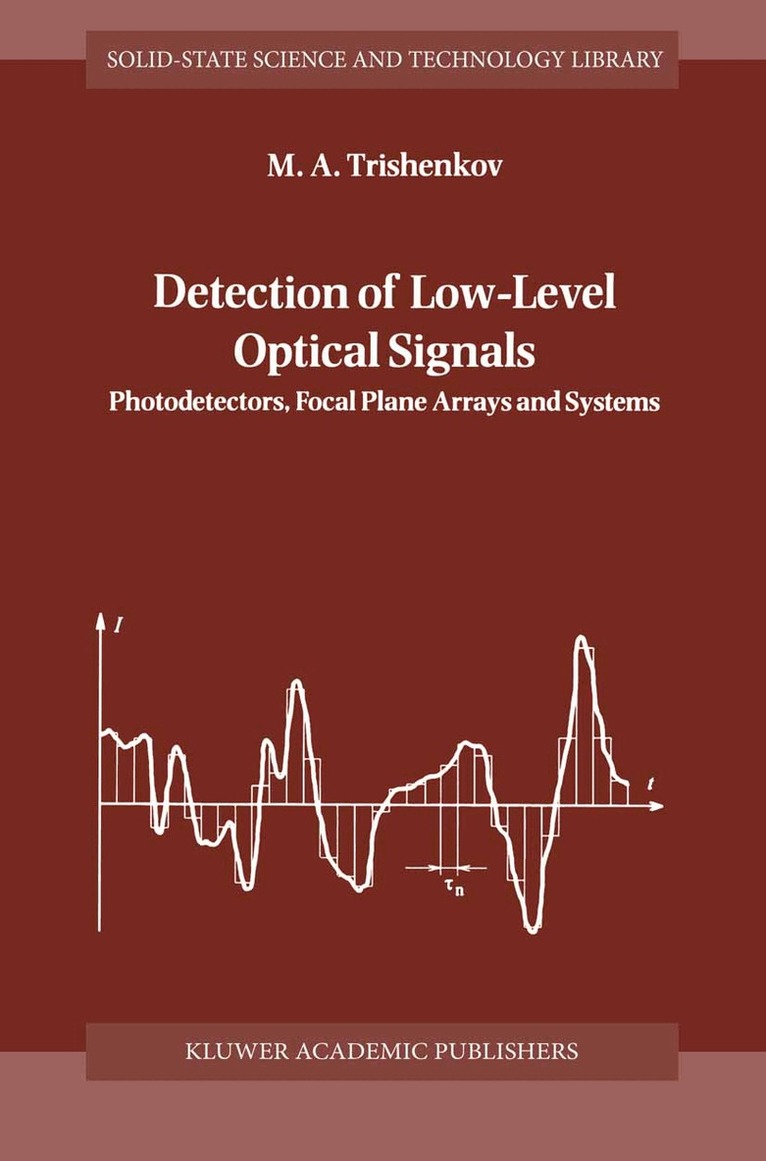
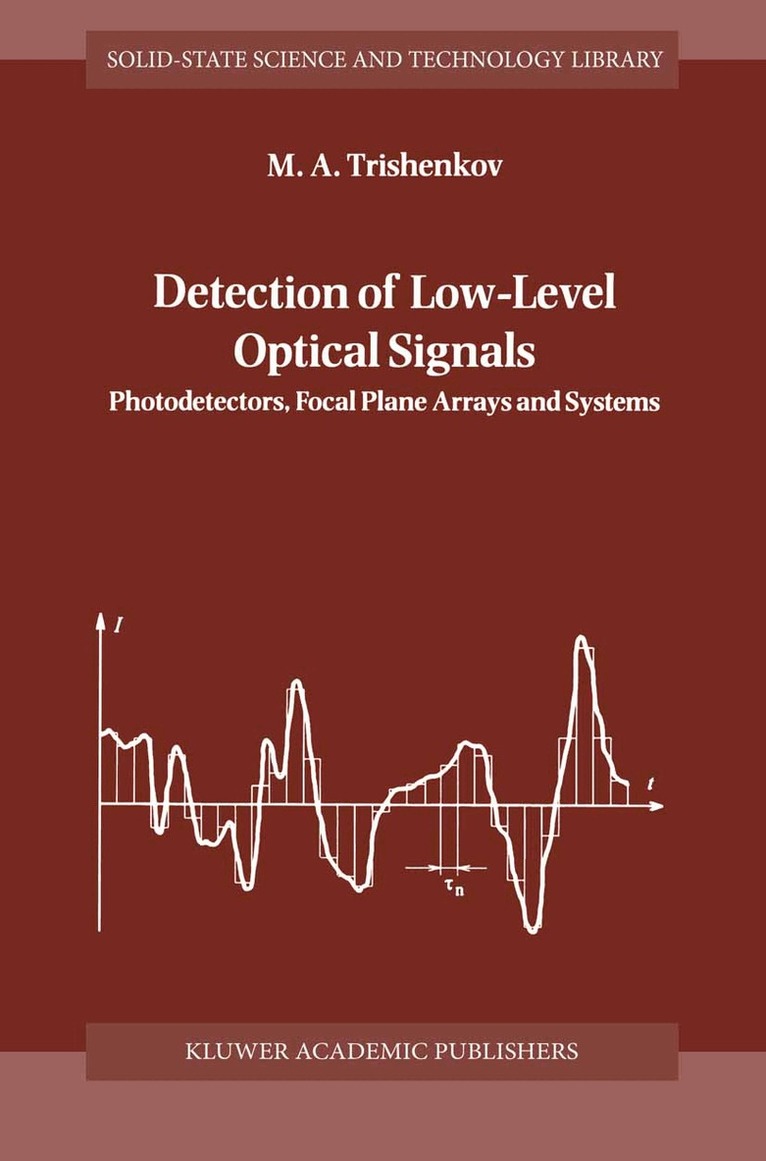
This book is addressed to designers of photodetectors and photodetecting systems, designers of focal plane arrays, charge-coupled devices, specialists in IR technologies, designers of optoelectronic detecting, guiding and tracking systems, systems for IR direction finders, lidars, lightwave communication systems, IR imagers. All these specialists are united by one common purpose: they are all striving to catch the weakest possible optical signal. The most important characteristic of photosensitive devices is their detectivity, which determines the lowest level of optical signal they are able to detect above the noise level. These threshold characteristics define the most important tactical and technical parameters of the entire optoelectronic system, such as its range, resolution, precision. The threshold characteristics of optoelectronic system depend on many of its components; all designers agree, however, that the critically responsible part of the system is the photodetector [1]. By the end of the 1960s the physicists and the engineers were able to overcome many obstacles and to create photodetectors (at least single-element or few-element ones) which covered all the main optical bands (0. 4 . . . 2,2 . . . 3, 3 . . . 5,8 . . . 14 J. . Lm), carried out the detection almost without any loss (the quantum yield being as high as 0. 7 . . . 0. 9), and reduced the noise level to the lowest possible limit.
Inbunden, Engelska, 2000
1 633 kr
Skickas inom 10-15 vardagar
The earliest experimental data on an oxygen-free glass have been published by Schulz-Sellack in 1870 [1]. Later on, in 1902, Wood [2], as well as Meier in 1910 [3], carried out the first researches on the optical properties of vitreous selenium. The interest in the glasses that exhibit transparency in the infrared region of the optical spectrum rose at the beginning of the twentieth century. Firstly were investigated the heavy metal oxides and the transparency limit was extended from (the case of the classical oxide glasses) up to wavelength. In order to extend this limit above the scientists tried the chemical compositions based on the elements of the sixth group of the Periodic Table, the chalcogens: sulphur, selenium and tellurium. The systematic research in the field of glasses based on chalcogens, called chalcogenide glasses, started at the middle of our century. In 1950 Frerichs [4] investigated the glass and published the paper: “New optical glasses transparent in infrared up to 12 . Several years later he started the study of the selenium glass and prepared several binary glasses with sulphur [5]. Glaze and co-workers [6] developed in 1957 the first method for the preparation of the glass at the industrial scale, while Winter-Klein [7] published reports on numerous chalcogenides prepared in the vitreous state.
Häftad, Engelska, 2001
1 633 kr
Skickas inom 10-15 vardagar
The earliest experimental data on an oxygen-free glass have been published by Schulz-Sellack in 1870 [1]. Later on, in 1902, Wood [2], as well as Meier in 1910 [3], carried out the first researches on the optical properties of vitreous selenium. The interest in the glasses that exhibit transparency in the infrared region of the optical spectrum rose at the beginning of the twentieth century. Firstly were investigated the heavy metal oxides and the transparency limit was extended from (the case of the classical oxide glasses) up to wavelength. In order to extend this limit above the scientists tried the chemical compositions based on the elements of the sixth group of the Periodic Table, the chalcogens: sulphur, selenium and tellurium. The systematic research in the field of glasses based on chalcogens, called chalcogenide glasses, started at the middle of our century. In 1950 Frerichs [4] investigated the glass and published the paper: “New optical glasses transparent in infrared up to 12 . Several years later he started the study of the selenium glass and prepared several binary glasses with sulphur [5]. Glaze and co-workers [6] developed in 1957 the first method for the preparation of the glass at the industrial scale, while Winter-Klein [7] published reports on numerous chalcogenides prepared in the vitreous state.
Del 7 - Solid-State Science and Technology Library
Physics of Quantum Well Devices
Häftad, Engelska, 2001
549 kr
Skickas inom 10-15 vardagar
Quantum well devices have been the objects of intensive research during the last two decades. Some of the devices have matured into commercially useful products and form part of modern electronic circuits. Some others require further dev- opment, but have the promise of being useful commercially in the near future. Study of the devices is, therefore, gradually becoming compulsory for electronics specialists. The functioning of the devices, however, involve aspects of physics which are not dealt with in the available text books on the physics of semicond- tor devices. There is, therefore, a need for a book to cover all these aspects at an introductory level. The present book has been written with the aim of meeting this need. In fact, the book grew out of introductory lectures given by the author to graduate students and researchers interested in this rapidly developing area of electron devices. The book covers the subjects of heterostructure growth techniques, band-offset theory and experiments, electron states, electron-photon interaction and related phenomena, electron transport and the operation of electronic, opto-electronic and photonic quantum well devices. The theory as well as the practical aspects of the devices are discussed at length. The aim of the book is to provide a comprehensive treatment of the physics underlying the various devices. A reader after going through the book should find himself equipped to deal with all kinds of quantum well devices.
Häftad, Engelska, 2001
1 633 kr
Skickas inom 10-15 vardagar
This book summarizes the proceedings of the invited talks presented at the “International Symposium on Massive TDM and WDM Optical Soliton Tra- mission Systems” held in Kyoto during November 9–12, 1999. The symposium is the third of the series organized by Research Group for Optical Soliton C- munications (ROSC) chaired by Akira Hasegawa. The research group, ROSC, was established in Japan in April 1995 with a support of the Japanese Ministry of Post and Telecommunications to promote collaboration and information - change among communication service companies, communication industries and academic circles in the theory and application of optical solitons. The symposium attracted enthusiastic response from worldwide researchers in the field of soliton based communications and intensive discussions were made. In the symposium held in 1997, new concept of soliton transmission based on dispersion management of optical fibers were presented. This new soliton is now called the dispersion managed soliton. The present symposium mainly focuses the theoretical and experimental developments of dispersion managed solitons. It is remarkable that the concept of the dispersion managed soliton, which was just born two years ago when the naming was not even given yet, has become the center of soliton research in two years. The dispersion managed soliton has an enhanced power in maintaining reasonable signal to noise ratio, yet has reduced Gordon-Haus timing jitter by reduced averagedispersion. The dispersion managed soliton also has demonstrated its power in soliton based WDM transmissions.
Häftad, Engelska, 2010
3 258 kr
Skickas inom 10-15 vardagar
Solid-State Imaging with Charge-Coupled Devices covers the complete imaging chain: from the CCD's fundamentals to the applications. The book is divided into four main parts: the first deals with the basics of the charge-coupled devices in general. The second explains the imaging concepts in close relation to the classical television application. Part three goes into detail on new developments in the solid-state imaging world (light sensitivity, noise, device architectures), and part four rounds off the discussion with a variety of applications and the imager technology. The book is a reference work intended for all who deal with one or more aspects of solid- state imaging: the educational, scientific and industrial world. Graduates, undergraduates, engineers and technicians interested in the physics of solid-state imagers will find the answers to their imaging questions. Since each chapter concludes with a short section `Worth Memorizing', reading this short summary allows readers to continue their reading without missing the main message from the previous section.
Häftad, Engelska, 2010
2 174 kr
Skickas inom 10-15 vardagar
This book is addressed to designers of photodetectors and photodetecting systems, designers of focal plane arrays, charge-coupled devices, specialists in IR technologies, designers of optoelectronic detecting, guiding and tracking systems, systems for IR direction finders, lidars, lightwave communication systems, IR imagers. All these specialists are united by one common purpose: they are all striving to catch the weakest possible optical signal. The most important characteristic of photosensitive devices is their detectivity, which determines the lowest level of optical signal they are able to detect above the noise level. These threshold characteristics define the most important tactical and technical parameters of the entire optoelectronic system, such as its range, resolution, precision. The threshold characteristics of optoelectronic system depend on many of its components; all designers agree, however, that the critically responsible part of the system is the photodetector [1]. By the end of the 1960s the physicists and the engineers were able to overcome many obstacles and to create photodetectors (at least single-element or few-element ones) which covered all the main optical bands (0. 4 . . . 2,2 . . . 3, 3 . . . 5,8 . . . 14 J. . Lm), carried out the detection almost without any loss (the quantum yield being as high as 0. 7 . . . 0. 9), and reduced the noise level to the lowest possible limit.
Häftad, Engelska, 2012
549 kr
Skickas inom 10-15 vardagar
This book summarizes the proceedings of the invited talks presented at the International Symposium on New Trends in Optical Soliton Transmission Systems held in Kyoto during November 18 - 21, 1997. As a result of worldwide demand for ultra high bitrate transmissions and increased scientific interest from the soliton community, research on optical solitons in fibres has made remarkable progress in recent years. In view of these trends, the Research Group for Optical Soliton Communications (ROSC), chaired by Akira Hasegawa, was established in Japan in April 1995 to promote collaboration and information exchange among communication service companies, industries and academic circles in the theory and application of optical solitons. This symposium was organized as a part of the ROSC activities. As with the 1 st ROSC symposium, this symposium attracted enthusiastic response from worldwide researchers involved in the subject of soliton based communications and intensive discussions were held throughout the symposium. Particular emphases were made to dispersion managements of soliton transmission. I would like to note that in the }'t symposium the (adiabatic) dispersion managements just began to appear in reducing radiation at amplifiers and reducing collision effects in WDM system. These have become standard this time, but in addition new, non-adiabatic dispersion managements have been introduced independently by various scientists all over the world.
Häftad, Engelska, 2011
2 174 kr
Skickas inom 10-15 vardagar
Bidirectional transmission over optical fibre networks may yield a large cost reduction because of the reduction of the network infrastructure by a factor two and the potential cost reduction by an integrated transceiver design. It may also provide a cost-effective way to upgrade distribution networks by adding bidirectional channels. This book is the first to provide a comprehensive overview of bidirectional transmission in optical networks. It handles physical aspects: the behaviour of the fibre itself in bidirectional transmission transmission aspects: the behaviour and design of bidirectional systems and network aspects: the influence of bidirectional transmission on network design. £/LIST£ Practical guidelines are also given for bidirectional system design. Audience:This book is aimed at designers, builders and operators of optical networks, e.g. the manufacturers of optical transmission systems, public-network operators, developers of local-area networks, cable-television operators, etcetera. The intended level of readership is graduate level in physics or electrical engineering.
Häftad, Engelska, 2011
2 174 kr
Skickas inom 10-15 vardagar
This book summarizes the proceedings of the invited talks presented at the International Symposium of Physics and Application of Optical Solitons in Fibers held in Kyoto during November 14 to 17,1995. As a result of worldwide demand for ultra high bitrate transmissions and increased scientific interests from the soliton community, research on optical solitons in fibers has made a remarkable progress in recent years. In view of these trends, and with the support of the Japanese Ministry of Posts and Telecommunications, the Research Group for Optical Soliton Communications (ROSC), chaired by Akira Hasegawa, was established in Japan in April 1995 to promote collaboration and information exchange 'among communication service companies, industries and academic circles in the theory and application of optical solitons. This symposium was organized as a part of the ROSC activities. The symposium attracted enthusiastic response by worldwide researchers involved in this subject which has lead to the most intensive meeting that the editor ever attended. The reader will find the contents to be well-balanced among theory, experiment and technology. Although the evaluation of the contents shall naturally depend on the particular area of interest of the reader, the symposium has confirmed that the soliton based light wave transmission has achieved the best result in one channel, both in distance of transmission and in bitrate although in wavelength division multiplexed (WDM) systems, NRZ transmission has yet better result.