Southern Legal Studies Ser. – serie
1 176 kr
Läs direkt efter köp
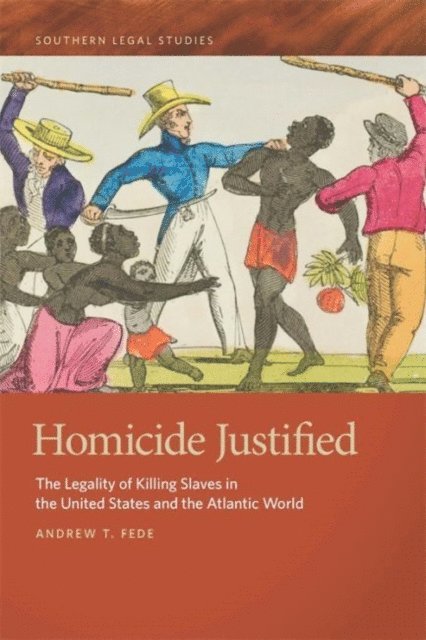
This comparative study looks at the laws concerning the murder of slaves by their masters and at how these laws were implemented. Andrew T. Fede cites a wide range of cases—across time, place, and circumstance—to illuminate legal, judicial, and other complexities surrounding this regrettably common occurrence. These laws had evolved to limit in different ways the masters’ rights to severely punish and even kill their slaves while protecting valuable enslaved people, understood as “property,” from wanton destruction by hirers, overseers, and poor whites who did not own slaves.To explore the conflicts of masters’ rights with state and colonial laws, Fede shows how slave homicide law evolved and was enforced not only in the United States but also in ancient Roman, Visigoth, Spanish, Portuguese, French, and British jurisdictions. His comparative approach reveals how legal reforms regarding slave homicide in antebellum times, like past reforms dictated by emperors and kings, were the products of changing perceptions of the interests of the public; of the individual slave owners; and of the slave owners’ families, heirs, and creditors.Although some slave murders came to be regarded as capital offenses, the laws consistently reinforced the second-class status of slaves. This influence, Fede concludes, flowed over into the application of law to free African Americans and would even make itself felt in the legal attitudes that underlay the Jim Crow era.
899 kr
Läs direkt efter köp
In 1808 the legislature of the Louisiana territory appointed two men to translate the Digest of the Laws in Force in the Territory of Orleans (or, as it was called at the time, simply the Code) from the original French into English. Those officials, however, did not reveal who received the commission, and the translators never identified themselves. Indeed, the “translators of 1808” guarded their secret so well that their identities have remained unknown for more than two hundred years. Their names, personalities, careers, and credentials, indeed everything about them, have been a missing chapter in Louisiana legal history.In this volume, Vernon Valentine Palmer, through painstaking research, uncovers the identity of the translators, presents their life stories, and evaluates their translation in the context of the birth of civil law in Louisiana. One consequence of the translators'' previous anonymity has been that the translation itself has never been fully examined before this study. To be sure, the translation has been criticized and specific errors have been pointed out, but Palmer''s study is the first general evaluation that considers the translation''s goals, the Louisiana context, its merits and demerits, its innovations, failures, and successes. It thus allows us to understand how much and in what ways the translators affected the future course of Louisiana law. The Lost Translators, through painstaking research, uncovers the identity of the translators, presents their life stories, and evaluates their translation in the context of the birth of civil law in Louisiana.