Special Issues of Cognitive Neuropsychology – serie
Visar alla böcker i serien Special Issues of Cognitive Neuropsychology. Handla med fri frakt och snabb leverans.
18 produkter
18 produkter
Inbunden, Engelska, 1999
1 325 kr
Skickas inom 10-15 vardagar
Perception and Action have long been considered as two separate information processes and have accordingly been investigated in relative isolation from one another. However, it is now acknowledged that perception and action are functionally related. This special issue presents original contributions from cognitive neuroscientists and cognitive neuropsychologists who address this area from different complementary perspectives.Functional imaging investigations have recently extended to the study of several cognitive processes involved in the recognition of actions or body parts. Two papers report on brain-activation experiments in healthy human subjects during the recognition of hand positions and during the perception of human actions. The visual mechanisms underlying the perception of biological movements are investigated in normal subjects, with the use of the apparent motion paradigm. Several papers deal with neuropsychological cases, with apraxic patients, with Parkinson patients, and with an agnosic patient. The study of perception and action is relevant to psychopathology, as attested to by the work on autistic patients. A review paper on willed action and its physiological basis is also presented.
Inbunden, Engelska, 2000
2 097 kr
Skickas inom 10-15 vardagar
For social primates like us, faces may be the most biologically significant stimuli we view. Faces provide information not only about identity but also about mood, age, sex, and direction of overt attention. Does our ability to extract this information from faces rely on special-purpose cognitive and neural mechanisms distinct from those involved in the perception of other classes of visual stimuli? If so, how do those mechanisms work? Do these mechanisms arise from experience alone, or is there an innate predisposition to create them? How is face recognition affected by development and aging? What is the relation between face recognition and other cognitive functions such as memory and attention and the neural substrates that mediate them?This special issue showcases new findings from many investigators in this field who address these fundamental questions in studies that use a wide range of experimental techniques including brain imaging, ERPs, patient studies, and single-unit recording in monkeys.
Häftad, Engelska, 2024
576 kr
Skickas inom 10-15 vardagar
The papers in this volume examine the state of the art in key areas of developmental cognitive neuroscience, focusing on theoretically driven research on cognition and its development. The past decade has seen an increasing number of empirical papers on the relationship between brain and cognitive development. But despite the clearly burgeoning interest in this topic, there is a relative paucity of work motivated by deep theoretical questions about the nature of cognition and its development. Many papers are still in the mode of reporting brain-cognition correlations with a focus on regional activations during brain imaging - a useful approach, but one that is limited with respect to its contributions to understanding the structure of cognition and its development. The papers in this special issue of Cognitive Neuropsychology consider a number of domains and mechanisms in cognition, including language, number, space, faces, reading, memory, and attention, and represent the wealth of approaches and techniques that can be used to shed light on the nature of cognitive development in brain and mind. These include cross-species comparisons, studies of development under experiential deprivation or genetic differences, classical developmental experimentation, and imaging techniques such as NIRS and fMRI which have recently been applied to developmental questions. The combination of solid theorizing together with a broad range of approaches allows a critical but constructive look at the latest findings in the field relevant to answering enduring questions about cognition, its development, and its realization in the developing brain.
Häftad, Engelska, 2017
437 kr
Skickas inom 10-15 vardagar
Perception and Action have long been considered as two separate information processes and have accordingly been investigated in relative isolation from one another. However, it is now acknowledged that perception and action are functionally related. This special issue presents original contributions from cognitive neuroscientists and cognitive neuropsychologists who address this area from different complementary perspectives.Functional imaging investigations have recently extended to the study of several cognitive processes involved in the recognition of actions or body parts. Two papers report on brain-activation experiments in healthy human subjects during the recognition of hand positions and during the perception of human actions. The visual mechanisms underlying the perception of biological movements are investigated in normal subjects, with the use of the apparent motion paradigm. Several papers deal with neuropsychological cases, with apraxic patients, with Parkinson patients, and with an agnosic patient. The study of perception and action is relevant to psychopathology, as attested to by the work on autistic patients. A review paper on willed action and its physiological basis is also presented.
Häftad, Engelska, 2019
640 kr
Skickas inom 10-15 vardagar
People sometimes remember events that never happened. These illusory or false memories have important practical implications in various aspects of everyday life, and also have significant theoretical implications for cognitive and neuropsychological models of memory. Cognitive psychologists and neuropsychologists have long been aware of false recognition, confabulation, and related kinds of memory distortions, but during the past several years research on these topics has increased rapidly.In recognition of this emerging domain of interest, this special issue of Cognitive Neuropsychology is devoted to the cognitive neuropsychology of false memories. Edited by Daniel L. Schacter, the special issue features experimental and theoretical contributions from leading cognitive psychologists, neuropsychologists, and neurologists that explore such issues as false recognition after frontal lobe damage, the nature of confabulation, amnesia and false memories, physiological correlates of memory illusions, memory distortions in normal and abnormal aging, and computational models of true and false memories.
Häftad, Engelska, 2019
492 kr
Skickas inom 10-15 vardagar
The papers in the special issue describe computational models and principles that attempt to explain the performance of brain damaged subjects. The models elucidate the cognitive processes that underlie speaking, reading, spelling, and visuospatial planning by implementing hypothesized mechanisms and then identifying the consequences of specific "lesions" in these mechanisms for the model’s behaviour which, in turn, is related to the subjects’ behaviour. Although most of the presented models view cognitive mechanisms in connectionist or neural-network terms, they exhibit considerable variety in their underlying cognitive theories, their approach to modelling pathology, and particularly in how they use models to draw conclusions about theory.
Häftad, Engelska, 2015
850 kr
Skickas inom 10-15 vardagar
Category-specific knowledge disorders are among the most intriguing and perplexing syndromes in cognitive neuropsychology. The past decade has witnessed increased interest in these disorders, due largely to a heightened appreciation of the profound implications that an understanding of concept representation has for such diverse topics as object recognition, the organisation of the lexicon, and storage of long-term memories. Until recently, information about the representation of concepts was limited to findings from patients with brain injury and disease. This state of affairs has now changed with the advent and wide-spread availability of functional imaging for studying cognition in the normal human brain. The purpose of this special issue is to provide a forum for new findings and critical, theoretical analyses of existing data from patient and functional brain imaging studies. The contributions, all from major investigators in the field, range from studies of specific object categories such as animals, tools, fruit and vegetables, and faces, to the more general domains of number processing, social interaction, and mechanical knowledge. A unifying theme of these papers is the extent to which the findings can be best understood within the context of models that posit an innate, domain-specific organisation, those that appeal to an organisation by sensory- and motor-based features and properties, and those that propose an undifferentiated, distributed neural organisation.
Häftad, Engelska, 2019
379 kr
Skickas inom 10-15 vardagar
To understand mental function, we need to uncover the representations and processes underlying our ability to comprehend and to produce words, sentences,numbers and objects (or pictures of them). The unique contribution of the field of cognitive neuropsychology is the investigation of these representations and processes in individuals who have sustained selective brain damage. Indeed, studies of such individuals provide a window into the mental system and allow us to explore the functional architecture that is necessary and sufficient for cognition. This special issue of Cognitive Neuropsychology is a collection of papers that exemplifies this type of cognitive neuropsychology research. The special issue is designed to honour and pay tribute to Eleanor M. Saffran, one of the pioneers of this discipline, who adopted this approach in her wide-ranging investigations of individuals with cognitive impairment following brain damage.The papers included in this collection all explore issues concerning behavioural and neural mechanisms mediating cognition and are divided into four separate sections. Two of these focus on language, with the emphasis of the first on single word recognition and the second on processes that are invoked beyond the single word level. Conceptual and semantic processes are covered in a third section and the final section is concerned with issues related to more peripheral processes, which, when impaired, give rise to alexia, agnosia and/or agraphia. This extensive collection of papers represents a comprehensive overview of the current state of the field and the papers elucidate the most recent findings in the domain of cognitive neuropsychology.
Häftad, Engelska, 2019
640 kr
Skickas inom 10-15 vardagar
The papers in this volume consider the role of sensory-motor processes and their neural structures in higher cognitive functions such as visual and motor imagery, iconic memory and temporal judgment. The evidence brought to bear on this issue comes from behavioral studies of brain-damaged subjects and fMRI and TMS studies with normal subjects. The issue also includes several theoretical reviews and discussions.
Häftad, Engelska, 2015
748 kr
Skickas inom 10-15 vardagar
For social primates like us, faces may be the most biologically significant stimuli we view. Faces provide information not only about identity but also about mood, age, sex, and direction of overt attention. Does our ability to extract this information from faces rely on special-purpose cognitive and neural mechanisms distinct from those involved in the perception of other classes of visual stimuli? If so, how do those mechanisms work? Do these mechanisms arise from experience alone, or is there an innate predisposition to create them? How is face recognition affected by development and aging? What is the relation between face recognition and other cognitive functions such as memory and attention and the neural substrates that mediate them?This special issue showcases new findings from many investigators in this field who address these fundamental questions in studies that use a wide range of experimental techniques including brain imaging, ERPs, patient studies, and single-unit recording in monkeys.
Häftad, Engelska, 2006
897 kr
Skickas inom 10-15 vardagar
Traditionally, cognitive neuropsychology has focused on selective impairments in individuals who suffered brain damage as adults. However, in recent years, there have been a number of cognitive neuropsychological studies of selective impairments due to developmental deficits. Papers in Selective Deficits in Developmental Cognitive Neuropsychology include a diverse range of disorders involving those affecting spatial orientation, face recognition, reading, and memory. These papers illustrate the value of this approach and its promise as a means to gain insight into cognition and its neural and developmental basis.
Inbunden, Engelska, 2008
1 600 kr
Skickas inom 5-8 vardagar
The papers in the special issue describe computational models and principles that attempt to explain the performance of brain damaged subjects. The models elucidate the cognitive processes that underlie speaking, reading, spelling, and visuospatial planning by implementing hypothesized mechanisms and then identifying the consequences of specific "lesions" in these mechanisms for the model’s behaviour which, in turn, is related to the subjects’ behaviour. Although most of the presented models view cognitive mechanisms in connectionist or neural-network terms, they exhibit considerable variety in their underlying cognitive theories, their approach to modelling pathology, and particularly in how they use models to draw conclusions about theory.
Inbunden, Engelska, 2003
2 222 kr
Skickas inom 10-15 vardagar
Category-specific knowledge disorders are among the most intriguing and perplexing syndromes in cognitive neuropsychology. The past decade has witnessed increased interest in these disorders, due largely to a heightened appreciation of the profound implications that an understanding of concept representation has for such diverse topics as object recognition, the organisation of the lexicon, and storage of long-term memories. Until recently, information about the representation of concepts was limited to findings from patients with brain injury and disease. This state of affairs has now changed with the advent and wide-spread availability of functional imaging for studying cognition in the normal human brain. The purpose of this special issue is to provide a forum for new findings and critical, theoretical analyses of existing data from patient and functional brain imaging studies. The contributions, all from major investigators in the field, range from studies of specific object categories such as animals, tools, fruit and vegetables, and faces, to the more general domains of number processing, social interaction, and mechanical knowledge. A unifying theme of these papers is the extent to which the findings can be best understood within the context of models that posit an innate, domain-specific organisation, those that appeal to an organisation by sensory- and motor-based features and properties, and those that propose an undifferentiated, distributed neural organisation.
Inbunden, Engelska, 2004
1 116 kr
Skickas inom 5-8 vardagar
To understand mental function, we need to uncover the representations and processes underlying our ability to comprehend and to produce words, sentences,numbers and objects (or pictures of them). The unique contribution of the field of cognitive neuropsychology is the investigation of these representations and processes in individuals who have sustained selective brain damage. Indeed, studies of such individuals provide a window into the mental system and allow us to explore the functional architecture that is necessary and sufficient for cognition. This special issue of Cognitive Neuropsychology is a collection of papers that exemplifies this type of cognitive neuropsychology research. The special issue is designed to honour and pay tribute to Eleanor M. Saffran, one of the pioneers of this discipline, who adopted this approach in her wide-ranging investigations of individuals with cognitive impairment following brain damage.The papers included in this collection all explore issues concerning behavioural and neural mechanisms mediating cognition and are divided into four separate sections. Two of these focus on language, with the emphasis of the first on single word recognition and the second on processes that are invoked beyond the single word level. Conceptual and semantic processes are covered in a third section and the final section is concerned with issues related to more peripheral processes, which, when impaired, give rise to alexia, agnosia and/or agraphia. This extensive collection of papers represents a comprehensive overview of the current state of the field and the papers elucidate the most recent findings in the domain of cognitive neuropsychology.
Inbunden, Engelska, 2005
2 164 kr
Skickas inom 10-15 vardagar
The papers in this volume consider the role of sensory-motor processes and their neural structures in higher cognitive functions such as visual and motor imagery, iconic memory and temporal judgment. The evidence brought to bear on this issue comes from behavioral studies of brain-damaged subjects and fMRI and TMS studies with normal subjects. The issue also includes several theoretical reviews and discussions.
Inbunden, Engelska, 2013
2 097 kr
Skickas inom 10-15 vardagar
The papers in this volume examine the state of the art in key areas of developmental cognitive neuroscience, focusing on theoretically driven research on cognition and its development. The past decade has seen an increasing number of empirical papers on the relationship between brain and cognitive development. But despite the clearly burgeoning interest in this topic, there is a relative paucity of work motivated by deep theoretical questions about the nature of cognition and its development. Many papers are still in the mode of reporting brain-cognition correlations with a focus on regional activations during brain imaging - a useful approach, but one that is limited with respect to its contributions to understanding the structure of cognition and its development. The papers in this special issue of Cognitive Neuropsychology consider a number of domains and mechanisms in cognition, including language, number, space, faces, reading, memory, and attention, and represent the wealth of approaches and techniques that can be used to shed light on the nature of cognitive development in brain and mind. These include cross-species comparisons, studies of development under experiential deprivation or genetic differences, classical developmental experimentation, and imaging techniques such as NIRS and fMRI which have recently been applied to developmental questions. The combination of solid theorizing together with a broad range of approaches allows a critical but constructive look at the latest findings in the field relevant to answering enduring questions about cognition, its development, and its realization in the developing brain.
Inbunden, Engelska, 1999
769 kr
Tillfälligt slut
People sometimes remember events that never happened. These illusory or false memories have important practical implications in various aspects of everyday life, and also have significant theoretical implications for cognitive and neuropsychological models of memory. Cognitive psychologists and neuropsychologists have long been aware of false recognition, confabulation, and related kinds of memory distortions, but during the past several years research on these topics has increased rapidly.In recognition of this emerging domain of interest, this special issue of Cognitive Neuropsychology is devoted to the cognitive neuropsychology of false memories. Edited by Daniel L. Schacter, the special issue features experimental and theoretical contributions from leading cognitive psychologists, neuropsychologists, and neurologists that explore such issues as false recognition after frontal lobe damage, the nature of confabulation, amnesia and false memories, physiological correlates of memory illusions, memory distortions in normal and abnormal aging, and computational models of true and false memories.
Häftad, Engelska, 2012
712 kr
Tillfälligt slut
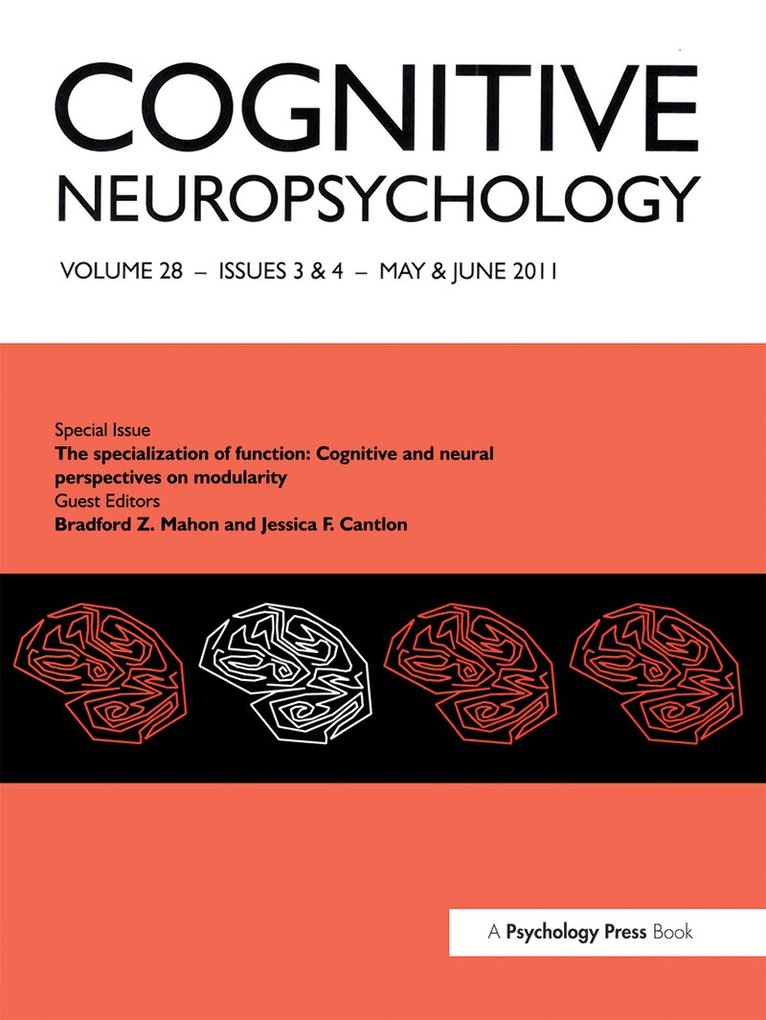
Functional specialization is a property of biological systems generally. A unifying theme that cuts across all research areas and techniques in the cognitive and brain sciences is whether there is specialization of function at levels of processing that are ‘abstracted away’ from sensory inputs and motor outputs. The articles collected together within this issue advance our understanding of the roles of modularity and functional specialization in deriving inferences about the structure of the mind from behavior in normal and brain damaged individuals, functional neuroimaging, computational modeling, development, and the study of individual differences.