Studies in Kant and German Idealism - Böcker
Visar alla böcker i serien Studies in Kant and German Idealism. Handla med fri frakt och snabb leverans.
5 produkter
5 produkter
363 kr
Skickas inom 7-10 vardagar
A Stanford University Press classic.
1 114 kr
Skickas inom 7-10 vardagar
This is a collection of four essays on aesthetic, ethical, and political issues by Dieter Henrich, the preeminent Kant scholar in Germany today. Although his interests have ranged widely, he is perhaps best known for rekindling interest in the great classical German tradition from Kant to Hegel.The first essay summarizes Henrich's research into the development of the Kant's moral philosophy, focusing on the architecture of the third Critique. Of special interest in this essay is Henrich's intriguing and wholly new account of the relations between Kant and Rousseau. In the second essay, Henrich analyzes the interrelations between Kant's aesthetics and his cognitive theories. His third essay argues that the justification of the claim that human rights are universally valid requires reference to a moral image of the world. To employ Kant's notion of a moral image of the world without ignoring the insights and experience of this century requires drastic changes in the content of such an image. Finally, in Henrich's ambitious concluding essay, the author compares the development of the political process of the French Revolution and the course of classical German philosophy, raise the general question of the relation between political processes and theorizing, and argues that both the project of political liberty set in motion by the French Revolution, and the projects of classical German philosophy remain incomplete.
271 kr
Skickas inom 7-10 vardagar
This is a collection of four essays on aesthetic, ethical, and political issues by Dieter Henrich, the preeminent Kant scholar in Germany today. Although his interests have ranged widely, he is perhaps best known for rekindling interest in the great classical German tradition from Kant to Hegel.The first essay summarizes Henrich's research into the development of the Kant's moral philosophy, focusing on the architecture of the third Critique. Of special interest in this essay is Henrich's intriguing and wholly new account of the relations between Kant and Rousseau. In the second essay, Henrich analyzes the interrelations between Kant's aesthetics and his cognitive theories. His third essay argues that the justification of the claim that human rights are universally valid requires reference to a moral image of the world. To employ Kant's notion of a moral image of the world without ignoring the insights and experience of this century requires drastic changes in the content of such an image. Finally, in Henrich's ambitious concluding essay, the author compares the development of the political process of the French Revolution and the course of classical German philosophy, raise the general question of the relation between political processes and theorizing, and argues that both the project of political liberty set in motion by the French Revolution, and the projects of classical German philosophy remain incomplete.
978 kr
Skickas inom 7-10 vardagar
Friedrich Hölderlin (1770-1843) has long been recognized as one of the greatest poets of the German language, but his importance to philosophy has surfaced only comparatively recently. Although Schelling and Hegel acknowledged Hölderlin early on as their equal, for a long time his philosophical thought remained unknown outside the small circle of his friends.Among the most prominent figures in the rediscovery of Hölderlin's thought is Dieter Henrich, who, in a series of highly influential studies over the last thirty years, has shown that Hölderlin played a decisive role in the development of philosophy from Kant to Hegel, and hence in the formation of German Idealism. Among other things, Henrich demonstrated that Hölderlin, while still a student, launched a powerful critique of Fichte's Wissenschaftslehre and outlined an alternative to the dominant view of the foundation of philosophy. This alternative proved pathbreaking for his philosophical friends, forcing Hegel, for example, to abandon his own Kantianism and, eventually, to give systematic articulation to a position that went even beyond Hölderlin's.This volume includes six of Henrich's most important essays on Hölderlin's philosophical significance. Among the topics discussed are Hölderlin's motivation and methodological orientation in his work on German Idealism, the intellectual atmosphere of Hölderlin's student years and the philosophical problems that occupied him, Hölderlin's attitude toward any first-principle philosophy, and the complex personal and philosophical relationships between Hegel and Hölderlin. The last essay is a long, detailed interpretation of one of Hölderlin's greatest poems, "Remembrance." In elucidating its lyric composition and structure, Henrich also seeks to show how it incorporates and develops Hölderlin's philosophical thought.
702 kr
Skickas inom 10-15 vardagar
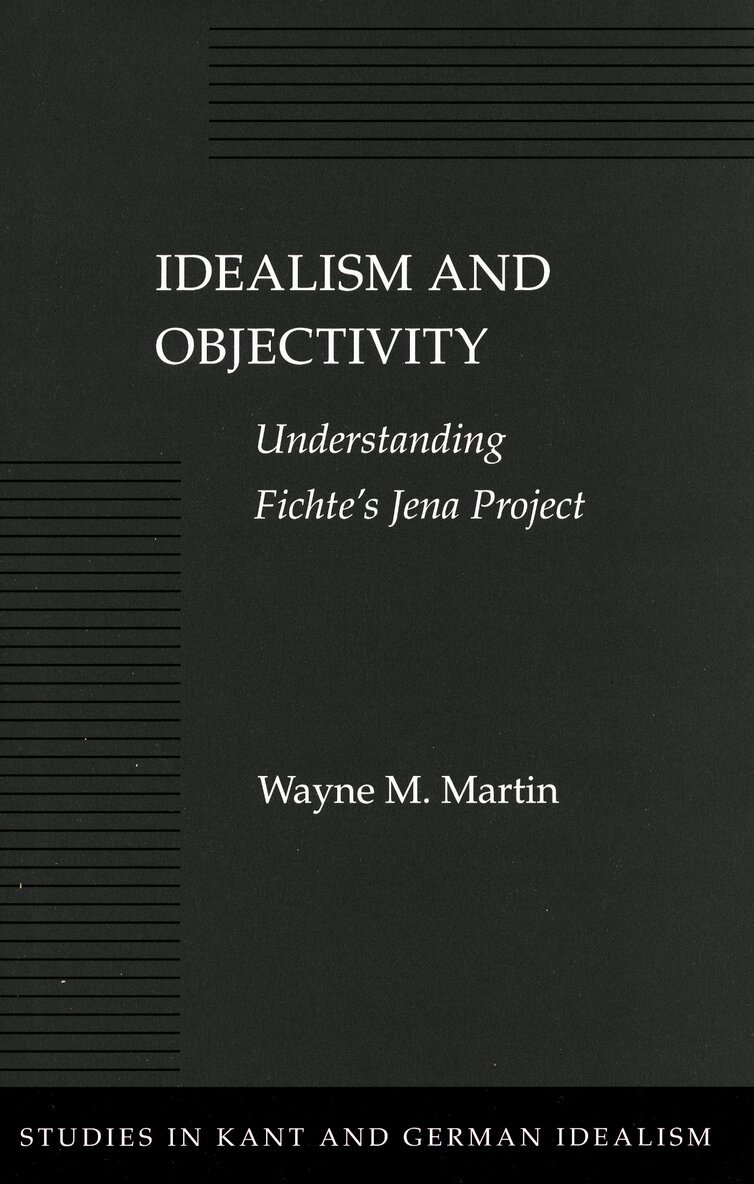
The theoretical writings from Johann Gottlieb Fichte's short tenure at Jena (1794-99) are among the most difficult and influential works of classical German philosophy. Fichte's appropriation of Kant's transcendental project not only established the framework for the subsequent idealist tradition (Schelling, Hölderlin, Hegel), but also introduced philosophical themes and strategies that would dominate the Continental tradition well into the twentieth century.This book offers a new interpretation of Fichte's Jena system, focusing in particular on the problem of the objectivity of consciousness. The Jena system, the author argues, set out to develop an account of the constitutive structures of subjectivity in virtue of which conscious states have objective content. It is in the context of this project that Fichte's central philosophical innovations must be understood: his account of the acts of "self-positing" and "opposing"; his attack on the thing in itself; the development of a dialectical strategy in transcendental inquiry; and his bold assertion of the "primacy of practice."Fichte's investigations of objectivity find their center of gravity, it is argued, in two powerful insights. First, the theory of objectivity must be idealistic rather than naturalistic or "dogmatic." That is, it must transcend the conception of human beings as simply complex mechanisms determined by their causal transactions with the world. Second, the theory of objectivity must find its basis in an account of the practical character of human beings—our character as agents, comporting ourselves teleogically in a world in which we find resistance.The account of Fichte's Jena project developed here demonstrates that Fichte's thought is of far more than antiquarian interest. In its attempt to explore the limits of naturalistic accounts of human subjectivity and its articulation of the practical foundations of human representational capacities, Fichte's Jena project is of direct relevance to contemporary debates in both analytic and continental philosophy.