• Fri frakt över 249 kr
  • •
  • Snabba leveranser
  • •
  • Billiga böcker
Kundservice

Du är på sajten för privatpersoner.

Företag, bibliotek eller offentlig verksamhet?

Du handlar på classic.bokus.com, där alla dina funktioner finns intakta.
Till classic.bokus.com
Bokus logotyp. Gå till startsidan.
  • Erbjudanden
  • Student
  • Topplistor
  • Barn & ungdom
  • Bokus Play
  • E-böcker
  • Ljudböcker
  • Pocketböcker
  • Spel & pussel

Upp till 25% på utvalda nyheter →

Sidfot

Mina sidor

    Hjälp

    • Kundservice
    • Vanliga frågor och svar
    • Frakt och leverans
    • Retur vid ångerrätt
    • Reklamera vara
    • Betalning
    • Köpvillkor
    • Allmänna villkor
    • Information om webbplatsens tillgänglighet

    Om Bokus

    • Om oss
    • Pressrum
    • För studenter
    • För företag
    • För bibliotek och offentlig verksamhet
    • För leverantörer
    • Hållbarhet

    Populärt

    • Aktuella erbjudanden
    • Presentkort
    • Studentlitteratur
    • Nya böcker
    • Topplistor
    • Signerade böcker
    • Engelska böcker

    Inspiration

    • Boktips
    • BookTok
    • Populära bokserier
    • Barnbokskaraktärer
    • Populära författare
    Logotyp för Bokus
    Följ oss på Facebook (extern länk)Följ oss på Instagram (extern länk)Följ oss på YouTube (extern länk)Följ oss på TikTok (extern länk)
    bokus @ CookiesAnpassa cookiesIntegritetspolicyKöpvillkor
    Till Citymail hemsida (extern länk)Till Budbee hemsida (extern länk)Till Postnord hemsida (extern länk)Till Schenker hemsida (extern länk)Till Early Bird hemsida (extern länk)Till Walleys hemsida (extern länk)
    1. Naturvetenskap och teknik
    2. Teknik och industri
    3. Elektronik och kommunikationer

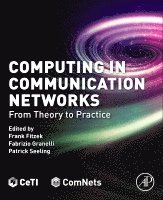
    Computing in Communication Networks

    From Theory to Practice

    AvFrank H. P. Fitzek,Fabrizio Granelli

    Häftad, Engelska, 2020

    1 233 kr

    Beställningsvara. Skickas inom 10-15 vardagar. Fri frakt över 249 kr.

    Beskrivning

    Computing in Communication Networks: From Theory to Practice provides comprehensive details and practical implementation tactics on the novel concepts and enabling technologies at the core of the paradigm shift from store and forward (dumb) to compute and forward (intelligent) in future communication networks and systems. The book explains how to create virtualized large scale testbeds using well-established open source software, such as Mininet and Docker. It shows how and where to place disruptive techniques, such as machine learning, compressed sensing, or network coding in a newly built testbed. In addition, it presents a comprehensive overview of current standardization activities.

    Specific chapters explore upcoming communication networks that support verticals in transportation, industry, construction, agriculture, health care and energy grids, underlying concepts, such as network slicing and mobile edge cloud, enabling technologies, such as SDN/NFV/ ICN, disruptive innovations, such as network coding, compressed sensing and machine learning, how to build a virtualized network infrastructure testbed on one's own computer, and more.


    • Provides a uniquely comprehensive overview on the individual building blocks that comprise the concept of computing in future networks
    • Gives practical hands-on activities to bridge theory and implementation
    • Includes software and examples that are not only employed throughout the book, but also hosted on a dedicated website

    Produktinformation

    • Utgivningsdatum:2020-05-21
    • Mått:191 x 235 x 27 mm
    • Vikt:1 060 g
    • Format:Häftad
    • Språk:Engelska
    • Antal sidor:522
    • Förlag:Elsevier Science
    • ISBN:9780128204887

    Utforska kategorier

    • Elektronik och kommunikationer inom Naturvetenskap och teknik
    • Nätverk och kommunikation inom Data och IT

    Mer om författaren

    Frank H. P. Fitzek is a Professor and head of the “Deutsche Telekom Chair of Communication Networks” at TU Dresden coordinating the 5G Lab Germany. He is the spokesman of the DFG Cluster of Excellence “Center for Tactile Internet” (CeTI). He received his diploma (Dipl.-Ing.) degree in electrical engineering from the University of Technology – Rheinisch-Westfälische Technische Hochschule (RWTH) – Aachen, Germany, in 1997 and his Ph.D. (Dr.-Ing.) in Electrical Engineering from the Technical University Berlin, Germany in 2002 and became Adjunct Professor at the University of Ferrara, Italy in the same year. In 2003 he joined Aalborg University as Professor. Fabrizio Granelli is Associate Professor at the Dept. of Information Engineering and Computer Science (DISI) – University of Trento (Italy), IEEE ComSoc Director for Educational Services (2018-19) and Chair of Joint IEEE VTS/ComSoc Italian Chapter. He is Research Associate Professor at the University of New Mexico, NM, USA.He received the M.Sc. and Ph.D. degrees from University of Genoa, Italy, in 1997 and 2001. He was visiting professor at the State University of Campinas (Brasil) and at the University of Tokyo (Japan), and IEEE ComSoc Distinguished Lecturer in 2012-15.He is Associate Editor in Chief of IEEE Communications Surveys and Tutorials. Patrick Seeling is a Professor in the Department of Computer Science at Central Michigan University, USA. He received his diploma (Dipl.-Ing.) degree in Industrial Engineering and Management from the Technical University Berlin, Germany, in 2002 and his his Ph.D. in Electrical Engineering from Arizona State University (ASU), USA, in 2005. He was an Associated Faculty at ASU until 2008 and an Assistant Professor at the University of Wisconsin-Stevens Point until 2011. In 2011, he joined Central Michigan University as Assistant Professor, where he became a tenured Associate Professor in 2015 and a Full Professor in 2018.

    Innehållsförteckning

    • PART 1 FUTURE COMMUNICATION NETWORKS AND SYSTEMS1. On the need of computing in future communication networks2. Standardization activities for future communication networksPART 2 CONCEPTS3. Network slicing4. Mobile edge cloud5. Content distributionPART 3 ENABLING TECHNOLOGIES6. Software-defined networks7. Network function virtualizationPART 4 INNOVATION TRACK8. Machine learning9. Network coding10. Compressed sensingPART 5 BUILDING THE TESTBED11. Mininet: An insant virtual network on your computer12. Docker: Containerize your application13. ComNetsEmu: A lightweight emulatorPART 6 EXAMPLES14. Realizing network slicing15. Realizing mobile edge clouds16. Machine learning for routing17. Machine learning for flow compression18. Machine learning for congestion control19. Machine learning for object detection20. Network coding for transport21. Network coding for storage22. In-network compressed sensing23. Security for mobile edge cloudPART 7 EXTENSIONS24. Connecting to the outer world25. Integrating time-sensitive networking26. Integrating software-defined radiosPART 8 TOOLS27. Networking tools