• Fri frakt över 249 kr
  • •
  • Snabba leveranser
  • •
  • Billiga böcker
Kundservice

Du är på sajten för privatpersoner.

Företag, bibliotek eller offentlig verksamhet?

Du handlar på classic.bokus.com, där alla dina funktioner finns intakta.
Till classic.bokus.com
Bokus logotyp. Gå till startsidan.
  • Erbjudanden
  • Nyheter
  • Student
  • Topplistor
  • Barn & ungdom
  • Bokus Play
  • E-böcker
  • Pocketböcker
  • Spel & pussel

10% rabatt på allt med kod: NYSTART10 →

Sidfot

Mina sidor

    Hjälp

    • Kundservice
    • Vanliga frågor och svar
    • Frakt och leverans
    • Retur vid ångerrätt
    • Reklamera vara
    • Betalning
    • Köpvillkor
    • Allmänna villkor
    • Information om webbplatsens tillgänglighet

    Om Bokus

    • Om oss
    • Pressrum
    • För studenter
    • För företag
    • För bibliotek och offentlig verksamhet
    • För leverantörer
    • Hållbarhet

    Populärt

    • Aktuella erbjudanden
    • Presentkort
    • Studentlitteratur
    • Nya böcker
    • Topplistor
    • Signerade böcker
    • Engelska böcker

    Inspiration

    • Boktips
    • BookTok
    • Populära bokserier
    • Barnbokskaraktärer
    • Populära författare
    Logotyp för Bokus
    Följ oss på Facebook (extern länk)Följ oss på Instagram (extern länk)Följ oss på YouTube (extern länk)Följ oss på TikTok (extern länk)
    bokus @ CookiesAnpassa cookiesIntegritetspolicyKöpvillkor
    Till Citymail hemsida (extern länk)Till Budbee hemsida (extern länk)Till Postnord hemsida (extern länk)Till Schenker hemsida (extern länk)Till Early Bird hemsida (extern länk)Till Walleys hemsida (extern länk)
    1. Språk och ordböcker
    2. Språkvetenskap och lingvistik

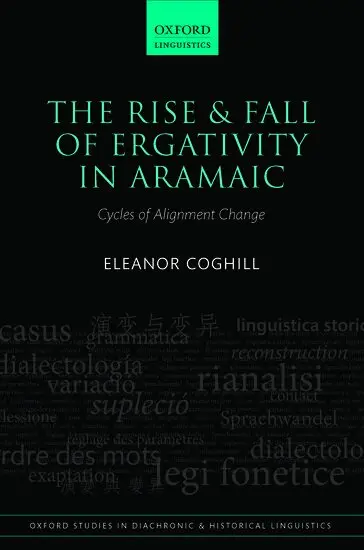
    The Rise and Fall of Ergativity in Aramaic

    Cycles of Alignment Change

    AvEleanor Coghill

    Inbunden, Engelska, 2016

    Del 21 i serien Oxford Studies in Diachronic and Historical Linguistics

    2 673 kr

    Beställningsvara. Skickas inom 5-8 vardagar. Fri frakt över 249 kr.

    Beskrivning

    This book traces the changes in argument alignment that have taken place in Aramaic during its 3000-year documented history. Eastern Aramaic dialects first developed tense-conditioned ergative alignment in the perfect, which later developed into a past perfective. However, while some modern dialects preserve a degree of ergative alignment, it has been eroded by movement towards semantic/Split-S alignment and by the use of separate marking for the patient, and some dialects have lost ergative alignment altogether. Thus an entire cycle of alignment change can be traced, something which had previously been considered unlikely.Eleanor Coghill examines evidence from ancient Aramaic texts, recent dialectal documentation, and cross-linguistic parallels to provide an account of the pathways through which these alignment changes took place. She argues that what became the ergative construction was originally limited mostly to verbs with an experiencer role, such as 'see' and 'hear', which could encode the experiencer with a dative. While this dative-experiencer scenario shows some formal similarities with other proposed explanations for alignment change, the data analysed in this book show that it is clearly distinct. The book draws important theoretical conclusions on the development of tense-conditioned alignment cross-linguistically, and provides a valuable basis for further research.

    Produktinformation

    • Utgivningsdatum:2016-08-11
    • Mått:164 x 239 x 27 mm
    • Vikt:730 g
    • Format:Inbunden
    • Språk:Engelska
    • Serie:Oxford Studies in Diachronic and Historical Linguistics
    • Antal sidor:404
    • Förlag:OUP OXFORD
    • ISBN:9780198723806

    Utforska kategorier

    • Språkvetenskap och lingvistik inom Språk och ordböcker

    Mer om författaren

    Eleanor Coghill studied Assyriology, Arabic, and Hebrew at the University of Cambridge, before specializing in the study of the endangered dialects of Neo-Aramaic, spoken in Iraq, Turkey, Iran, and Syria. Following a PhD and Junior Research Fellowship also at Cambridge, she worked on the Cambridge North-Eastern Neo-Aramaic Project, documenting some of the huge dialectal diversity of the language. She has also investigated aspects of change in Aramaic, both short and long term. Between 2010 and 2015 she was at the Zukunftskolleg and Department of Linguistics at the University of Konstanz, leading a project funded by the German Research Council on how the grammar of Neo-Aramaic dialects has been affected by contact with neighbouring languages. This was followed by a research position on the Language and Space project at the University of Zurich. As of 2016 she is Professor of Semitic Languages at Uppsala University.

    Innehållsförteckning

    • Series preface Acknowledgements List of maps and tables Abbreviations and glosses Map 1: North-Eastern Neo-Aramaic Dialects, Turoyo, and Mlahso 1: Introduction 2: Alignment 3: Aramaic 4: Alignment in Eastern Neo-Aramaic dialects 5: The verbal system and alignment in earlier Eastern Aramaic 6: The origin and development of the Q.til li construction 7: The decline of ergative alignment and new developments 8: Conclusions Appendices Appendix A: All cases of Q.til li from the Syriac corpus Appendix B: Examples of Q.til li gathered from Syriac secondary sources and other miscellaneous examples Appendix C: Examples of Q.til li from Jewish Babylonian Aramaic Appendix D: Examples of Q.til li from Classical Mandaic Appendix E: Verb lexemes found in Prefix Conjugation forms in the Syriac Corpus References Index