• Fri frakt över 249 kr
  • •
  • Snabba leveranser
  • •
  • Billiga böcker
Kundservice

Du är på sajten för privatpersoner.

Företag, bibliotek eller offentlig verksamhet?

Du handlar på classic.bokus.com, där alla dina funktioner finns intakta.
Till classic.bokus.com
Bokus logotyp. Gå till startsidan.
  • Erbjudanden
  • Student
  • Topplistor
  • Barn & ungdom
  • Bokus Play
  • E-böcker
  • Ljudböcker
  • Pocketböcker
  • Spel och pussel

Pocketfynda! Hundratals böcker för 49 kr/st →

Sidfot

Mina sidor

    Hjälp

    • Kundservice
    • Vanliga frågor och svar
    • Frakt och leverans
    • Retur vid ångerrätt
    • Reklamera vara
    • Betalning
    • Köpvillkor
    • Allmänna villkor
    • Information om webbplatsens tillgänglighet

    Om Bokus

    • Om oss
    • Pressrum
    • För studenter
    • För företag
    • För bibliotek och offentlig verksamhet
    • För leverantörer
    • Hållbarhet

    Populärt

    • Aktuella erbjudanden
    • Presentkort
    • Studentlitteratur
    • Nya böcker
    • Topplistor
    • Signerade böcker
    • Engelska böcker

    Inspiration

    • Boktips
    • BookTok
    • Barnbokskaraktärer
    • Populära författare
    Logotyp för Bokus
    Följ oss på Facebook (extern länk)Följ oss på Instagram (extern länk)Följ oss på YouTube (extern länk)Följ oss på TikTok (extern länk)
    bokus @ CookiesAnpassa cookiesIntegritetspolicyKöpvillkor
    Till Citymail hemsida (extern länk)Till Budbee hemsida (extern länk)Till Postnord hemsida (extern länk)Till Schenker hemsida (extern länk)Till Early Bird hemsida (extern länk)Till Walleys hemsida (extern länk)
    1. Naturvetenskap och teknik
    2. Matematik och naturvetenskap
    3. Matematik
    4. Beräkning och matematisk analys

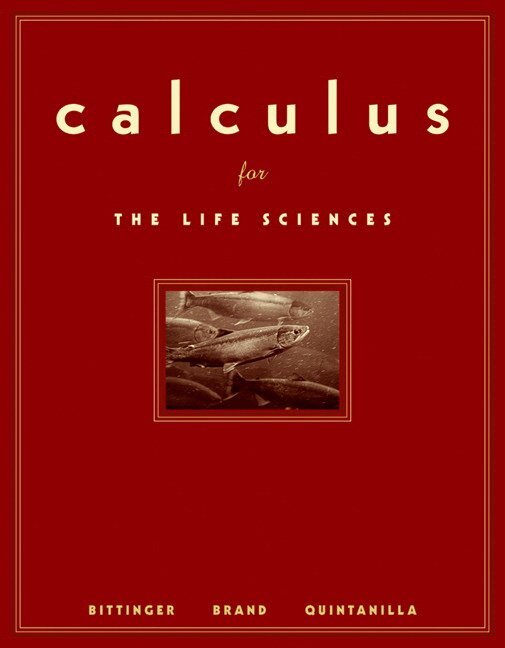
    Calculus for the Life Sciences

    AvMarvin Bittinger,Neal Brand

    Inbunden, Engelska, 2005

    3 095 kr

    Beställningsvara. Skickas inom 7-10 vardagar. Fri frakt över 249 kr.

    Beskrivning

    Based on the best-selling Calculus and Its Applications by Marv Bittinger, this new text is appropriate for a two-semester calculus course for life science majors. With four new chapters and two new co-authors, Calculus for the Life Sciences continues the Bittinger reputation as one of the most student-oriented and clearly written Applied Calculus texts available. The exercises and examples have been substantially updated to include additional relevant life science applications and current topics.

    Produktinformation

    • Utgivningsdatum:2005-12-19
    • Mått:209 x 260 x 37 mm
    • Vikt:1 640 g
    • Format:Inbunden
    • Språk:Engelska
    • Antal sidor:832
    • Upplaga:1
    • Förlag:Pearson Education
    • ISBN:9780321279354

    Utforska kategorier

    • Beräkning och matematisk analys inom Naturvetenskap och teknik

    Mer om författaren

    Marvin Bittinger For over thirty years Professor Marvin L. Bittinger has been teaching math at the university level. Since 1968 he has been employed as a professor of mathematics education at Indiana University - Purdue University at Indianapolis. Professor Bittinger has authored 159 publications on topics ranging from Basic Mathematics to Algebra and Trigonometry to Brief Calculus. He received his BA in Mathematics from Manchester College in 1963 and his PhD in Mathematics Education from Purdue University in 1968. Special honors include being Distinguished Visiting Professor at the United States Air Force Academy and being elected to the Manchester College Board of Trustees from 1992 to 1999. His hobbies include hiking, baseball, golf, and bowling and he enjoys membership in the Professional Bowler's Association and the Society for the Advancement of Baseball Research. Professor Bittinger has also had the privilege of speaking at a recent mathematics convention giving a lecture entitled, Baseball and Mathematics. In addition, he also has an interest in philosophy and theology, in particular, apologetics. Professor Bittinger currently lives in Carmel, Indiana with his wife Elaine. He has two grown and married sons, Lowell and Chris, and three grandchildren.  Neal Brand is the Departmental Chair and Professor of Mathematics at the University of North Texas in Denton, Texas, where he has taught since 1983. Before teaching at UNT, he taught at Ohio State University and Loyola University of Chicago, and he was employed as a scientist at McDonnell-Douglass Corporation. He received his BS in Mathematics from Purdue University in 1974, and his MS and PhD in Mathematics from Stanford University in 1976 and 1978 respectively. He has authored or co-authored 26 refereed articles that have appeared in the mathematical literature.Dr. Brand is a member of the Mathematical Association of America and the American Mathematical Society. Outside of mathematics, his interests include woodworking and carpentry. He is a founding board member and current board president of Habitat for Humanity of Denton County. He lives in Denton, Texas with his wife Shari. He also has two grown daughters.  John A. Quintanilla is an Associate Professor of Mathematics at the University of North Texas in Denton, Texas, where he has taught since 1996. He received both his BS and MS in Mathematics from Stanford University in 1992, and he received his PhD in Civil of Engineering and Operations Research from Princeton University in 1997. He has authored or co-authored 18 refereed articles that have appeared in the scientific literature.Dr. Quintanilla has been the recipient of multiple teaching awards. In 2004, he received the University of North Texas President's Council Teaching Award. In 2005, he was conferred the Distinguished College or University Teaching of Mathematics Award by the Texas Section of the Mathematical Association of America. Dr. Quintanilla is a member of the Mathematical Association of America and the Association of Christians in the Mathematical Sciences. His outside interests include golf, volleyball, softball, and Bible study. He lives in Denton, Texas with his wife Sandra and their daughter Sarah.

    Innehållsförteckning

    • Chapter 1    Functions and Graphs1.1    Slope and Linear Functions1.2    Polynomial Functions1.3    Rational and Radical Functions1.4    Trigonometric Functions1.5    Trigonometric Functions and the Unit CircleSummary and ReviewTestEXTENDED LIFE SCIENCE CONNECTION:  Carbon Dioxide Concentrations  Chapter 2    Differentiation2.1    Limits and Continuity:  Numerically and Graphically2.2    Limits: Algebraically2.3    Average Rates of Change2.4    Differentiation Using Limits of Difference Quotients2.5    Differentiation Techniques: Introduction2.6    Instantaneous Rates of Change2.7    Differentiation Techniques:  The Product and Quotient Rules2.8    The Chain Rule2.9    Higher-Order DerivativesSummary and ReviewTestEXTENDED LIFE SCIENCE CONNECTION:  Rate of Epidemic Spread: SARS  Chapter 3    Applications of Differentiation3.1    Using the First Derivatives to Find Maximum and Minimum Values and Sketch Graphs3.2    Using Second Derivatives to Find Maximum and Minimum Values and Sketch Graphs3.3    Graph Sketching:  Asymptotes and Rational Functions3.4    Using Derivatives to Find Absolute Maximum and Minimum Values3.5    Maximum-Minimum Problems3.6    Approximation Techniques3.7    Implicit Differentiation of Related RatesSummary and ReviewTestEXTENDED LIFE SCIENCE CONNECTION:  Polymorphism  Chapter 4    Exponential and Logarithmic Functions4.1    Exponential Functions4.2    Logarithmic Functions4.3    Applications:  The Uninhibited Growth Model, dP/dt = kP4.4    Applications:  Decay4.5    The Derivatives of ax and logaxSummary and ReviewTestEXTENDED LIFE SCIENCE CONNECTION:  Maximum Sustainable Harvest  Chapter 5    Integration5.1    Integration5.2    Riemann Sums and Definite Integrals5.3    Fundamental Theorem of Calculus5.4    Properties of Definite Integrals5.5    Integration Techniques: Substitution5.6    Integration Techniques:  Integration by Parts5.7    Integration Techniques:  Tables and Technology5.8    Volume5.9    Improper IntegralsSummary and ReviewTestEXTENDED LIFE SCIENCE CONNECTION:  Estimating Dinosaur Mass  Chapter 6    Matrices6.1    Matrix Operations6.2    Solving Linear Systems of Equations6.3    Finding a Matrix Inverse and Determinant6.4    Computing Eigenvalues and Eigenvectors6.5    Solving Difference EquationsSummary and ReviewTestEXTENDED LIFE SCIENCE CONNECTION:  Population Growth  Chapter 7    Functions of Several Variables7.1    Functions of Several Variables7.2    Partial Derivatives7.3    Maximum-Minimum Problems7.4    An Application:  The Method of Least Squares7.5    Multiple IntegrationSummary and ReviewTestEXTENDED LIFE SCIENCE CONNECTION:  Stocking Fish  Chapter 8    First-Order Differential Equations8.1    Differential Equations and Initial-Value Problems8.2    Linear First-Order Differential Equations8.3    Stability of Autonomous Differential Equations8.4    Separable Differential Equations8.5    Numerical Solutions of Differential EquationsSummary and ReviewTestEXTENDED LIFE SCIENCE CONNECTION:  Larvae and Forest Defoliation  Chapter 9    Higher-Order and Systems of Differential Equations9.1    Higher-Order Homogeneous Differential Equations9.2    Higher-Order Nonhomogeneous Differential Equations9.3    Systems of Linear Differential Equations9.4    Matrices and Trajectories9.5    Models of Population Biology9.6    Numerical MethodsSummary and ReviewTestEXTENDED LIFE SCIENCE CONNECTION:  Epidemics  Chapter 10    Probability10.1    Probability10.2    Multiplication Trees and Bayes’ Rule10.3    The Binomial Distribution10.4    Expected Value and Standard Deviation for Discrete Random Variables10.5    Continuous Random Variables10.6    Poisson Process10.7    The Normal DistributionSummary and ReviewTestEXTENDED LIFE SCIENCE CONNECTION:  Axenic Cultures  Appendix A:    Review of Basic AlgebraAppendix B:    Functions  TablesIntegration FormulasAreas for a Standard Normal Distribution  Answers  Index