• Fri frakt över 249 kr
  • •
  • Snabba leveranser
  • •
  • Billiga böcker
Kundservice

Du är på sajten för privatpersoner.

Företag, bibliotek eller offentlig verksamhet?

Du handlar på classic.bokus.com, där alla dina funktioner finns intakta.
Till classic.bokus.com
Bokus logotyp. Gå till startsidan.
  • Erbjudanden
  • Student
  • Topplistor
  • Barn & ungdom
  • Bokus Play
  • E-böcker
  • Ljudböcker
  • Pocketböcker
  • Spel och pussel

5% studentrabatt – använd koden KURSBOK27 →

Sidfot

Mina sidor

    Hjälp

    • Kundservice
    • Vanliga frågor och svar
    • Frakt och leverans
    • Retur vid ångerrätt
    • Reklamera vara
    • Betalning
    • Köpvillkor
    • Allmänna villkor
    • Information om webbplatsens tillgänglighet

    Om Bokus

    • Om oss
    • Pressrum
    • För studenter
    • För företag
    • För bibliotek och offentlig verksamhet
    • För leverantörer
    • Hållbarhet

    Populärt

    • Aktuella erbjudanden
    • Presentkort
    • Studentlitteratur
    • Nya böcker
    • Topplistor
    • Signerade böcker
    • Engelska böcker

    Inspiration

    • Boktips
    • BookTok
    • Barnbokskaraktärer
    • Populära författare
    Logotyp för Bokus
    Följ oss på Facebook (extern länk)Följ oss på Instagram (extern länk)Följ oss på YouTube (extern länk)Följ oss på TikTok (extern länk)
    bokus @ CookiesAnpassa cookiesIntegritetspolicyKöpvillkor
    Till Citymail hemsida (extern länk)Till Budbee hemsida (extern länk)Till Postnord hemsida (extern länk)Till Schenker hemsida (extern länk)Till Early Bird hemsida (extern länk)Till Walleys hemsida (extern länk)
    1. Samhälle och politik
    2. Samhälle och kultur
    3. Kultur och medier
    4. Referensverk och tvärvetenskap

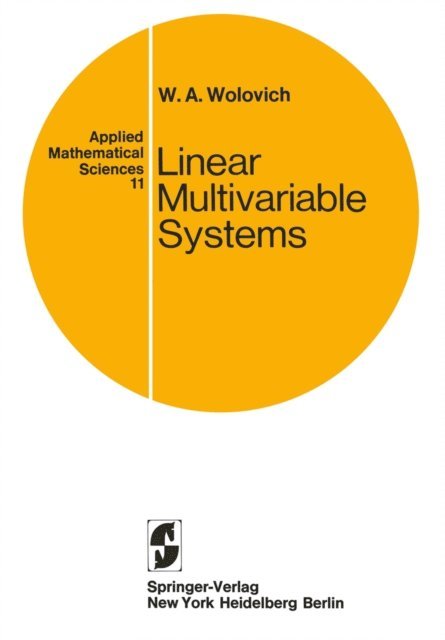
    Linear Multivariable Systems

    AvW. A. Wolovich

    Häftad, Engelska, 1974

    Del i serien Applied Mathematical Sciences

    536 kr

    Beställningsvara. Skickas inom 10-15 vardagar. Fri frakt över 249 kr.

    Fler format och utgåvor

    E-bok

    702 kr

    Beskrivning

    This text was developed over a three year period of time (1971- 1973) from a variety of notes and references used in the presentation of a senior/first year graduate level course in the Division of En­ gineering at Brown University titled Linear System Theory. The in­ tent of the course was not only to introduce students to the more modern, state-space approach to multivariable control system analysis and design, as opposed to the classical, frequency domain approach, but also to draw analogies between the two approaches whenever and wherever possible. It is therefore felt that the material presented will have broader appeal to practicing engineers than a text devoted exclusively to the state-space approach. It was assumed that students taking the course had also taken, as a prerequisite, an undergraduate course in classical control theory and also were familiar with certain standard linear algebraic notions as well as the theory of ordinary differential equations, although a substantial effort was expended to make the material as self-contained as possible. In particular, Chapter 2 is employed to familiarize the reader with a good deal of the mathematical material employed through­ out the remainder of the text. Chapters 3 through 5 were drawn, in part, from a number of contemporary state-space and matrix algebraic references, as well as some recent research of the author, especially those portions which deal with polynomial matrices and the differential operator approach.


    Produktinformation

    • Utgivningsdatum:1974-07-26
    • Mått:168 x 240 x 21 mm
    • Vikt:623 g
    • Format:Häftad
    • Språk:Engelska
    • Serie:Applied Mathematical Sciences
    • Antal sidor:358
    • Förlag:Springer-Verlag New York Inc.
    • ISBN:9780387901015

    Utforska kategorier

    • Referensverk och tvärvetenskap inom Samhälle och politik

    Innehållsförteckning

    • 1 — Introduction.- 2 — Mathematical Preliminaries.- 2.1 Introduction.- 2.2 Linear Vector Spaces.- 2.3 Linear Operators.- 2.4 Scalar Matrices.- 2.5 Polynomial Matrices.- 2.6 Concluding Remarks and References.- 3 — The State Space.- 3.1 Introduction.- 3.2 State Representations.- 3.3 The Determination of eAt.- 3.4 Equivalent Systems.- 3.5 Controllability and Observability.- 3.6 Controllable and Observable Companion Forms.- 3.7 Concluding Remarks and References.- 4 — Frequency Domain Representations.- 4.1 Introduction.- 4.2 The Transfer Matrix.- 4.3 The Structure Theorem.- 4.4 Realization Theory (Time Domain Reduction).- 4.5 Concluding Remarks and References.- 5 — Differential Operator Representations.- 5.1 Introduction.- 5.2 Transfer and Equivalence Relations.- 5.3 Differential Operator Controllability and Observability.- 5.4 Realization Theory (Frequency Domain Reduction).- 5.5 System Invertibility and Functional Reproducibility.- 5.6 Concluding Remarks and References.- 6 — Linear State Variable Feedback.- 6.1 Introduction.- 6.2 Quadratic Optimization.- 6.3 Pole Assignment via the Controllable Companion Form.- 6.4 Asymptotic State Estimation.- 6.5 Concluding Remarks and References.- 7 — Frequency Domain Compensation.- 7.1 Introduction.- 7.2 Frequency Domain Implications of State Feedback.- 7.3 Frequency Domain State Estimation and Feedback.- 7.4 A General Compensation Technique.- 7.5 Concluding Remarks and References.- 8 — Design Objectives.- 8.1 Introduction.- 8.2 Arbitrary Pole Placement.- 8.3 Decoupling.- 8.4 Static Decoupling.- 8.5 Exact Model Matching.- 8.6 Concluding Remarks and References.- References.