• Fri frakt över 249 kr
  • •
  • Snabba leveranser
  • •
  • Billiga böcker
Kundservice

Du är på sajten för privatpersoner.

Företag, bibliotek eller offentlig verksamhet?

Du handlar på classic.bokus.com, där alla dina funktioner finns intakta.
Till classic.bokus.com
Bokus logotyp. Gå till startsidan.
  • Erbjudanden
  • Student
  • Topplistor
  • Barn & ungdom
  • Bokus Play
  • E-böcker
  • Ljudböcker
  • Pocketböcker
  • Spel & pussel

Upp till 25% på utvalda nyheter →

Sidfot

Mina sidor

    Hjälp

    • Kundservice
    • Vanliga frågor och svar
    • Frakt och leverans
    • Retur vid ångerrätt
    • Reklamera vara
    • Betalning
    • Köpvillkor
    • Allmänna villkor
    • Information om webbplatsens tillgänglighet

    Om Bokus

    • Om oss
    • Pressrum
    • För studenter
    • För företag
    • För bibliotek och offentlig verksamhet
    • För leverantörer
    • Hållbarhet

    Populärt

    • Aktuella erbjudanden
    • Presentkort
    • Studentlitteratur
    • Nya böcker
    • Topplistor
    • Signerade böcker
    • Engelska böcker

    Inspiration

    • Boktips
    • BookTok
    • Populära bokserier
    • Barnbokskaraktärer
    • Populära författare
    Logotyp för Bokus
    Följ oss på Facebook (extern länk)Följ oss på Instagram (extern länk)Följ oss på YouTube (extern länk)Följ oss på TikTok (extern länk)
    bokus @ CookiesAnpassa cookiesIntegritetspolicyKöpvillkor
    Till Citymail hemsida (extern länk)Till Budbee hemsida (extern länk)Till Postnord hemsida (extern länk)Till Schenker hemsida (extern länk)Till Early Bird hemsida (extern länk)Till Walleys hemsida (extern länk)
    1. Naturvetenskap och teknik
    2. Teknik och industri
    3. Teknik: allmänt

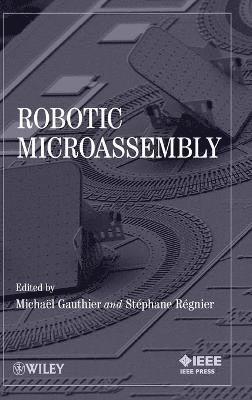
    Robotic Microassembly

    AvMichael Gauthier,Michael Gauthier

    Inbunden, Engelska, 2010

    1 698 kr

    Beställningsvara. Skickas inom 5-8 vardagar. Fri frakt över 249 kr.

    Beskrivning

    Discover the latest models and methods for robotic microassembly from around the world This book presents and analyzes new and emerging models and methods developed around the world for robotic microassembly, a new and innovative way to produce better microsystems. By exploring everything from the physics of micromanipulation to microassembly to microhandling, it provides the first complete overview and review of this rapidly growing field. Robotic Microassembly is divided into three parts: Part One: Modeling of the Microworld Part Two: Handling Strategies Part Three: Robotic and Microassembly Together, these three parts feature eight chapters contributed by eight different authors. The authors, internationally recognized experts in the field of robotic microassembly, represent research laboratories in Asia, Europe, and North America. As a result, readers get a remarkable perspective on different approaches to robotic microassembly from around the world. Examples provided throughout the chapters help readers better understand how these different approaches work in practice. References at the end of each chapter lead to the primary literature for further investigation of individual topics.Robotic microassembly offers a new, improved way to manufacture high-performance microelectro-mechanical systems (MEMS). Therefore, any professional or student involved in microrobotics, micromechatronics, self-assembly or MEMS will find plenty of novel ideas and methods in this book that set the stage for new approaches to design and build the next generation of MEMS and microproducts.

    Produktinformation

    • Utgivningsdatum:2010-09-24
    • Mått:163 x 241 x 23 mm
    • Vikt:626 g
    • Format:Inbunden
    • Språk:Engelska
    • Antal sidor:328
    • Förlag:John Wiley & Sons Inc
    • ISBN:9780470484173

    Utforska kategorier

    • Teknik: allmänt inom Naturvetenskap och teknik

    Mer om författaren

    MICHAËL GAUTHIER, PhD, is a researcher at the Centre National de la Recherche Scientifique (CNRS), working with the Automation and Micromechatronic Systems Department in the FEMTO-ST Institute in France. His research interests focus on the modeling and study of automatic micromanipulation strategies, with an emphasis on artificial microobjects under 50 µm. STÉPHANE RÉGNIER, PhD, is Professor as well as head of the micromanipulation team at the Institut des Systèmes Intelligents et Robotique (ISIR) in France. His research examines microscale phenomena such as micromechatronics and biological cell micromanipulation.

    Innehållsförteckning

    • Preface. Introduction.PART I MODELING OF THE MICROWORLD.1 Microworld modeling in Vacuum and Gaseous Environments.1.1 Introduction.1.2 Classical models.1.3 Recent developments.References.2 Microworld Modelling: Impact of liquid and roughness.2.1 Introduction.2.2 Liquid environments.2.3 Microscopic analysis.2.4 Surface Roughness.References.PART II HANDLING STRATEGIES.3 Unified view of robotic microhandling and selfassembly.3.1 Background.3.2 Robotic Microhandling.3.3 SelfAssembly.3.4 Components of Microhandling.3.5 Hybrid Microhandling.3.6 Conclusion.References.4 Towards a precise micro manipulation.4.1 Introduction.4.2 Handling principles and strategies adapted to the microworld.4.3 Micromanipulation setup.4.4 Experimentations.4.5 Conclusion.References.5 Microhandling Strategies and Microassembly in Submerged.Medium.5.1 Introduction.5.2 Dielectrophoretic Gripper.5.3 Submerged freeze gripper.5.4 Chemical control of the release in submerged handling.5.5 Release on adhesive substrate and microassembly.5.6 Conclusion.References.PART III ROBOTIC AND MICROASSEMBLY.6 Robotic microassembly of 3D MEMS Structures.6.1 Introduction.6.2 Methodology of the Microassembly System.6.3 Robotic Micromanipulator.6.4 Overview of Microassembly System.6.5 Modular Design Features for Compatibility with the Microassembly System.6.6 Grasping Interface (Interface Feature).6.7 PMKIL Microassembly Process.6.8 Experimental Results and discussion.6.9 Conclusion.References.7 High Yield Automated MEMS Assembly.7.1 Introduction.7.2 General Guidelines for 2 1 2D Microassembly.7.3 Compliant Part Design.7.4 3 Microassembly System.7.5 High Yield Microassembly.7.6 Conclusion and Future work.References.8 Design of a desktop microassembly machine and its industrial.application to micro solder ball manipulation.8.1 Introduction.8.2 Outline of the machine design to achieve fine accuracy.8.3 Application to the joining process of electric Components.8.4 Pursuing higher accuracy.8.5 Conclusion.References.