• Fri frakt över 249 kr
  • •
  • Snabba leveranser
  • •
  • Billiga böcker
Kundservice

Du är på sajten för privatpersoner.

Företag, bibliotek eller offentlig verksamhet?

Du handlar på classic.bokus.com, där alla dina funktioner finns intakta.
Till classic.bokus.com
Bokus logotyp. Gå till startsidan.
  • Erbjudanden
  • Student
  • Topplistor
  • Barn & ungdom
  • Bokus Play
  • E-böcker
  • Ljudböcker
  • Pocketböcker
  • Spel och pussel

5% studentrabatt – använd koden KURSBOK27 →

Sidfot

Mina sidor

    Hjälp

    • Kundservice
    • Vanliga frågor och svar
    • Frakt och leverans
    • Retur vid ångerrätt
    • Reklamera vara
    • Betalning
    • Köpvillkor
    • Allmänna villkor
    • Information om webbplatsens tillgänglighet

    Om Bokus

    • Om oss
    • Pressrum
    • För studenter
    • För företag
    • För bibliotek och offentlig verksamhet
    • För leverantörer
    • Hållbarhet

    Populärt

    • Aktuella erbjudanden
    • Presentkort
    • Studentlitteratur
    • Nya böcker
    • Topplistor
    • Signerade böcker
    • Engelska böcker

    Inspiration

    • Boktips
    • BookTok
    • Barnbokskaraktärer
    • Populära författare
    Logotyp för Bokus
    Följ oss på Facebook (extern länk)Följ oss på Instagram (extern länk)Följ oss på YouTube (extern länk)Följ oss på TikTok (extern länk)
    bokus @ CookiesAnpassa cookiesIntegritetspolicyKöpvillkor
    Till Citymail hemsida (extern länk)Till Budbee hemsida (extern länk)Till Postnord hemsida (extern länk)Till Schenker hemsida (extern länk)Till Early Bird hemsida (extern länk)Till Walleys hemsida (extern länk)
    1. Naturvetenskap och teknik
    2. Matematik och naturvetenskap
    3. Biologi

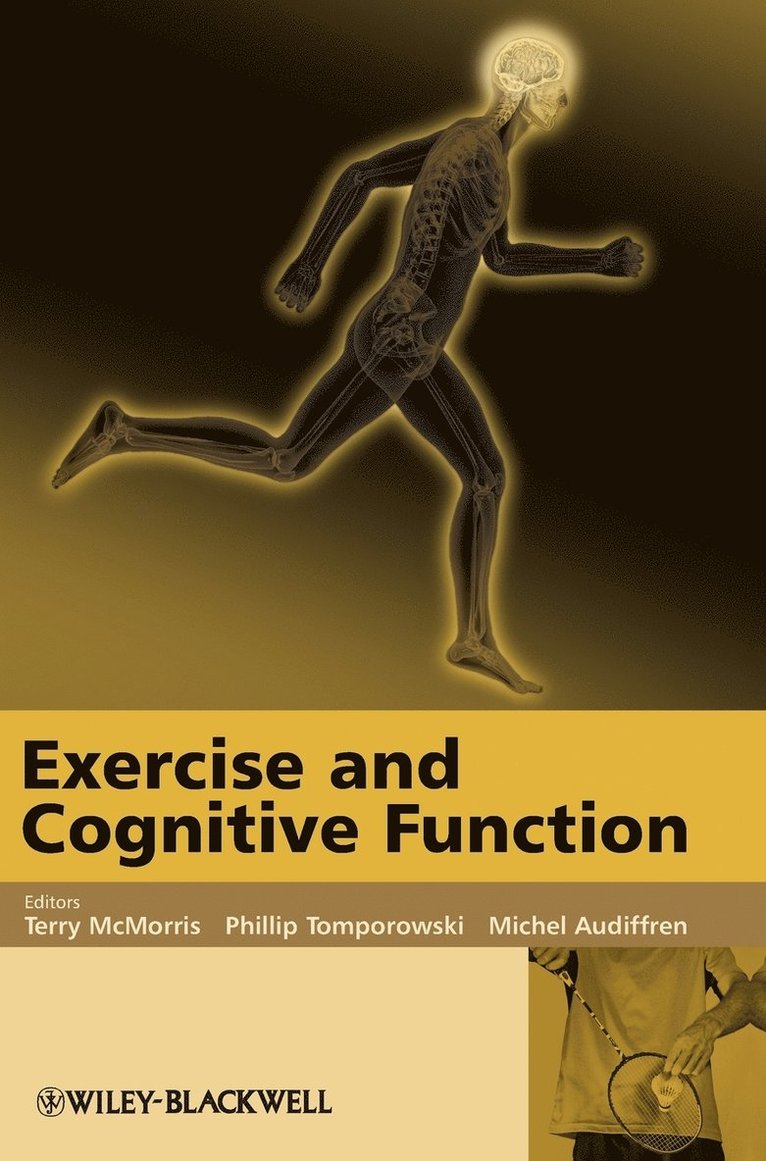
    Exercise and Cognitive Function

    AvMcMorris,Terry McMorris

    Inbunden, Engelska, 2009

    1 465 kr

    Beställningsvara. Skickas inom 5-8 vardagar. Fri frakt över 249 kr.

    Beskrivning

    This textbook focuses on the relationship between physical exercise and cognition, a very timely and important topic with major theoretical and practical implications for a number of areas including ageing, neurorehabilitation, depression and dementia. It brings together a wide range of analytical approaches and experimental results to provide a very useful overview and synthesis of this growing field of study. The book is divided into three parts:Part I covers the conceptual, theoretical and methodological underpinnings and issues.Part II focuses on advances in exercise and cognition research, with appropriate sub-sections on ‘acute’ and ‘chronic’ exercise and cognition.Part III presents an overview of the area and makes suggestions for the direction of future research.This text provides a cutting-edge examination of this increasingly important area written by leading experts from around the world.  The book will prove invaluable to researchers and practitioners in a number of fields, including exercise science, cognitive science, neuroscience and clinical medicine.Key Features: Unique in-depth investigation of the relationship between physical exercise and brain function.Covers theoretical approaches and experimental results and includes chapters on the latest developments in research design.Examines the effects of both acute and chronic exercise on brain function.International list of contributors, who are leading researchers in their field.

    Produktinformation

    • Utgivningsdatum:2009-02-27
    • Mått:175 x 252 x 27 mm
    • Vikt:798 g
    • Format:Inbunden
    • Språk:Engelska
    • Antal sidor:400
    • Förlag:John Wiley & Sons Inc
    • ISBN:9780470516607

    Utforska kategorier

    • Biologi inom Naturvetenskap och teknik
    • Neurologi och klinisk neurofysiologi inom Medicin

    Mer om författaren

    Professor Terry McMorris, University of Chichester, UKDr Phillip Tomporowski, University of Georgia, USAProfessor Michel Audiffren, University of Poitiers, France

    Recensioner i media

    "A text brimming with new research in the field and practical suggestions for application and future research. … Discussion of the methodologies and protocols presented should generate considerable interest. … I found the text to be a worthwhile addition to my library." (PsycCRITIQUES, February 2010)

    Innehållsförteckning

    • Preface ixContributors xiPART 1 THEORETICAL AND METHODOLOGICAL ISSUES 11 Acute exercise and psychological functions: a cognitive-energetic approach 3Michel Audiffren1.1 Varieties of exercise effects on psychological variables 41.2 The cognitive psychology approach 91.3 The energetic approach 111.4 Exercise effects and cognitive-energetic models 141.5 Sensorimotor and cognitive functions affected by exercise 241.6 Limits of the cognitive-energetic approach and future perspectives 331.7 Conclusion 392 Exercise and cognitive function: a neuroendocrinological explanation 41Terry McMorris2.1 Catecholamines and 5-hydroxytryptamine as brain neurotransmitters 412.2 How exercise induces increases in brain concentrations of noradrenaline, dopamine, cortisol and 5-hydroxytryptamine 432.3 Exercise, catecholamines, cortisol and cognition: research 502.4 Task type 592.5 Discussion 632.6 Developing a neuroendocrinological model for an interaction between exercise and cognition 673 The transient hypofrontality theory and its implications for emotion and cognition 69Arne Dietrich3.1 Clearing the ground 713.2 Exercise-induced transient hypofrontality 733.3 Implications for emotion 793.4 Implications for cognition 813.5 Reconceptualizing the existing data in the field 874 Methodological issues: research approaches, research design, and task selection 91Phillip D. Tomporowski4.1 Research approaches 924.2 Research design issues 994.3 Task selection issues 1064.4 Conclusions and recommendations 112PART 2 ACUTE EXERCISE AND COGNITION 1155 Exercise, dehydration and cognitive function 117Terry McMorris5.1 Exercise-induced dehydration and cognitive function 1195.2 Discussion 1285.3 Conclusions 1346 Exercise, nutrition and cognition 135Adam David Cunliffe and Gulshanara Begum6.1 Fatigue and limits to human performance 1366.2 Assessing the effects of exercise and nutrition on cognitive performance 1386.3 Nutrition, exercise and cognitive performance 1426.4 Micronutrients, exercise and cognitive performance 1456.5 Nutritional ergogenic aids and cognitive performance 1476.6 Integration of research observations 1486.7 Challenges in research 1506.8 Conclusion 1517 A chronometric and electromyographic approach to the effect of exercise on reaction time 153Karen Davranche and Michel Audiffren7.1 Research 1567.2 Conclusion 1598 Acute aerobic exercise effects on event-related brain potentials 161Charles H. Hillman, Matthew Pontifex and Jason R. Themanson8.1 Executive control 1638.2 Neuroelectric measurement 1648.3 Event-related brain potentials during exercise 1658.4 Event-related brain potentials following exercise 1708.5 Future directions and conclusions 1779 Exercise and decision-making in team games 179Terry McMorris9.1 Designing a decision-making test 1809.2 Research results 1839.3 Ecological validity and future research 1899.4 Implications for team games players and coaches 19210 Blood glucose and brain metabolism in exercise 193Niels H. Secher, Thomas Seifert, Henning B. Nielsen and Bjørn Quistorff10.1 Cerebral metabolism during exercise 19410.2 Cerebral oxygenation 20210.3 Cerebral metabolism 20310.4 Acute hypoglycemia 20910.5 Conclusions 20910.6 Future research 210Acknowledgements 210PART 3 CHRONIC EXERCISE AND COGNITION 21111 An integrated approach to the effect of acute and chronic exercise on cognition: the linked role of individual and task constraints 213Caterina Pesce11.1 The gap between acute and chronic exercise research 21311.2 Individual constraints on the acute exercise–cognition relationship: the role of chronic exercise effects 21511.3 Effect of physical fitness: links to exercise intensity and to the time relation between physical exercise and cognitive task 21811.4 Effect of cognitive expertise: links to cognitive task complexity, exercise intensity and duration, and age 21911.5 Effect of motor coordination skills: links to physical exercise complexity, intensity and duration 22311.6 Bridging the gap between acute and chronic exercise studies 22512 Chronic exercise and cognition in older adults 227Jennifer Etnier12.1 Theoretical underpinnings 22812.2 Empirical evidence 23012.3 Moderators of the relationship 24512.4 Practical conclusions 24512.5 Challenges 24612.6 Future research 24713 Exercise and cognition in children 249Catherine L. Davis and Kate Lambourne13.1 Definition of terms 24913.2 Literature review 25013.3 The Medical College of Georgia study 25413.4 Potential mechanisms 26213.5 Summary and recommendations for future research 26614 Chronic exercise and developmental disabilities 269James Zagrodnik and Michael Horvat14.1 Defining terms 26914.2 Research investigating the effects of exercise on cognition among the developmentally disabled 27214.3 Problems to address and future research considerations 27914.4 Practical applications and conclusions 28215 Chronic exercise in brain diseases 285Laura Eggermont and Erik Scherder15.1 Observational studies of physical activity 28615.2 Physical activity intervention studies 28815.3 Physical activity, cognition and different types of dementia 29815.4 Role of vascular disease 30215.5 Neurodegenerative disease, nitric oxide, vascular disease and physical activity 30515.6 Final conclusion 305PART 4 DISCUSSION AND CONCLUSION 30716 Summary and direction for future research 309Terry McMorris, Phillip D. Tomporowski, and Michel Audiffren16.1 Summary: emerging theoretical approaches 30916.2 Summary of research results 31216.3 Future theoretically driven research 31416.4 Future applied research 31616.5 General summary 317References 319Index 375