• Fri frakt över 249 kr
  • •
  • Snabba leveranser
  • •
  • Billiga böcker
Kundservice

Du är på sajten för privatpersoner.

Företag, bibliotek eller offentlig verksamhet?

Du handlar på classic.bokus.com, där alla dina funktioner finns intakta.
Till classic.bokus.com
Bokus logotyp. Gå till startsidan.
  • Erbjudanden
  • Student
  • Topplistor
  • Barn & ungdom
  • Bokus Play
  • E-böcker
  • Ljudböcker
  • Pocketböcker
  • Spel och pussel

5% studentrabatt – använd koden KURSBOK27 →

Sidfot

Mina sidor

    Hjälp

    • Kundservice
    • Vanliga frågor och svar
    • Frakt och leverans
    • Retur vid ångerrätt
    • Reklamera vara
    • Betalning
    • Köpvillkor
    • Allmänna villkor
    • Information om webbplatsens tillgänglighet

    Om Bokus

    • Om oss
    • Pressrum
    • För studenter
    • För företag
    • För bibliotek och offentlig verksamhet
    • För leverantörer
    • Hållbarhet

    Populärt

    • Aktuella erbjudanden
    • Presentkort
    • Studentlitteratur
    • Nya böcker
    • Topplistor
    • Signerade böcker
    • Engelska böcker

    Inspiration

    • Boktips
    • BookTok
    • Barnbokskaraktärer
    • Populära författare
    Logotyp för Bokus
    Följ oss på Facebook (extern länk)Följ oss på Instagram (extern länk)Följ oss på YouTube (extern länk)Följ oss på TikTok (extern länk)
    bokus @ CookiesAnpassa cookiesIntegritetspolicyKöpvillkor
    Till Citymail hemsida (extern länk)Till Budbee hemsida (extern länk)Till Postnord hemsida (extern länk)Till Schenker hemsida (extern länk)Till Early Bird hemsida (extern länk)Till Walleys hemsida (extern länk)
    1. Ekonomi och Ledarskap
    2. Nationalekonomi
    3. Mikroekonomi

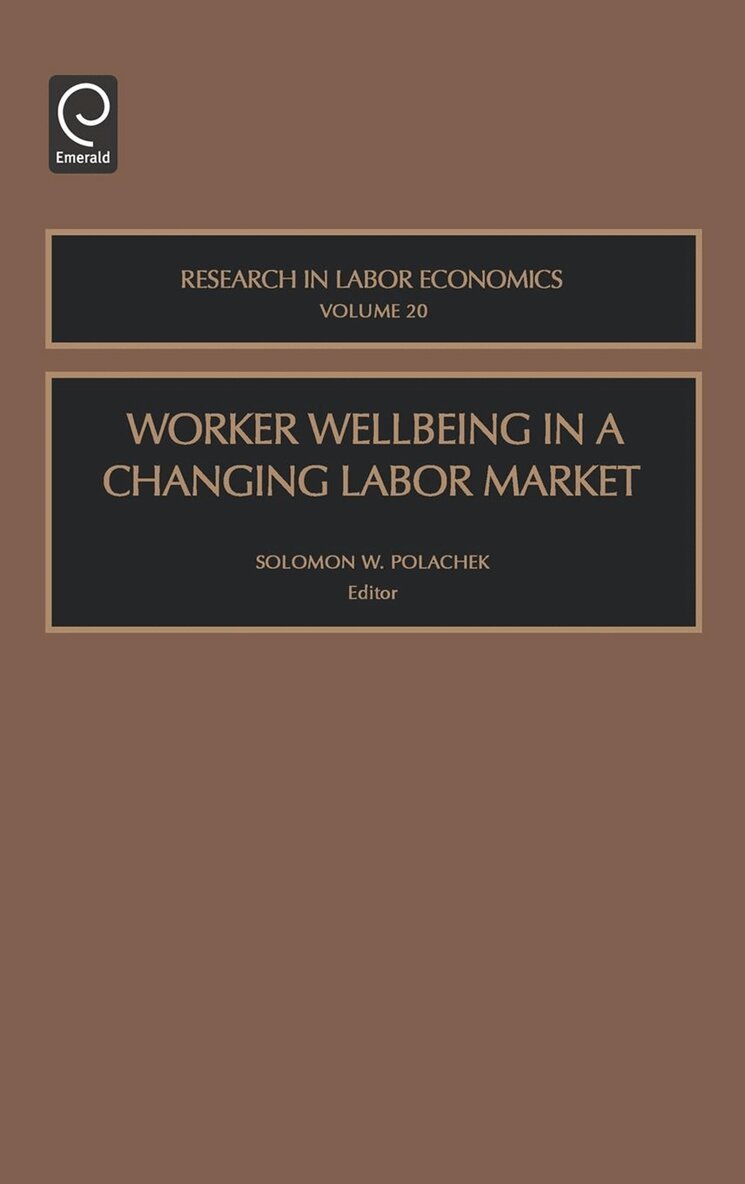
    Worker Wellbeing in a Changing Labor Market

    AvSolomon W. Polachek

    Inbunden, Engelska, 2001

    Del 20 i serien Research in Labor Economics

    1 718 kr

    Beställningsvara. Skickas inom 5-8 vardagar. Fri frakt över 249 kr.

    Beskrivning

    How do workers fare in a continually changing labor market? This volume contains fifteen original scientific papers each examining how socio-economic changes affect worker wellbeing. Among the findings are: most increases in female labor force participation occur among women with high husbands' earnings, dispelling the myth that shrinking husbands' relative earnings cause women's work activities to rise; increased globalization equalizes pay between but expands pay within corporate establishments; high quality colleges widen the earnings distribution for top earners but only negligibly affect earnings for low wage earners; mathematical success depends on school quality more so than verbal learning; and adult daughters who visit ailing parents daily in a nursing home decrease their annual labor supply by about 1,000 hours implying a welfare loss of 180,000 dollars. Findings are: physical and/or sexual abuse appear to afflict over 30 per cent of the population leading to a 15 per cent drop in employment probability and a 32 per cent loss in wages; and, training workers in an entirely new occupation raises an employee's wage growth while training workers in the same occupation decreases their wage growth, at least during the Russian economy's recent transition.

    Produktinformation

    • Utgivningsdatum:2001-12-05
    • Mått:156 x 234 x 25 mm
    • Vikt:807 g
    • Format:Inbunden
    • Språk:Engelska
    • Serie:Research in Labor Economics
    • Antal sidor:452
    • Förlag:Emerald Publishing Limited
    • ISBN:9780762308330

    Utforska kategorier

    • Mikroekonomi inom Ekonomi och Ledarskap

    Innehållsförteckning

    • Preface (Soloman W. Polachek). Inter-generational labor market and welfare consequences of poor health (T.J. Kniesner, A.T. LoSasso). The effect of health on employment transitions of older men (D.M. Blau, D. B. Gilleskie). Abuse and work among poor women: evidence from Washington State (M.W. Smith). Early test scores, school quality and sex: longitudinal effects on wages and employment outcomes (J. Currie, D. Thomas). School quality and the distribution of earnings (E.R. Eide, M.H. Showalter). Worker training in a restructuring economy: evidence from the Russian transition (M.C.Berger, J.S.Earle, K.Z.Sabirianova). A comparison of the human capital and signaling models: the case of the self-employed and the increase in the schooling premium in the 1980's (M. Lofstrom). Do returns human capital equalize across occupational paths? (J.A.Freeman, B. T. Hirsch). Has compensation become more flexible? (S.A Cannon et al.). Skill based technical change and trends in employer size effects (T. Idson). Employment of women and demand-side forces (D.K. Ginther, C. Juhn). Revising women's preferences about future labor force attachment: what effect do they have on earnings, and what are they affected by? (B. Sen). Getting ahead: the determinants of and pay-offs to internal promotion for young U.S. men and women (D. A. Cobb-Clark). Looking again at instrumental variable estimation of wage models in the gender wage gap literature (A. Kunze). Less-skilled workers, welfare reform, and the unemployment insurance system (C.K. Gustafson, P.B. Levine).