• Fri frakt över 249 kr
  • •
  • Snabba leveranser
  • •
  • Billiga böcker
Kundservice

Du är på sajten för privatpersoner.

Företag, bibliotek eller offentlig verksamhet?

Du handlar på classic.bokus.com, där alla dina funktioner finns intakta.
Till classic.bokus.com
Bokus logotyp. Gå till startsidan.
  • Erbjudanden
  • Student
  • Topplistor
  • Barn & ungdom
  • Bokus Play
  • E-böcker
  • Ljudböcker
  • Pocketböcker
  • Spel och pussel

Pocketfynda! Hundratals böcker för 49 kr/st →

Sidfot

Mina sidor

    Hjälp

    • Kundservice
    • Vanliga frågor och svar
    • Frakt och leverans
    • Retur vid ångerrätt
    • Reklamera vara
    • Betalning
    • Köpvillkor
    • Allmänna villkor
    • Information om webbplatsens tillgänglighet

    Om Bokus

    • Om oss
    • Pressrum
    • För studenter
    • För företag
    • För bibliotek och offentlig verksamhet
    • För leverantörer
    • Hållbarhet

    Populärt

    • Aktuella erbjudanden
    • Presentkort
    • Studentlitteratur
    • Nya böcker
    • Topplistor
    • Signerade böcker
    • Engelska böcker

    Inspiration

    • Boktips
    • BookTok
    • Barnbokskaraktärer
    • Populära författare
    Logotyp för Bokus
    Följ oss på Facebook (extern länk)Följ oss på Instagram (extern länk)Följ oss på YouTube (extern länk)Följ oss på TikTok (extern länk)
    bokus @ CookiesAnpassa cookiesIntegritetspolicyKöpvillkor
    Till Citymail hemsida (extern länk)Till Budbee hemsida (extern länk)Till Postnord hemsida (extern länk)Till Schenker hemsida (extern länk)Till Early Bird hemsida (extern länk)Till Walleys hemsida (extern länk)
    1. Psykologi och pedagogik
    2. Pedagogik

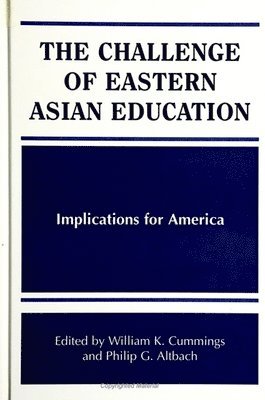
    Challenge of Eastern Asian Education

    Implications for America

    AvWilliam K. Cummings,Philip G. Altbach

    Häftad, Engelska, 1997

    Del i serien SUNY series, Frontiers in Education

    459 kr

    Beställningsvara. Skickas inom 5-8 vardagar. Fri frakt över 249 kr.

    Beskrivning

    Provides specific examples of Asian educational practice that may have relevance to the United States.The Challenge of Eastern Asian Education highlights how Asian education policy and practice challenge American schools. The book focuses on innovations that the nations of the Pacific Rim have developed for their schools, and it analyzes how these educational systems have tried to meet the challenges of rapid social and economic change. It is unique in that it provides in-depth coverage of the Asian approach to education and explicitly discusses the implications of Asian education for America.There is special interest in Asian countries, not only because of their unparalleled economic success, but because Asian societies have been held up as models for social harmony and discipline. This book provides specific examples of Asian educational practice that may have relevance to the United States. It is unique in that it deals not only with Japan, which has received considerable attention, but with other Pacific Rim nations as well.

    Produktinformation

    • Utgivningsdatum:1997-03-06
    • Mått:228 x 152 x 26 mm
    • Vikt:513 g
    • Format:Häftad
    • Språk:Engelska
    • Serie:SUNY series, Frontiers in Education
    • Antal sidor:340
    • Förlag:State University of New York Press
    • ISBN:9780791432846

    Utforska kategorier

    • Pedagogik inom Psykologi och pedagogik

    Mer om författaren

    William K. Cummings is Professor and Director, Comparative and Global Studies in Education, State University of New York, Buffalo. Philip G. Altbach is Professor and Director, Center for International Higher Education, Boston College. He has edited several books, including Emergent Issues in Education: Comparative Perspectives (with Robert F. Arnove and Gail P. Kelly) and The Racial Crisis in American Higher Education (with Kofi Lomotey), and has authored The Knowledge Context: Comparative Perspectives on the Distribution of Knowledge, all published by SUNY Press.

    Recensioner i media

    "There's nothing quite like this book. The organization of the topics is a plus, distinguishing between basic and secondary and not ignoring the private sector. The selection of authors is first-rate with a good mix of Asian and American experts. The introductory article by Lewis is a classic and sets the tone well—children bonding with the concept of school—and moving on to reforms, some economic analysis, and concluding with the nonformal sector of juku in Japan." — John N. Hawkins, UCLA Graduate School of Education, Comparative Education Dean, UCLA International Studies and Overseas Programs

    Innehållsförteckning

    • List of Tables List of Figures Acknowledgments INTRODUCTIONWilliam K. Cummings and Philip G. Altbach I. Basic Education 1. THE ROOTS OF JAPANESE EDUCATIONAL ACHIEVEMENT: HELPING CHILDREN DEVELOP BONDS TO SCHOOLCatherine C. Lewis 2. THE EAST ASIAN VERSION OF WHOLE-CLASS TEACHINGHarold W. Stevenson and Shinying Lee 3. LOOKING IN THE CHINESE MIRROR: REFLECTING ON MORAL-POLITICAL EDUCATION IN THE UNITED STATESGay Garland Reed 4. CHINESE TEACHERS AS MIRRORS OF REFORM POSSIBILITIESLynn Paine II. Secondary Education 5. RESTRUCTURING JAPANESE HIGH SCHOOLS: REFORMS FOR DIVERSITYNobuo K. Shimahara 6. DISRUPTION AND RECONNECTION: COUNSELING YOUNG ADOLESCENTS IN JAPANESE SCHOOLSGerald K. LeTendre 7. HUMAN CAPITAL FORMATION AND SCHOOL EXPANSION IN ASIA: DOES A UNIQUE REGIONAL MODEL EXIST?David P. Baker and Donald B. Holsinger III. The Private Sector 8. PRIVATE EDUCATION IN EASTERN ASIAWilliam K. Cummings 9. LESSONS FROM JAPANESE CRAM SCHOOLSNancy Ukai Russell IV Linking Education to Society 10. EDUCATION AND WORK IN JAPAN: IMPLICATIONS FOR POLICYSam Stern 11. EDUCATION POLICIES IN TAIWAN (CHINA) AND HONG KONGKin Bing Wu 12. IMPROVING SCHOOL-COMMUNITY RELATIONS IN THAILANDChristopher W. Wheeler, James Gallagher, Maureen McDonough, and Benjalug Sookpokakit-Namfa V. The Relevance of Asian Education 13. DIFFERENCES THAT MAKE A DIFFERENCE: EXPLAINING JAPAN'S SUCCESSThomas P. Rohlen 14. EDUCATION AND STATE DEVELOPMENT: LESSONS FOR THE UNITED STATES?S. Gopinathan 15. THE ROLE OF THE STATE IN EDUCATIONAL REFORM IN THE PEOPLE'S REPUBLIC OF CHINANina Y. Borevskaya 16. HUMAN RESOURCE DEVELOPMENT: THE J-MODELWilliam K. Cummings Notes References Contributors Index