• Fri frakt över 249 kr
  • •
  • Snabba leveranser
  • •
  • Billiga böcker
Kundservice

Du är på sajten för privatpersoner.

Företag, bibliotek eller offentlig verksamhet?

Du handlar på classic.bokus.com, där alla dina funktioner finns intakta.
Till classic.bokus.com
Bokus logotyp. Gå till startsidan.
  • Erbjudanden
  • Student
  • Topplistor
  • Barn & ungdom
  • Bokus Play
  • E-böcker
  • Ljudböcker
  • Pocketböcker
  • Spel och pussel

Pocketfynda! Hundratals böcker för 49 kr/st →

Sidfot

Mina sidor

    Hjälp

    • Kundservice
    • Vanliga frågor och svar
    • Frakt och leverans
    • Retur vid ångerrätt
    • Reklamera vara
    • Betalning
    • Köpvillkor
    • Allmänna villkor
    • Information om webbplatsens tillgänglighet

    Om Bokus

    • Om oss
    • Pressrum
    • För studenter
    • För företag
    • För bibliotek och offentlig verksamhet
    • För leverantörer
    • Hållbarhet

    Populärt

    • Aktuella erbjudanden
    • Presentkort
    • Studentlitteratur
    • Nya böcker
    • Topplistor
    • Signerade böcker
    • Engelska böcker

    Inspiration

    • Boktips
    • BookTok
    • Barnbokskaraktärer
    • Populära författare
    Logotyp för Bokus
    Följ oss på Facebook (extern länk)Följ oss på Instagram (extern länk)Följ oss på YouTube (extern länk)Följ oss på TikTok (extern länk)
    bokus @ CookiesAnpassa cookiesIntegritetspolicyKöpvillkor
    Till Citymail hemsida (extern länk)Till Budbee hemsida (extern länk)Till Postnord hemsida (extern länk)Till Schenker hemsida (extern länk)Till Early Bird hemsida (extern länk)Till Walleys hemsida (extern länk)
    1. Naturvetenskap och teknik
    2. Matematik och naturvetenskap
    3. Matematik
    4. Tillämpad matematik

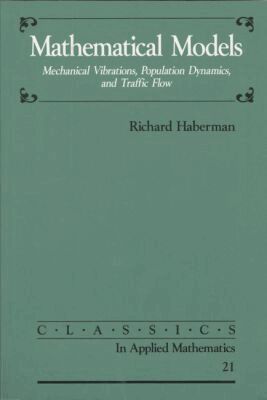
    Mathematical Models

    Mechanical Vibrations, Populations Dynamics, and Traffic Flow

    AvRichard Haberman

    Häftad, Engelska, 1998

    Del i serien Classics in Applied Mathematics

    961 kr

    Beställningsvara. Skickas inom 5-8 vardagar. Fri frakt över 249 kr.

    Beskrivning

    Mathematics is a grand subject in the way it can be applied to various problems in science and engineering. To use mathematics, one needs to understand the physical context. The author uses mathematical techniques along with observations and experiments to give an in-depth look at models for mechanical vibrations, population dynamics, and traffic flow. Equal emphasis is placed on the mathematical formulation of the problem and the interpretation of the results.In the sections on mechanical vibrations and population dynamics, the author emphasizes the nonlinear aspects of ordinary differential equations and develops the concepts of equilibrium solutions and their stability. He introduces phase plane methods for the nonlinear pendulum and for predator-prey and competing species models.Haberman develops the method of characteristics to analyze the nonlinear partial differential equations that describe traffic flow. Fan-shaped characteristics describe the traffic situation that occurs when a traffic light turns green and shock waves describe the effects of a red light or traffic accident.Although it was written over 20 years ago, this book is still relevant. It is intended as an introduction to applied mathematics, but can be used for undergraduate courses in mathematical modeling or nonlinear dynamical systems or to supplement courses in ordinary or partial differential equations.

    Produktinformation

    • Utgivningsdatum:1998-03-31
    • Mått:151 x 228 x 23 mm
    • Vikt:568 g
    • Format:Häftad
    • Språk:Engelska
    • Serie:Classics in Applied Mathematics
    • Antal sidor:419
    • Förlag:Society for Industrial & Applied Mathematics,U.S.
    • ISBN:9780898714081

    Utforska kategorier

    • Tillämpad matematik inom Naturvetenskap och teknik

    Recensioner i media

    'Before courses in math modeling became de rigueur, Richard Haberman had already demonstrated that mathematical techniques could be unusually effective in understanding elementary mechanical vibrations, population dynamics, and traffic flow, as well as how such intriguing applications could motivate the further study of nonlinear ordinary and partial differential equations. My students and I can attest that this carefully crafted book is perfect for both self-study and classroom use.' Robert E. O'Malley, Jr, University of Washington

    Innehållsförteckning

    • ForewordPreface to the Classics EditionPrefacePart 1: Mechanical Vibrations. Introduction to Mathematical Models in the Physical SciencesNewton's LawNewton's Law as Applied to a Spring-Mass SystemGravityOscillation of a Spring-Mass SystemDimensions and UnitsQualitative and Quantitative Behavior of a Spring-Mass SystemInitial Value ProblemA Two-Mass OscillatorFrictionOscillations of a Damped SystemUnderdamped OscillationsOverdamped and Critically Damped OscillationsA PendulumHow Small is Small?A Dimensionless Time VariableNonlinear Frictionless SystemsLinearized Stability Analysis of an Equilibrium SolutionConservation of EnergyEnergy CurvesPhase Plane of a Linear OscillatorPhase Plane of a Nonlinear PendulumCan a Pendulum Stop?What Happens if a Pendulum is Pushed Too Hard?Period of a Nonlinear PendulumNonlinear Oscillations with DampingEquilibrium Positions and Linearized StabilityNonlinear Pendulum with DampingFurther Readings in Mechanical VibrationsPart 2: Population Dynamics--Mathematical Ecology. Introduction to Mathematical Models in BiologyPopulation ModelsA Discrete One-Species ModelConstant Coefficient First-Order Difference EquationsExponential GrowthDiscrete Once-Species Models with an Age DistributionStochastic Birth ProcessesDensity-Dependent GrowthPhase Plane Solution of the Logistic EquationExplicit Solution of the Logistic EquationGrowth Models with Time DelaysLinear Constant Coefficient Difference EquationsDestabilizing Influence of DelaysIntroduction to Two-Species ModelsPhase Plane, Equilibrium, and LinearizationSystem of Two Constant Coefficient First-Order Differential Equations, Stability of Two-Species Equilibrium PopulationsPhase Plane of Linear SystemsPredator-Prey ModelsDerivation of the Lotka-Volterra EquationsQualitative Solution of the Lotka-Volterra EquationsAverage Populations of Predators and PreysMan's Influence on Predator-Prey EcosystemsLimitations of the Lotka-Volterra EquationTwo Competing SpeciesFurther Reading in Mathematical EcologyPart 3: Traffic Flow. Introduction to Traffic FlowAutomobile Velocities and a Velocity FieldTraffic Flow and Traffic DensityFlow Equals Density Times VelocityConservation of the Number of CarsA Velocity-Density RelationshipExperimental ObservationsTraffic FlowSteady-State Car-Following ModelsPartial Differential EquationsLinearizationA Linear Partial Differential EquationTraffic Density WavesAn Interpretation of Traffic WavesA Nearly Uniform Traffic Flow ExampleNonuniform Traffic - The Method of CharacteristicsAfter a Traffic Light Turns GreenA Linear Velocity-Density RelationshipAn ExampleWave Propagation of Automobile Brake LightsCongestion AheadDiscontinuous TrafficUniform Traffic Stopped by a Red LightA Stationary Shock WaveThe Earliest ShockValidity of LinearizationEffect of a Red Light or an AccidentExits and EntrancesConstantly Entering CarsA Highway EntranceFurther Reading in Traffic FlowIndex.