• Fri frakt över 249 kr
  • •
  • Snabba leveranser
  • •
  • Billiga böcker
Kundservice

Du är på sajten för privatpersoner.

Företag, bibliotek eller offentlig verksamhet?

Du handlar på classic.bokus.com, där alla dina funktioner finns intakta.
Till classic.bokus.com
Bokus logotyp. Gå till startsidan.
  • Erbjudanden
  • Student
  • Topplistor
  • Barn & ungdom
  • Bokus Play
  • E-böcker
  • Ljudböcker
  • Pocketböcker
  • Spel och pussel

Pocketfynda! Hundratals böcker för 49 kr/st →

Sidfot

Mina sidor

    Hjälp

    • Kundservice
    • Vanliga frågor och svar
    • Frakt och leverans
    • Retur vid ångerrätt
    • Reklamera vara
    • Betalning
    • Köpvillkor
    • Allmänna villkor
    • Information om webbplatsens tillgänglighet

    Om Bokus

    • Om oss
    • Pressrum
    • För studenter
    • För företag
    • För bibliotek och offentlig verksamhet
    • För leverantörer
    • Hållbarhet

    Populärt

    • Aktuella erbjudanden
    • Presentkort
    • Studentlitteratur
    • Nya böcker
    • Topplistor
    • Signerade böcker
    • Engelska böcker

    Inspiration

    • Boktips
    • BookTok
    • Barnbokskaraktärer
    • Populära författare
    Logotyp för Bokus
    Följ oss på Facebook (extern länk)Följ oss på Instagram (extern länk)Följ oss på YouTube (extern länk)Följ oss på TikTok (extern länk)
    bokus @ CookiesAnpassa cookiesIntegritetspolicyKöpvillkor
    Till Citymail hemsida (extern länk)Till Budbee hemsida (extern länk)Till Postnord hemsida (extern länk)Till Schenker hemsida (extern länk)Till Early Bird hemsida (extern länk)Till Walleys hemsida (extern länk)
    1. Ekonomi och Ledarskap
    2. Företagsekonomi
    3. Affärsstrategi

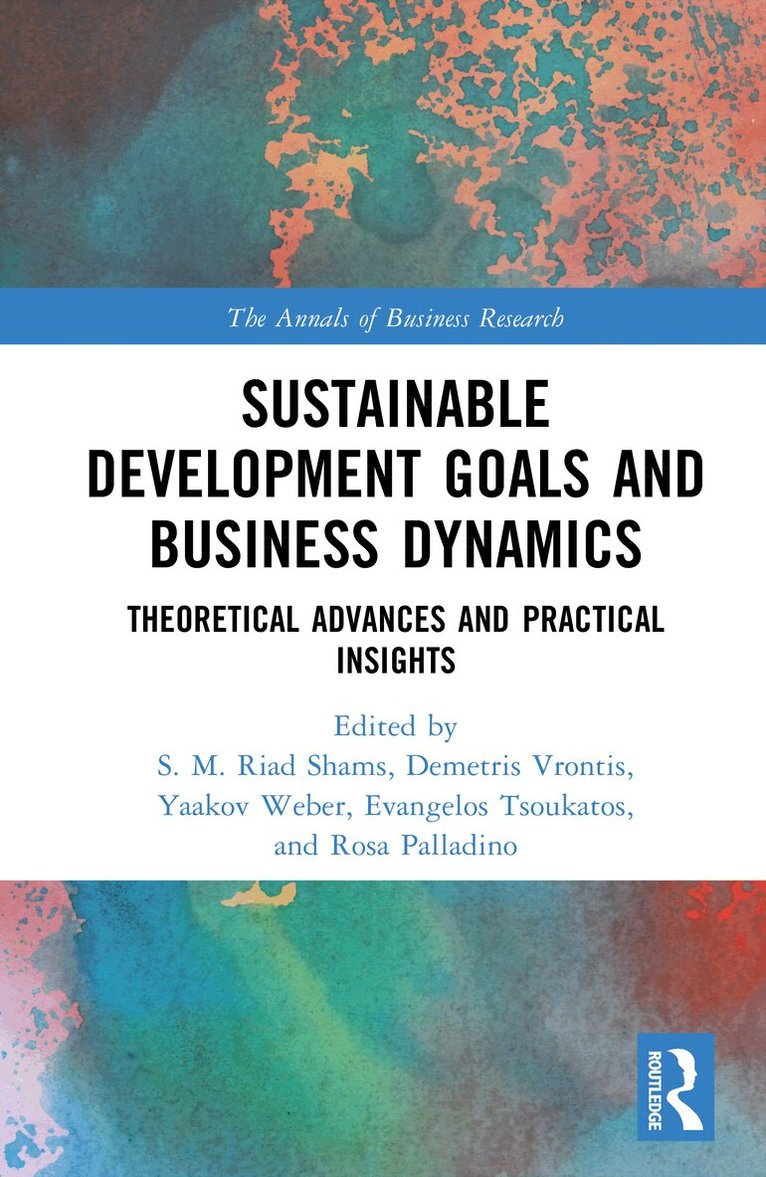
    Sustainable Development Goals and Business Dynamics

    Theoretical Advances and Practical Insights

    AvS. M. Riad Shams,Demetris Vrontis

    Inbunden, Engelska, 2025

    Del i serien Annals of Business Research

    2 481 kr

    Beställningsvara. Skickas inom 10-15 vardagar. Fri frakt över 249 kr.

    Beskrivning

    In recent years, the global socio-economic balance has been disrupted by a series of events: first, the economic crisis, then the pandemic, followed by conflicts both within and outside Europe, and finally the energy crisis. These events have had significant repercussions on the resilience of people and organizations worldwide. In this context, the Sustainable Development Goals (SDGs), adopted as part of the United Nations 2030 Agenda, provide a universal framework for addressing pressing global economic, environmental, and social challenges. They also emphasize the critical role of innovation in developing novel solutions for people, the planet, and prosperity.Business firms are recognized as key drivers in the global pursuit of the SDGs. However, it remains unclear how to strategically allocate resources and set business objectives that align with sustainability requirements. The path to fully achieving the SDGs is still evolving and requires the generation and application of new knowledge, as well as practical, actionable solutions to support the transition to more sustainable practices.This book contributes to our understanding of how business firms can support the achievement of the SDGs, drawing on both theoretical developments and practical insights from emerging areas of business research. Researchers, policymakers, and practitioners will find value in these novel perspectives as they engage with the challenges of achieving the SDGs.

    Produktinformation

    • Utgivningsdatum:2025-12-22
    • Mått:152 x 229 x 19 mm
    • Vikt:630 g
    • Format:Inbunden
    • Språk:Engelska
    • Serie:Annals of Business Research
    • Antal sidor:232
    • Förlag:Taylor & Francis Ltd
    • ISBN:9781032868363

    Utforska kategorier

    • Affärsstrategi inom Ekonomi och Ledarskap
    • Projektledning inom Ekonomi och Ledarskap
    • Organisationsteori inom Ekonomi och Ledarskap

    Mer om författaren

    S. M. Riad Shams is an Assistant Professor in Marketing and PhD Program Leader at Newcastle Business School, Northumbria University.Demetris Vrontis is ranked among the top 2% of the best scientists in the world, according to a list compiled by Stanford University in collaboration with Elsevier and SciTech Strategies. Demetris Vrontis is the Vice Rector for Faculty and Research and a Professor of Strategic Marketing Management at the University of Nicosia, Cyprus.Yaakov Weber teaches courses on Strategic Management, Mergers and Acquisitions Management, Strategic Alliances, Corporate Strategy, Cross-Cultural Management, and Global Strategic Management.Evangelos Tsoukatos is a faculty member at the University of Nicosia, Cyprus, and the Hellenic Open University. He holds a PhD in Management Science from the Lancaster University Management School (LUMS), UK, a BSc in Mathematics from the “Aristotelion” University of Thessaloniki, Greece, and a postgraduate diploma and MSc in Operational Research from LUMS, UK.Rosa Palladino is an Associate Professor of Management at IUL Digital University (Florence). She obtained the national scientific qualification as a full professor.

    Innehållsförteckning

    • 1. Industry 4.0 Business Model for SDG: Integrating Smart Mobility for Sustainable Growth 2. Digital Human Entrepreneurship: Navigating the DARQ+ Technological Revolution 3. Harnessing Knowledge Management insights for SDGs: Lessons learned and future directions 4. Higher Education Sector for Halting Biodiversity Loss: Insights for Achieving SDG15 from Italian Universities 5. Sustainability in the business literature on cultural and creative industries 6. Innovating the Marketing of Packaging in the Agri-Food Industry: An SDG Perspective 7. Global Value Chains and Nascent Enterprises: Evidence from 39 Developing Countries 8. Managing the Alignment of SDGs with Reduction of Carbon Footprints in Port Containerization Logistics 9. The Baltic and Scandinavian approaches to Europe’s green transition strategy implementation 10. SDG 8: Decent Work and Economic Growth - The Role of Financial Inclusion in Business Development 11. The dual side of charities: the “responsible” and the “unwanted” space of doing good