• Fri frakt över 249 kr
  • •
  • Snabba leveranser
  • •
  • Billiga böcker
Kundservice

Du är på sajten för privatpersoner.

Företag, bibliotek eller offentlig verksamhet?

Du handlar på classic.bokus.com, där alla dina funktioner finns intakta.
Till classic.bokus.com
Bokus logotyp. Gå till startsidan.
  • Erbjudanden
  • Student
  • Topplistor
  • Barn & ungdom
  • Bokus Play
  • E-böcker
  • Ljudböcker
  • Pocketböcker
  • Spel & pussel

Upp till 25% på utvalda nyheter →

Sidfot

Mina sidor

    Hjälp

    • Kundservice
    • Vanliga frågor och svar
    • Frakt och leverans
    • Retur vid ångerrätt
    • Reklamera vara
    • Betalning
    • Köpvillkor
    • Allmänna villkor
    • Information om webbplatsens tillgänglighet

    Om Bokus

    • Om oss
    • Pressrum
    • För studenter
    • För företag
    • För bibliotek och offentlig verksamhet
    • För leverantörer
    • Hållbarhet

    Populärt

    • Aktuella erbjudanden
    • Presentkort
    • Studentlitteratur
    • Nya böcker
    • Topplistor
    • Signerade böcker
    • Engelska böcker

    Inspiration

    • Boktips
    • BookTok
    • Populära bokserier
    • Barnbokskaraktärer
    • Populära författare
    Logotyp för Bokus
    Följ oss på Facebook (extern länk)Följ oss på Instagram (extern länk)Följ oss på YouTube (extern länk)Följ oss på TikTok (extern länk)
    bokus @ CookiesAnpassa cookiesIntegritetspolicyKöpvillkor
    Till Citymail hemsida (extern länk)Till Budbee hemsida (extern länk)Till Postnord hemsida (extern länk)Till Schenker hemsida (extern länk)Till Early Bird hemsida (extern länk)Till Walleys hemsida (extern länk)
    1. Ekonomi och Ledarskap
    2. Nationalekonomi
    3. Internationell ekonomi

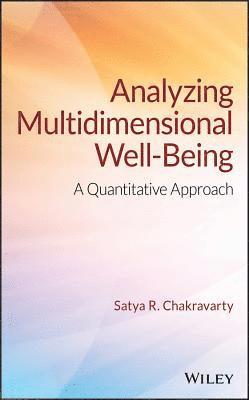
    Analyzing Multidimensional Well-Being

    A Quantitative Approach

    AvSatya R. Chakravarty

    Inbunden, Engelska, 2018

    1 297 kr

    Beställningsvara. Skickas inom 5-8 vardagar. Fri frakt över 249 kr.

    Fler format och utgåvor

    E-bok

    1 518 kr

    E-bok

    1 499 kr

    Beskrivning

    “An indispensable reference for all researchers interested in the measurement of social  welfare. . .”—François Bourguignon, Emeritus Professor at Paris School of Economics, Former Chief Economist of the World Bank.  “. . .a detailed, insightful, and pedagogical presentation of the theoretical grounds of multidimensional well-being, inequality, and poverty measurement. Any student, researcher, and practitioner interested in the multidimensional approach should begin their journey into such a fascinating theme with this wonderful book.”—François Maniquet, Professor, Catholic University of Louvain, Belgium.A Review of the Multidimensional Approaches to the Measurement of Welfare, Inequality, and PovertyAnalyzing Multidimensional Well-Being: A Quantitative Approach offers a comprehensive approach to the measurement of well-being that includes characteristics such as income, health, literacy, and housing. The author presents a systematic comparison of the alternative approaches to the measurement of multidimensional welfare, inequality, poverty, and vulnerability. The text contains real-life applications of some multidimensional aggregations (most of which have been designed by international organizations such as the United NationsDevelopment Program and the Organization for Economic Co-operation and Development) that help to judge the performance of a country in the various dimensions of well-being.The text offers an evaluation of how well a society is doing with respect to achievements of all the individuals in the dimensions considered and clearly investigates how achievements in the dimensions can be evaluated from different perspectives. The author includes a detailed scrutiny of alternative techniques for setting weights to individual dimensional metrics and offers an extensive analysis into both the descriptive and welfare theoretical approaches to the concerned multi-attribute measurement and related issues. This important resource:• Contains a synthesis of multidimensional welfare, inequality, poverty, and vulnerability analysis• Examines aggregations of achievement levels in the concerned dimensions of well-being from various standpoints• Shows how to measure poverty using panel data instead of restricting attention to a single period and when we have imprecise information on dimensional achievements• Argues that multidimensional analysis is intrinsically different from marginal distributions-based analysisWritten for students, teachers, researchers, and scholars, Analyzing Multidimensional Well-Being: A Quantitative Approach puts the focus on various approaches to the measurementof the many aspects of well-being and quality of life.Satya R. Chakravarty is a Professor of Economics at the Indian Statistical Institute, Kolkata, India. He is an Editor of Social Choice and Welfare and a member of the Editorial Board of Journal of Economic Inequality.

    Produktinformation

    • Utgivningsdatum:2018-01-12
    • Mått:158 x 231 x 23 mm
    • Vikt:590 g
    • Format:Inbunden
    • Språk:Engelska
    • Antal sidor:336
    • Förlag:John Wiley & Sons Inc
    • ISBN:9781119256908

    Utforska kategorier

    • Internationell ekonomi inom Ekonomi och Ledarskap
    • Socialt arbete och välfärd inom Samhälle och politik

    Mer om författaren

    Satya R. Chakravarty is a Professor of Economics at the Indian Statistical Institute, Kolkata, India. He is an Editor of Social Choice and Welfare and a member of the Editorial Board of Journal of Economic Inequality.

    Innehållsförteckning

    • Preface xiEndorsements xv1 Well-Being as a Multidimensional Phenomenon 11.1 Introduction 11.2 Income as a Dimension ofWell-Being and Some Related Aggregations 41.3 Scales of Measurement: A Brief Exposition 101.4 Preliminaries for MultidimensionalWelfare Analysis 111.5 The Dashboard Approach andWeights on DimensionalMetrics in a Composite Index 141.6 MultidimensionalWelfare Function Axioms 171.6.1 Invariance Axioms 171.6.2 Distributional Axioms 191.7 MultidimensionalWelfare Functions 271.8 Concluding Remarks 37References 382 An Overview of Multidimensional Economic Inequality 492.1 Introduction 492.2 A Review of One-DimensionalMeasurement 512.2.1 Normative One-Dimensional Inequality Indices 512.2.2 Subgroup-Decomposable Indices of Inequality 532.3 Multidimensional Inequality Indices 562.3.1 The Direct Approach 562.3.1.1 Axioms for a Multidimensional Inequality Index 562.3.1.2 Examples of Indices 602.3.2 The Inclusive Measure ofWell-being Approach 692.4 Concluding Remarks 77References 783 A Synthesis of Multidimensional Poverty 853.1 Introduction 853.2 A Brief Review of One-Dimensional Analysis 893.3 Preliminaries for Multidimensional Poverty Analysis 933.4 Identification of the Poor and Deprivation Counting 953.5 Axioms for a Multidimensional Poverty Metric 993.5.1 Invariance Axioms 1003.5.2 Distributional Axioms 1033.5.3 Decomposability Axioms 1083.5.4 Threshold Limit Sensitivity Axiom 1113.5.5 Technical Axioms 1123.6 Multidimensional Poverty Measurement 1133.6.1 The Dashboard Approach 1133.6.2 The Direct Approach 1173.6.3 The Inclusive Measure ofWell-being Approach 1233.7 Multidimensional Poverty Orderings 1253.7.1 A Brief Outline of One-Dimensional Orderings 1263.7.2 Multidimensional Orderings 1293.8 Dimensions ofWell-Being with Ordinal Significance and Multidimensional Poverty 1313.9 Orderings Based on Deprivations Counts 1343.10 Multidimensional Material Deprivation 1383.11 Concluding Remarks 142References 1434 Fuzzy Set Approaches to the Measurement of Multidimensional Poverty 1634.1 Introduction 1634.2 Fuzzy Membership Function 1654.3 Axioms for a Fuzzy Multidimensional Poverty Index 1734.3.1 Invariance Axioms 1754.3.1.1 Fuzzy Strong Ratio Scale Invariance 1754.3.1.2 Fuzzy Strong Translation Scale Invariance 1774.3.1.3 FuzzyWeak Focus 1774.3.1.4 Fuzzy Strong Focus 1784.3.1.5 Fuzzy Symmetry 1784.3.1.6 Fuzzy Population Replication Invariance 1794.3.2 Distributional Axioms 1794.3.2.1 Fuzzy Monotonicity 1794.3.2.2 Fuzzy Monotonicity Sensitivity 1804.3.2.3 Fuzzy DimensionalMonotonicity 1814.3.2.4 Fuzzy Transfer 1824.3.2.5 Increasing Fuzzy Poverty under Correlation-Increasing Switch 1844.3.3 Decomposability Axioms 1854.3.3.1 Fuzzy Subgroup Decomposability 1854.3.3.2 Fuzzy Factor Decomposability 1854.3.4 Fuzzy Sensitivity Axiom 1864.3.4.1 Increasing Fuzzy Poverty for Increased Membership Function 1864.3.5 Technical Axioms 1874.3.5.1 Fuzzy Boundedness 1874.3.5.2 Fuzzy Continuity 1874.4 Fuzzy Multidimensional Poverty Indices 1874.5 Fuzzy Poverty Orderings 1914.6 Concluding Remarks 195References 1955 Poverty and Time: A Multidimensional Appraisal 2015.1 Introduction 2015.2 Preliminaries 2075.3 The Block Approach 2085.3.1 IndividualMultidimensional Intertemporal Poverty Index 2085.3.2 Aggregate Multidimensional Intertemporal Poverty Index 2185.3.3 A Review of Some Related One-Dimensional Proposals 2205.4 An Exploration of the Counting Approaches to MultidimensionalIntertemporal Deprivations 2265.5 The Multidimensional Duration Approach 2295.5.1 A Review of One-Dimensional Duration-Reliant Offers 2295.5.2 Axioms for a Chronic Multidimensional Poverty Quantifier 2315.5.3 The Bourguignon–Chakravarty Approach to Chronic Multidimensional Poverty Measurement 2405.6 Intertemporal Poverty Orderings 2435.7 Concluding Remarks 245References 2466 Vulnerability to Poverty: A Multidimensional Evaluation 2516.1 Introduction 2516.2 A Review of One-DimensionalMeasurement 2546.3 Multidimensional Representation of Vulnerability to Poverty: An Axiomatic Investigation 2626.4 Concluding Remarks 269References 2717 An Exploration of Some Composite and Individualistic Indices 2777.1 Introduction 2777.2 Human Development Index 2787.3 Human Poverty Index 2847.4 Gender Inequality Index 2867.5 Better Life Index 2887.6 Active Citizenship Composite Index 2917.7 Measuring Human Opportunity: A Counting Approach 2937.8 Assessment of Progress toward Achievements in Millennium Development Goals 2957.9 Air Quality Index 3017.10 Concluding Remarks 303References 304Index 311