• Fri frakt över 249 kr
  • •
  • Snabba leveranser
  • •
  • Billiga böcker
Kundservice

Du är på sajten för privatpersoner.

Företag, bibliotek eller offentlig verksamhet?

Du handlar på classic.bokus.com, där alla dina funktioner finns intakta.
Till classic.bokus.com
Bokus logotyp. Gå till startsidan.
  • Erbjudanden
  • Student
  • Topplistor
  • Barn & ungdom
  • Bokus Play
  • E-böcker
  • Ljudböcker
  • Pocketböcker
  • Spel och pussel

5% studentrabatt – använd koden KURSBOK27 →

Sidfot

Mina sidor

    Hjälp

    • Kundservice
    • Vanliga frågor och svar
    • Frakt och leverans
    • Retur vid ångerrätt
    • Reklamera vara
    • Betalning
    • Köpvillkor
    • Allmänna villkor
    • Information om webbplatsens tillgänglighet

    Om Bokus

    • Om oss
    • Pressrum
    • För studenter
    • För företag
    • För bibliotek och offentlig verksamhet
    • För leverantörer
    • Hållbarhet

    Populärt

    • Aktuella erbjudanden
    • Presentkort
    • Studentlitteratur
    • Nya böcker
    • Topplistor
    • Signerade böcker
    • Engelska böcker

    Inspiration

    • Boktips
    • BookTok
    • Barnbokskaraktärer
    • Populära författare
    Logotyp för Bokus
    Följ oss på Facebook (extern länk)Följ oss på Instagram (extern länk)Följ oss på YouTube (extern länk)Följ oss på TikTok (extern länk)
    bokus @ CookiesAnpassa cookiesIntegritetspolicyKöpvillkor
    Till Citymail hemsida (extern länk)Till Budbee hemsida (extern länk)Till Postnord hemsida (extern länk)Till Schenker hemsida (extern länk)Till Early Bird hemsida (extern länk)Till Walleys hemsida (extern länk)
    1. Naturvetenskap och teknik
    2. Matematik och naturvetenskap
    3. Matematik

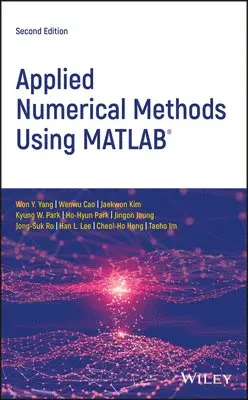
    Applied Numerical Methods Using MATLAB

    AvWon Y. Yang,Wenwu Cao

    Inbunden, Engelska, 2020

    1 792 kr

    Beställningsvara. Skickas inom 5-8 vardagar. Fri frakt över 249 kr.

    Beskrivning

    This new edition provides an updated approach for students, engineers, and researchers to apply numerical methods for solving problems using MATLAB®This accessible book makes use of MATLAB® software to teach the fundamental concepts for applying numerical methods to solve practical engineering and/or science problems. It presents programs in a complete form so that readers can run them instantly with no programming skill, allowing them to focus on understanding the mathematical manipulation process and making interpretations of the results.Applied Numerical Methods Using MATLAB®, Second Edition begins with an introduction to MATLAB usage and computational errors, covering everything from input/output of data, to various kinds of computing errors, and on to parameter sharing and passing, and more. The system of linear equations is covered next, followed by a chapter on the interpolation by Lagrange polynomial. The next sections look at interpolation and curve fitting, nonlinear equations, numerical differentiation/integration, ordinary differential equations, and optimization. Numerous methods such as the Simpson, Euler, Heun, Runge-kutta, Golden Search, Nelder-Mead, and more are all covered in those chapters. The eighth chapter provides readers with matrices and Eigenvalues and Eigenvectors. The book finishes with a complete overview of differential equations. Provides examples and problems of solving electronic circuits and neural networksIncludes new sections on adaptive filters, recursive least-squares estimation, Bairstow's method for a polynomial equation, and moreExplains Mixed Integer Linear Programing (MILP) and DOA (Direction of Arrival) estimation with eigenvectorsAimed at students who do not like and/or do not have time to derive and prove mathematical resultsApplied Numerical Methods Using MATLAB®, Second Edition is an excellent text for students who wish to develop their problem-solving capability without being involved in details about the MATLAB codes. It will also be useful to those who want to delve deeper into understanding underlying algorithms and equations.

    Produktinformation

    • Utgivningsdatum:2020-04-28
    • Mått:10 x 10 x 10 mm
    • Vikt:454 g
    • Format:Inbunden
    • Språk:Engelska
    • Antal sidor:656
    • Upplaga:2
    • Förlag:John Wiley & Sons Inc
    • ISBN:9781119626800

    Utforska kategorier

    • Matematik inom Naturvetenskap och teknik

    Mer om författaren

    Won Y. Yang, PhD, is a Professor in the Department of Electrical Engineering at Chung-Ang University in Seoul, Korea. Wenwu Cao, PhD, is a Professor in the Department of Materials Science and Engineering at Penn State University in University Park, Pennsylvania. Jaekwon Kim, PhD, is a Professor in the Department of Electrical Engineering at Yongsei University in Wonju, Korea. Kyung W. Park, PhD, is a Professor in the Department of Electrical Engineering at Yonsei University, Wonju, Korea. Ho-Hyun Park, PhD, is a Professor in the School of Electrical and Electronics Engineering at Chung-Ang University in Seoul, Korea. Jingon Joung, PhD, is a Professor in the Department of Electrical Engineering at Chung-Ang University in Seoul, Korea. Jong-Suk Ro is Creative Research Engineer Development at Brain Korea 21 Plus, Seoul National University in Seoul, Korea. Han L. Lee, PhD, is a Professor in the Department of Electrical Engineering at Chung-Ang University in Seoul, Korea. Cheol-Ho Hong is Assistant Professor in the School of Electrical and Electronics Engineering at Chung-Ang University in Seoul, Korea. Taeho Im, PhD, is a Professor in Oceanic IT Engineering at Hoseo University in Asan, Korea.

    Innehållsförteckning

    • Preface xvAcknowledgments xviiAbout the Companion Website xix1 MATLAB Usage and Computational Errors 11.1 Basic Operations of MATLAB 21.1.1 Input/Output of Data from MATLAB Command Window 31.1.2 Input/Output of Data Through Files 31.1.3 Input/Output of Data Using Keyboard 51.1.4 Two-Dimensional (2D) Graphic Input/Output 61.1.5 Three Dimensional (3D) Graphic Output 121.1.6 Mathematical Functions 131.1.7 Operations on Vectors and Matrices 161.1.8 Random Number Generators 251.1.9 Flow Control 271.2 Computer Errors vs. Human Mistakes 311.2.1 IEEE 64-bit Floating-Point Number Representation 311.2.2 Various Kinds of Computing Errors 351.2.3 Absolute/Relative Computing Errors 371.2.4 Error Propagation 381.2.5 Tips for Avoiding Large Errors 391.3 Toward Good Program 421.3.1 Nested Computing for Computational Efficiency 421.3.2 Vector Operation vs. Loop Iteration 431.3.3 Iterative Routine vs. Recursive Routine 451.3.4 To Avoid Runtime Error 451.3.5 Parameter Sharing via GLOBAL Variables 491.3.6 Parameter Passing Through VARARGIN 501.3.7 Adaptive Input Argument List 51Problems 522 System of Linear Equations 772.1 Solution for a System of Linear Equations 782.1.1 The Nonsingular Case (M = N) 782.1.2 The Underdetermined Case (M < N): Minimum-norm Solution 792.1.3 The Overdetermined Case (M > N): Least-squares Error Solution 822.1.4 Recursive Least-Squares Estimation (RLSE) 832.2 Solving a System of Linear Equations 862.2.1 Gauss(ian) Elimination 862.2.2 Partial Pivoting 882.2.3 Gauss-Jordan Elimination 972.3 Inverse Matrix 1002.4 Decomposition (Factorization) 1002.4.1 LU Decomposition (Factorization) – Triangularization 1002.4.2 Other Decomposition (Factorization) – Cholesky, QR and SVD 1052.5 Iterative Methods to Solve Equations 1082.5.1 Jacobi Iteration 1082.5.2 Gauss-Seidel Iteration 1112.5.3 The Convergence of Jacobi and Gauss-Seidel Iterations 115Problems 1173 Interpolation and Curve Fitting 1293.1 Interpolation by Lagrange Polynomial 1303.2 Interpolation by Newton Polynomial 1323.3 Approximation by Chebyshev Polynomial 1373.4 Pade Approximation by Rational Function 1423.5 Interpolation by Cubic Spline 1463.6 Hermite Interpolating Polynomial 1533.7 Two-Dimensional Interpolation 1553.8 Curve Fitting 1583.8.1 Straight-Line Fit – A Polynomial Function of Degree 1 1583.8.2 Polynomial Curve Fit – A Polynomial Function of Higher Degree 1603.8.3 Exponential Curve Fit and Other Functions 1653.9 Fourier Transform 1663.9.1 FFT vs. DFT 1673.9.2 Physical Meaning of DFT 1693.9.3 Interpolation by Using DFS 172Problems 1754 Nonlinear Equations 1974.1 Iterative Method toward Fixed Point 1974.2 Bisection Method 2014.3 False Position or Regula Falsi Method 2034.4 Newton(-Raphson) Method 2054.5 Secant Method 2084.6 Newton Method for a System of Nonlinear Equations 2094.7 Bairstow’s Method for a Polynomial Equation 2124.8 Symbolic Solution for Equations 2154.9 Real-World Problems 216Problems 2235 Numerical Differentiation/Integration 2455.1 Difference Approximation for the First Derivative 2465.2 Approximation Error of the First Derivative 2485.3 Difference Approximation for Second and Higher Derivative 2535.4 Interpolating Polynomial and Numerical Differential 2585.5 Numerical Integration and Quadrature 2595.6 Trapezoidal Method and Simpson Method 2635.7 Recursive Rule and Romberg Integration 2655.8 Adaptive Quadrature 2685.9 Gauss Quadrature 2725.9.1 Gauss-Legendre Integration 2725.9.2 Gauss-Hermite Integration 2755.9.3 Gauss-Laguerre Integration 2775.9.4 Gauss-Chebyshev Integration 2775.10 Double Integral 2785.11 Integration Involving PWL Function 281Problems 2856 Ordinary Differential Equations 3056.1 Euler’s Method 3066.2 Heun’s Method – Trapezoidal Method 3096.3 Runge-Kutta Method 3106.4 Predictor-Corrector Method 3126.4.1 Adams-Bashforth-Moulton Method 3126.4.2 Hamming Method 3166.4.3 Comparison of Methods 3176.5 Vector Differential Equations 3206.5.1 State Equation 3206.5.2 Discretization of LTI State Equation 3246.5.3 High-order Differential Equation to State Equation 3276.5.4 Stiff Equation 3286.6 Boundary Value Problem (BVP) 3336.6.1 Shooting Method 3336.6.2 Finite Difference Method 336Problems 3417 Optimization 3757.1 Unconstrained Optimization 3767.1.1 Golden Search Method 3767.1.2 Quadratic Approximation Method 3787.1.3 Nelder-Mead Method 3807.1.4 Steepest Descent Method 3837.1.5 Newton Method 3857.1.6 Conjugate Gradient Method 3877.1.7 Simulated Annealing 3897.1.8 Genetic Algorithm 3937.2 Constrained Optimization 3997.2.1 Lagrange Multiplier Method 3997.2.2 Penalty Function Method 4067.3 MATLAB Built-In Functions for Optimization 4097.3.1 Unconstrained Optimization 4097.3.2 Constrained Optimization 4137.3.3 Linear Programming (LP) 4167.3.4 Mixed Integer Linear Programming (MILP) 4237.4 Neural Network[K-1] 4337.5 Adaptive Filter[Y-3] 4397.6 Recursive Least Square Estimation (RLSE)[Y-3] 443Problems 4488 Matrices and Eigenvalues 4678.1 Eigenvalues and Eigenvectors 4688.2 Similarity Transformation and Diagonalization 4698.3 Power Method 4758.3.1 Scaled Power Method 4758.3.2 Inverse Power Method 4768.3.3 Shifted Inverse Power Method 4778.4 Jacobi Method 4788.5 Gram-Schmidt Orthonormalization and QR Decomposition 4818.6 Physical Meaning of Eigenvalues/Eigenvectors 4858.7 Differential Equations with Eigenvectors 4898.8 DoA Estimation with Eigenvectors[Y-3] 493Problems 4999 Partial Differential Equations 5099.1 Elliptic PDE 5109.2 Parabolic PDE 5159.2.1 The Explicit Forward Euler Method 5159.2.2 The Implicit Backward Euler Method 5169.2.3 The Crank-Nicholson Method 5189.2.4 Using the MATLAB function ‘pdepe()’ 5209.2.5 Two-Dimensional Parabolic PDEs 5239.3 Hyperbolic PDES 5269.3.1 The Explicit Central Difference Method 5269.3.2 Two-Dimensional Hyperbolic PDEs 5299.4 Finite Element Method (FEM) for Solving PDE 5329.5 GUI of MATLAB for Solving PDES – PDE tool 5439.5.1 Basic PDEs Solvable by PDEtool 5439.5.2 The Usage of PDEtool 5459.5.3 Examples of Using PDEtool to Solve PDEs 549Problems 559Appendix A Mean Value Theorem 575Appendix B Matrix Operations/Properties 577B.1 Addition and Subtraction 578B.2 Multiplication 578B.3 Determinant 578B.4 Eigenvalues and Eigenvectors of a Matrix 579B.5 Inverse Matrix 580B.6 Symmetric/Hermitian Matrix 580B.7 Orthogonal/Unitary Matrix 581B.8 Permutation Matrix 581B.9 Rank 581B.10 Row Space and Null Space 581B.11 Row Echelon Form 582B.12 Positive Definiteness 582B.13 Scalar (Dot) Product and Vector (Cross) Product 583B.14 Matrix Inversion Lemma 584Appendix C Differentiation W.R.T. A Vector 585Appendix D Laplace Transform 587Appendix E Fourier Transform 589Appendix F Useful Formulas 591Appendix G Symbolic Computation 595G.1 How to Declare Symbolic Variables and Handle Symbolic Expressions 595G.2 Calculus 597G.2.1 Symbolic Summation 597G.2.2 Limits 597G.2.3 Differentiation 598G.2.4 Integration 598G.2.5 Taylor Series Expansion 599G.3 Linear Algebra 600G.4 Solving Algebraic Equations 601G.5 Solving Differential Equations 601Appendix H Sparse Matrices 603Appendix I MATLAB 605References 611Index 613Index for MATLAB Functions 619Index for Tables 629