• Fri frakt över 249 kr
  • •
  • Snabba leveranser
  • •
  • Billiga böcker
Kundservice

Du är på sajten för privatpersoner.

Företag, bibliotek eller offentlig verksamhet?

Du handlar på classic.bokus.com, där alla dina funktioner finns intakta.
Till classic.bokus.com
Bokus logotyp. Gå till startsidan.
  • Erbjudanden
  • Student
  • Topplistor
  • Barn & ungdom
  • Bokus Play
  • E-böcker
  • Ljudböcker
  • Pocketböcker
  • Spel & pussel

Upp till 25% på utvalda nyheter →

Sidfot

Mina sidor

    Hjälp

    • Kundservice
    • Vanliga frågor och svar
    • Frakt och leverans
    • Retur vid ångerrätt
    • Reklamera vara
    • Betalning
    • Köpvillkor
    • Allmänna villkor
    • Information om webbplatsens tillgänglighet

    Om Bokus

    • Om oss
    • Pressrum
    • För studenter
    • För företag
    • För bibliotek och offentlig verksamhet
    • För leverantörer
    • Hållbarhet

    Populärt

    • Aktuella erbjudanden
    • Presentkort
    • Studentlitteratur
    • Nya böcker
    • Topplistor
    • Signerade böcker
    • Engelska böcker

    Inspiration

    • Boktips
    • BookTok
    • Populära bokserier
    • Barnbokskaraktärer
    • Populära författare
    Logotyp för Bokus
    Följ oss på Facebook (extern länk)Följ oss på Instagram (extern länk)Följ oss på YouTube (extern länk)Följ oss på TikTok (extern länk)
    bokus @ CookiesAnpassa cookiesIntegritetspolicyKöpvillkor
    Till Citymail hemsida (extern länk)Till Budbee hemsida (extern länk)Till Postnord hemsida (extern länk)Till Schenker hemsida (extern länk)Till Early Bird hemsida (extern länk)Till Walleys hemsida (extern länk)
    1. Psykologi och pedagogik
    2. Pedagogik

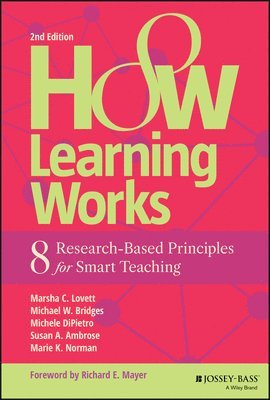
    How Learning Works

    Eight Research-Based Principles for Smart Teaching

    AvMarsha C. Lovett,Michael W. Bridges

    Inbunden, Engelska, 2023

    488 kr

    Skickas . Fri frakt över 249 kr.

    Beskrivning

    Apply these eight learning principles for more effective teaching As educators in the ever-evolving landscape of higher education, we are continuously challenged to keep our courses effective, engaging, relevant, and inclusive. The updated and expanded second edition of How Learning Works can help! It incorporates the latest research, provides a wider range of strategies, and adds a new principle to your toolkit. Readers will find eight essential learning principles that distill the overwhelming research literature into: Real-world teaching and learning scenariosExamples that reflect a diverse set of teaching environments and learner populations150 practical strategies you can apply to your teaching contextWith these practical, broadly applicable insights, you can: Understand why your successful teaching approaches workSolve common teaching and learning problemsAdapt your teaching to new modalities (e.g., online, hybrid) and challengesGround your innovations in evidence-based practiceBased on research from cognitive psychology, developmental psychology, education, anthropology, and more—this book makes learning work…for you and your students.

    Produktinformation

    • Utgivningsdatum:2023-03-14
    • Mått:158 x 231 x 33 mm
    • Vikt:567 g
    • Format:Inbunden
    • Språk:Engelska
    • Antal sidor:336
    • Upplaga:2
    • Förlag:John Wiley & Sons Inc
    • ISBN:9781119861690

    Utforska kategorier

    • Pedagogik inom Psykologi och pedagogik

    Mer om författaren

    Marsha C. Lovett, PhD, is Vice Provost for Teaching and Learning Innovation and a Teaching Professor of Psychology at Carnegie Mellon University. Michael W. Bridges, PhD, is Executive Director of the University Center for Teaching and Learning at the University of Pittsburgh. Michele DiPietro, PhD, is Executive Director of the Center for Excellence in Teaching and Learning and a Professor in the School of Data Science and Analytics at Kennesaw State University. Susan A. Ambrose, DA, is retired from Northeastern University, where she was Senior Vice Chancellor for Educational Innovation and a Professor of Education and History. Marie K. Norman, PhD, is Director of the Innovative Design for Education and Assessment (IDEA) Lab and Associate Professor of Medicine and Clinical and Translational Science at the University of Pittsburgh.

    Innehållsförteckning

    • List of Figures, Tables, and Exhibits xiForeword to the First Edition: Applying the Science of Learning to College TeachingRichard E. Mayer xiiiAcknowledgments xviiAbout the Authors xixPreface to the Second Edition xxiiiIntroduction Bridging Learning Research and Teaching Practice 11 Why Do Students’ Identities and Stages of Development Matter for Learning? 92 How Does Students’ Prior Knowledge Affect Their Learning? 393 How Does the Way Students Organize Knowledge Affect Their Learning? 644 What Factors Motivate Students to Learn? 845 How Do Students Develop Mastery? 1066 What Kinds of Practice and Feedback Enhance Learning? 1307 Why Does Course Climate Matter for Student Learning? 1628 How Do Students Become Self- Directed Learners? 187Conclusion Applying the Eight Principles to Ourselves 212Appendices Appendix A What Are Instructor Self- Assessments/Reflections and How Can We Use Them? 219Appendix B What Are Ground Rules and How Can We Use Them? 223Appendix C What Are Student Self- Assessments and How Can We Use Them? 226Appendix D What Are Concept Maps and How Can We Use Them? 229Appendix E What Are Rubrics and How Can We Use Them? 232Appendix F What Are Learner Checklists and How Can We Use Them? 242Appendix G What Are Learning Objectives and How Can We Use Them? 244Appendix H What Are Active Learning Strategies and How Can We Use Them? 247Appendix I What Are Reader Responses/Peer Reviews and How Can We Use Them? 250Appendix J What Are Exam Wrappers and How Can We Use Them? 252References 255Name Index 287Subject Index 299