Beställningsvara. Skickas inom 10-15 vardagar. Fri frakt över 249 kr.
Beskrivning
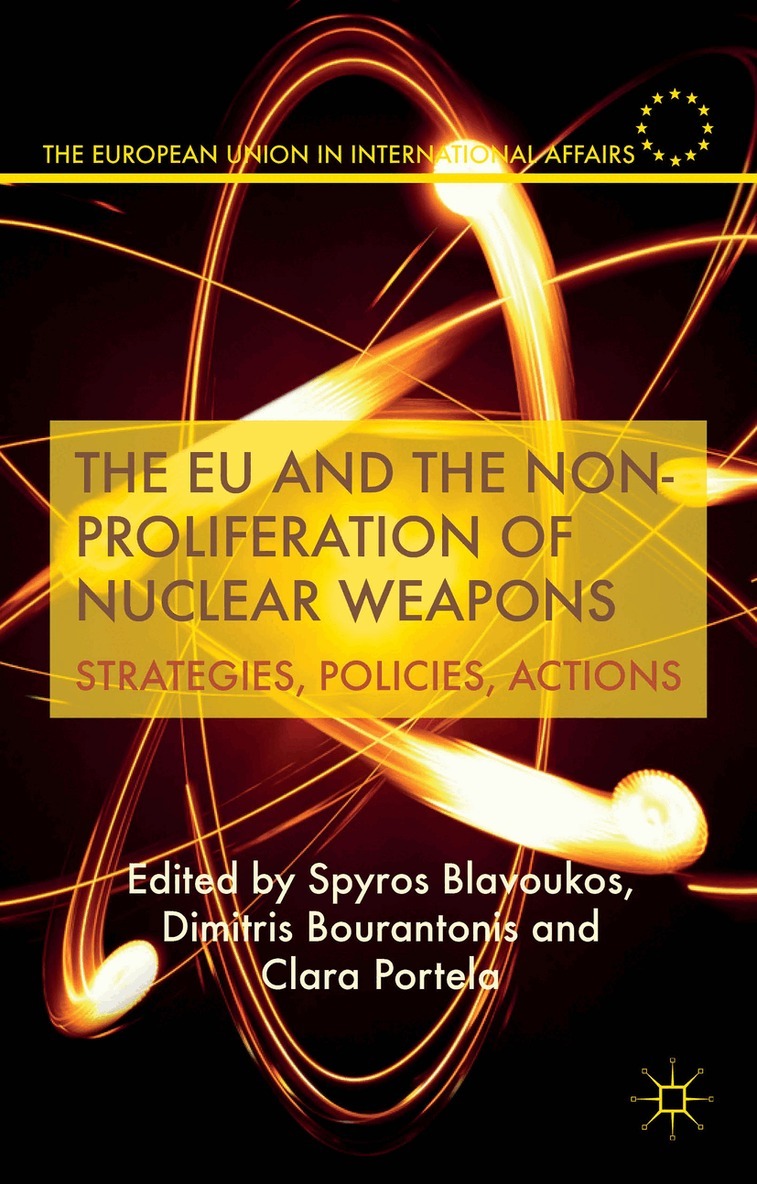
Much of the literature on the emerging role of the EU as a non-proliferation actor has only a minimal engagement with theory. This collection aims to rectify this by placing the role of the EU in the non-proliferation of nuclear weapons within an analytical framework inspired by emerging literature on the performance of international organisations.
Spyros Blavoukos, Athens University of Economics and Business, Greece Dimitris Bourantonis, Athens University of Economics and Business, Greece.Megan Dee, University of Warwick, UK Lina Grip, Stockholm International Peace Research Institute (SIPRI), SwedenBenjamin Kienzle, King's College London, UK Erik Lundin, Stockholm International Peace Research Institute (SIPRI), SwedenOliver Meier, German Institute for International and Security Affairs (SWP), GermanyClara Portela, Singapore Management UniversityGerrard Quille, European Parliament, BelgiumJim Sperling, University of Akron, USAKamil Zwolski, University of Southampton, UK
Recensioner i media
'The editors have brought together, in an admirably cohesive fashion, a group of well-known scholars and practitioners, providing fresh and unique insights into the EU's policy on nuclear proliferation, and offering a nuanced and effective analysis of its strengths and limitations. Students and policy practitioners alike will find this book invaluable for understanding the EU's role in the prevention of nuclear proliferation.' - Emil J. Kirchner, Jean Monnet Chair in European Political Integration , Department of Government, University of Essex, UK 'This book provides an extraordinarily rich discussion on the EU's decisive contribution to the strengthening of the nuclear non-proliferation regime [on the occasion of the first 'EU Strategy against the Proliferation of WMD' adoption in 2003]. This comprehensive study applies performance theory to evaluate the role of the EU in the field taking into account not only the achievement of set objectives, but also intra-organizational processes. The book thus constitutes a fresh approach to the study of this issue.' - Vicente Garrido Rebolledo, Member of the UN Secretary-General's Advisory Board on Disarmament Matters (2014-2017) and Professor of International Relations and Security Studies, King Juan Carlos University, Madrid, Spain
Innehållsförteckning
PART I INTRODUCTION AND ANALYTICAL FRAMEWORK 1. Introduction; Clara Portela, Spyros Blavoukos and Dimitris Bourantonis 2. Capturing the EU International Performance: An Analytical Framework; Spyros Blavoukos PART II: THE EU NUCLEAR NON-PROLIFERATION POLICY: BACKGROUND AND EVOLUTION 3. The International Nuclear Non-Proliferation Policy Framework under the NPT and Related Instruments; Dimitris Bourantonis 4. European Union Non-Proliferation Policies Before and After the 2003 Strategy: Continuity and Change; Clara Portela and Benjamin Kienzle 5. A Practitioner's View: The EU Strategy on Non-Proliferation and Disarmament; Gerrard Quille PART III: EU MULTILATERIAL INTERACTIONS 6. The European Union and its Performance in the NPT Negotiations: Consistency, Change and Challenges; Megan Dee 7. The Role of the EU in Controlling Sensitive Nuclear Technologies; Oliver Meier 8. The Performance of the EU in External Nuclear Non-Proliferation Assistance; Lina Grip 9. The EU, the IAEA and the Comprehensive Approach; Lars-Erik Lundin PART IV: EU BILATERAL INTERACTIONS AND GOVERNANCE 10. The US-EU Management of Nuclear Proliferation in the 21st Century: How Strategic a Strategic Partnership?; James Sperling 11. EU Strategies to Tackle the Iranian and North Korean Nuclear Issues; Clara Portela 12. Institutions and Epistemic Networks in the EU's Non-Proliferation Governance; Kamil Zwolski PART V: CONCLUSIONS 13 Assessing the EU Performance; Spyros Blavoukos, Dimitris Bourantonis and Clara Portela