• Fri frakt över 249 kr
  • •
  • Snabba leveranser
  • •
  • Billiga böcker
Kundservice

Du är på sajten för privatpersoner.

Företag, bibliotek eller offentlig verksamhet?

Du handlar på classic.bokus.com, där alla dina funktioner finns intakta.
Till classic.bokus.com
Bokus logotyp. Gå till startsidan.
  • Erbjudanden
  • Student
  • Topplistor
  • Barn & ungdom
  • Bokus Play
  • E-böcker
  • Ljudböcker
  • Pocketböcker
  • Spel och pussel

Pocketfynda! Hundratals böcker för 49 kr/st →

Sidfot

Mina sidor

    Hjälp

    • Kundservice
    • Vanliga frågor och svar
    • Frakt och leverans
    • Retur vid ångerrätt
    • Reklamera vara
    • Betalning
    • Köpvillkor
    • Allmänna villkor
    • Information om webbplatsens tillgänglighet

    Om Bokus

    • Om oss
    • Pressrum
    • För studenter
    • För företag
    • För bibliotek och offentlig verksamhet
    • För leverantörer
    • Hållbarhet

    Populärt

    • Aktuella erbjudanden
    • Presentkort
    • Studentlitteratur
    • Nya böcker
    • Topplistor
    • Signerade böcker
    • Engelska böcker

    Inspiration

    • Boktips
    • BookTok
    • Barnbokskaraktärer
    • Populära författare
    Logotyp för Bokus
    Följ oss på Facebook (extern länk)Följ oss på Instagram (extern länk)Följ oss på YouTube (extern länk)Följ oss på TikTok (extern länk)
    bokus @ CookiesAnpassa cookiesIntegritetspolicyKöpvillkor
    Till Citymail hemsida (extern länk)Till Budbee hemsida (extern länk)Till Postnord hemsida (extern länk)Till Schenker hemsida (extern länk)Till Early Bird hemsida (extern länk)Till Walleys hemsida (extern länk)
    1. Psykologi och pedagogik
    2. Psykologi

    Making Sense

    What It Means to Understand

    AvDavid R. Olson

    Inbunden, Engelska, 2022

    1 206 kr

    Beställningsvara. Skickas inom 7-10 vardagar. Fri frakt över 249 kr.

    Fler format och utgåvor

    Häftad

    320 kr

    E-bok

    368 kr

    E-bok

    368 kr

    Beskrivning

    Understanding, as Descartes, Locke and Kant all insisted, is the primary 'faculty' of the mind; yet our modern sciences have been slow to advance a clear and testable account of what it means to understand, of children's acquisition of this concept and, in particular, how children come to ascribe understanding to themselves and others. By drawing together developmental and philosophical theories, this book provides a systematic account of children's concept of understanding and places understanding at the heart of children's 'theory of mind'. Children's subjective awareness of their own minds, of what they think, depends on learning a language for ascribing mental states to themselves and others. This book will appeal to researchers in developmental psychology, cognitive science, education and philosophy who are interested in the cognitive and emotional development of children and in the more basic question of what it means to have a mind.

    Produktinformation

    • Utgivningsdatum:2022-05-05
    • Mått:157 x 235 x 14 mm
    • Vikt:450 g
    • Format:Inbunden
    • Språk:Engelska
    • Antal sidor:210
    • Förlag:Cambridge University Press
    • ISBN:9781316513330

    Utforska kategorier

    • Psykologi inom Psykologi och pedagogik

    Mer om författaren

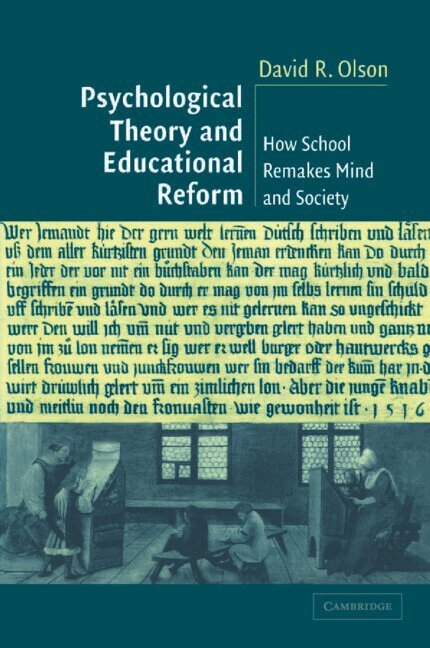
    David R. Olson is University Professor Emeritus at the Ontario Institute for Studies in Education at the University of Toronto, Canada. He has authored more than 300 articles and 20 books, including The World on Paper (Cambridge, 1994), Psychological Theory and Educational Reform: How School Remakes Mind and Society (Cambridge, 2004) and The Mind on Paper (Cambridge, 2016). His research focuses on children's developing consciousness of their own and others' mental states and on the role that language and literacy play in this development.

    Recensioner i media

    'When David R. Olson asked his apparently pre-verbal 1-year-old to get her shoes, she promptly complied - much to his surprise. That incident planted the seed for a deep enquiry. Had she truly understood him? What does it mean to ascribe understanding to such a young child? We also need to consider who is doing the ascribing. Are young children able to ascribe understanding to themselves? And what about animals and computers? Drawing on the contributions of philosophers, linguists, and psychologists, David R. Olson proposes that understanding is a uniquely human capacity, slowly acquired as part of a web of language practices. His book is a provocative and original contribution to the study of children's theory of mind.' Paul Lansley Harris, Harvard Graduate School of Education, USA

    Innehållsförteckning

    • Preface; 1. Introduction; 2. Understanding as feeling and understanding as concept; 3. The linguistic basis of mind- linguistic concepts; 4. Subjective mental states: the feeling of understanding; 5. Objective mental states: the truth of understanding; 6. Intersubjectivity of mental states; 7. Identity conditions for feelings and concepts; 8. What 'understanding' means: ascribing understanding; 9. The referential scope of understanding; 10. Understanding in the theory of mind; 11. Understanding and making sense; 12. Understanding as a learnable skill; 13. Understanding in everyday life; 14. Ascriptivism and cognitive development; References.