• Fri frakt över 249 kr
  • •
  • Snabba leveranser
  • •
  • Billiga böcker
Kundservice

Du är på sajten för privatpersoner.

Företag, bibliotek eller offentlig verksamhet?

Du handlar på classic.bokus.com, där alla dina funktioner finns intakta.
Till classic.bokus.com
Bokus logotyp. Gå till startsidan.
  • Erbjudanden
  • Student
  • Topplistor
  • Barn & ungdom
  • Bokus Play
  • E-böcker
  • Ljudböcker
  • Pocketböcker
  • Spel och pussel

Pocketfynda! Hundratals böcker för 49 kr/st →

Sidfot

Mina sidor

    Hjälp

    • Kundservice
    • Vanliga frågor och svar
    • Frakt och leverans
    • Retur vid ångerrätt
    • Reklamera vara
    • Betalning
    • Köpvillkor
    • Allmänna villkor
    • Information om webbplatsens tillgänglighet

    Om Bokus

    • Om oss
    • Pressrum
    • För studenter
    • För företag
    • För bibliotek och offentlig verksamhet
    • För leverantörer
    • Hållbarhet

    Populärt

    • Aktuella erbjudanden
    • Presentkort
    • Studentlitteratur
    • Nya böcker
    • Topplistor
    • Signerade böcker
    • Engelska böcker

    Inspiration

    • Boktips
    • BookTok
    • Barnbokskaraktärer
    • Populära författare
    Logotyp för Bokus
    Följ oss på Facebook (extern länk)Följ oss på Instagram (extern länk)Följ oss på YouTube (extern länk)Följ oss på TikTok (extern länk)
    bokus @ CookiesAnpassa cookiesIntegritetspolicyKöpvillkor
    Till Citymail hemsida (extern länk)Till Budbee hemsida (extern länk)Till Postnord hemsida (extern länk)Till Schenker hemsida (extern länk)Till Early Bird hemsida (extern länk)Till Walleys hemsida (extern länk)
    1. Naturvetenskap och teknik
    2. Geovetenskap
    3. Geovetenskap
    4. Meteorologi och klimatologi

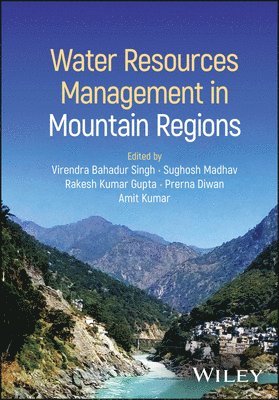
    Water Resources Management in Mountain Regions

    AvVirendra Bahadur Singh,Sughosh Madhav

    Inbunden, Engelska, 2025

    1 968 kr

    Beställningsvara. Skickas inom 5-8 vardagar. Fri frakt över 249 kr.

    Beskrivning

    An up-to-date and comprehensive analysis of mountainous region water resource managementIn Water Resources Management in Mountain Regions, a team of distinguished researchers delivers an up-to-date survey of mountain region hydrology, including the assessment, dynamics, and modeling of glaciers, rivers, and lakes, as well as coverage of the impact of climate change and anthropogenic activities on mountain ecosystems. The authors discuss the challenges posed for those attempting to sustainably manage water resources and explain the impacts of those challenges on water yield, water quality, and the risk of flash flooding.The book includes several case studies from the Himalayan mountain range, which serves as a model region for both medium-high and very high-altitude water resources. It also examines traditional methods of water resource management and conservation and their relevance for 21st century strategies.Readers will also find: A thorough introduction to the management challenges of water resources in the Sikkim Mountain regionsComprehensive explorations of the microbial dynamics, ecological resilience, and sustainable management strategies of mountainous water resourcesPractical discussions of the application of Geographic Information Systems and Remote Sensing in Satpuda mountainous terrainComplete examinations of water resource vulnerability to climate change in the mountain regions of IndiaPerfect for scientists and other professionals working in surface and subsurface hydrology, environmental management, and climate science, Water Resources Management in Mountain Regions will also prove invaluable to professionals working in companies and governmental institutions involved in water resource exploitation and conservation, hydroelectric power generation, and disaster prevention.

    Produktinformation

    • Utgivningsdatum:2025-04-24
    • Mått:182 x 248 x 28 mm
    • Vikt:992 g
    • Format:Inbunden
    • Språk:Engelska
    • Antal sidor:448
    • Förlag:John Wiley & Sons Inc
    • ISBN:9781394249589

    Utforska kategorier

    • Meteorologi och klimatologi inom Naturvetenskap och teknik
    • Hydrologi inom Naturvetenskap och teknik

    Mer om författaren

    Virendra Bahadur Singh, PhD, is Assistant Professor in the Department of Environmental Studies, Ram Lal Anand College, University of Delhi, New Delhi, India. Sughosh Madhav, PhD, is Postdoctoral Fellow in the Department of Civil Engineering, Jamia Millia Islamia, New Delhi, India. Rakesh Kumar Gupta, PhD, is Professor in the Department of Microbiology, Ram Lal Anand College, University of Delhi, New Delhi, India. Prerna Diwan, PhD, is Professor in the Department of Microbiology, Ram Lal Anand College, University of Delhi, New Delhi, India. Amit Kumar, PhD, is a Scientist at the Wadia Institute of Himalayan Geology, Dehradun, Uttarakhand, India.

    Innehållsförteckning

    • About the Editors xixList of Contributors xxiiiPreface xxix1 Management Challenges of Water Resources in Sikkim Mountain Regions 1Anil K. Misra, Om P. Kaptan, Priyanka Kumari, Krity Rai, Rakesh K. Ranjan, Nishchal Wanjari, and Subash Dhakal1.1 Introduction 11.2 Water Resources in Sikkim 61.3 Management Challenges 141.4 Future Adaptation Strategies and Options 16References 172 Basin-Scale Estimation of Runoff Components Using the SPHY Model: A Case Study of the Koshi River Basin, Central Himalaya 21Kiran Bishwakarma, Fan Zhang, Jharana Nepal, Guanxing Wang, Yuxuan Xiang, Ramesh R. Pant, and Narayan P. Khanal2.1 Introduction 212.2 Materials and Methods 232.3 Results 292.4 Discussion 362.5 Conclusion 38Acknowledgments 38References 393 Assessment and Prediction of Water Yield in the Chandra Basin, Western Himalaya, India: Using Physical Basis SWAT Model and Machine Learning 43Sobhana Mummaneni, Vinay K. Gaddam, Gnana S.S.V. Mendu, Nihitha Vemulapalli, Smitha C. Ch, and Sayyad Fazal Rahman Khadri3.1 Introduction 433.2 Study Area 473.3 Methodology 493.4 Conclusion(s) 59Acknowledgments 60Ethical Approval and Responsibilities of Authors 60Consent to Participate 60Consent to Publish 60Funding 60Competing Interests 60Author(s) Contributions 61Availability of Data and Materials 61References 614 Assessment of Suspended Sediment Properties and Particle Load for Optimal Operation of Hydropower Plants in the Himalayan Region 65Naman Arora, Arun Kumar, and Sunil K. Singal4.1 Introduction 654.2 Hydropower in India 664.3 Challenges of Hydropower Development in the Himalayas 664.4 Impact of Sediment on HPP 674.5 Alaknanda River Basin 684.6 Sutlej River Basin 694.7 Suspended Sediment Properties 714.8 Conclusion 76References 765 Hydrochemistry and Quality Assessment of High-Altitudinal Kareri Lake, Northwest Himalaya, Himachal Pradesh, India 85Pawan Kumar, Ambrish K. Mahajan, Deepak Kumar, and Anil Kumar5.1 Introduction 855.2 Information of the Study Site 875.3 Methodology 885.4 Results and Discussion 895.5 Hydrochemistry of the Lake 895.6 Qualitative Characteristics of Lake 925.7 Pearson Correlation Coefficient 925.8 Comparison of Different Parameters of Kareri with Other Himalayan Lakes 935.9 Conclusion 93References 966 Water Quality Assessment of Lakes in Mountain Region with Spatial Reference to Amarkantak, Madhya Pradesh, India 99Piyali Sabui, Shakshee Soni, Ayushii Yadav, and Pallavi Das6.1 Introduction 996.2 Study Area and Site Description 1026.3 Results and Discussion 1046.4 Conclusion 108Acknowledgement 109References 1097 Hydrogeochemical Evaluation of Groundwater Quality in Leh Town, Trans-Himalaya, India Using Entropy Water Quality Index 113Lobzang Chorol and Sunil K. Gupta7.1 Introduction 1137.2 Materials and Methods 1157.3 Results and Discussions 1217.4 Conclusions 129Acknowledgment 129References 1308 Revival of Drying Springs in Mountainous Regions of the Himalayas – Inferences from an Isotope Hydrochemical Study 135Tirumalesh Keesari, Diksha Pant, Hemant Mohokar, and Vinod Khatti8.1 Introduction 1358.2 Study Area 1368.3 Rainfall and Climate 1378.4 Sampling and Analytical Techniques 1398.5 Chemical Species 1408.6 Stable Isotopes (δ 2 H, and δ 18 O) 1408.7 Radioactive Isotope (3 H) 1418.8 Results and Discussion 1418.9 Discharge Rate Analysis 1418.10 Hydrochemistry 1468.11 Environmental Isotopes 1478.12 Isotopic Inferences and Recommendations 1528.13 Impact of Artificial Recharge Measures 1548.14 Conclusions 154Acknowledgment 158References 1589 Biogeochemical Characterization of Water Resources in the Indian Himalayan Regions 161Sayantan Das, Aman Verma, Saurabh K. Sharma, and Nidhi Verma9.1 Introduction 1619.2 Factors Impacting Water Resources 1629.3 Monitoring, Assessment, Management, and Treatment 1659.4 Case Studies 1689.5 Conclusion 1729.6 Future Directions 172References 17310 Mountainous Water Resources: Understanding Microbial Dynamics, Ecological Resilience, and Sustainable Management Strategies amidst Climatic Challenges 181Deepansha Raina, Devansh Kumar, Ashita S. Khasa, Mohit Marwah, Sunila Hooda, and Shalini Swami10.1 Introduction 18110.2 Microbial Dynamics and Mountainous Water Resources 18210.3 Climatic Challenges and Extreme Climatic Affairs 18410.4 Mountainous Ecological Resilience 18710.5 Strategies for Sustainable Management 18810.6 Vulnerability and Adaptability 19210.7 Case Reports and Best Practices 19510.8 Potential for Research and Future Routes 19710.9 Conclusion 198References 19911 Modeling the Glacier Energy and Mass Budget of the Phuche Glacier in the Cold-arid Trans-Himalayan Region, Ladakh Range 207Jaydeo Kumar Dharpure, Ajanta Goswami, Akansha Patel, Sanjay Kumar Jain, and Anil Vishnupant Kulkarni11.1 Introduction 20711.2 Study Area 20811.3 Data and Methods 21011.4 Results 21311.5 Discussion 22611.6 Conclusion 229Acknowledgment 229Funding 230References 23012 Estimation of Ice Thickness and Glacier-Stored Water of the Teesta Basin, Eastern Himalayas, Sikkim, India 237K. Shruti and M. Geetha Priya12.1 Introduction 23712.2 Study Area 24012.3 Data Used 24312.4 Methodology 24312.5 Results 24612.6 Discussion 24912.7 Conclusion 250Acknowledgments 251References 25113 Snowmelt Runoff Estimation Using Landsat 8 Snow Cover Area Products in Beas River Basin, Western Himalayan via SRM Degree-Day Modeling Approach 257Gopinadh Rongali, Ashok K. Keshari, Ashvani K. Gosain, Rakesh Khosa, and Raghavendra Ashrit13.1 Introduction 25713.2 Description of the Study Area 25913.3 Methodology 26013.4 Data Used 26813.5 Results and Discussion 26913.6 Conclusions 276Acknowledgments 277References 27714 Management of Water Resources Through the Application of Geographic Information Systems and Remote Sensing for Satpuda Mountainous Terrain, Madhya Pradesh, India 281S.F.R. Khadri, S.F.A. Khadri, Mayura D. Deshmukh, and Vinay K. Gaddam14.1 Introduction 28114.2 Climate and Vegetation 28114.3 Geomorphological Studies 28414.4 Structural Hill 28714.5 Water Resource Management of Satpuda Mountainous Terrain 29414.6 Summary and Conclusions 296Acknowledgments 296References 29715 Assessment and Management of Flash Floods in the India Himalayas: Challenges, Strategies, and Solutions 301Tanveer Dar and Kainat Aziz15.1 Introduction 30115.2 Causes of Flash Flood 30215.3 Flooding in Major River Basins of India 30315.4 Dynamics of Flash Floods in the Himalayan Region 30615.5 Factors Affecting Flash Floods 30815.6 Mitigation Strategies for Flash Floods 31115.7 Concluding Remarks 314References 31516 Critical Perspectives on Climate Change and Glacial Lake Outburst Floods’ Impact in the Himalayas: Policy Inferences from the South Lhonak Flood of 2023 319Arpan Sharma, Narpati Sharma, and Mousumi Gupta16.1 Introduction 31916.2 Outbursts and Climate Change Impact in the Last Century 32016.3 Warnings and South Lhonak Lake Outburst Flood 32516.4 Inferences from the South Lhonak Lake Outburst Flood 32916.5 Conclusion 330References 33017 A Comprehensive Review on Water Resource Vulnerability to Climate Change in the Mountain Region of India 335Deepika Dimri, Ambika Kumar, and Shalini Singh Chhetri17.1 Introduction 33517.2 The Documented Consequences of Climate Change 33617.3 Summary and Conclusion 346References 34618 Rainfall Intensity and Return Periods of Extreme Rainfall Over the Garhwal Himalaya, Uttarakhand, India 355Deen D. Khandelwal, Manish Mehta, and Dwarika P. Dobhal18.1 Introduction 35518.2 Study Area and Environmental Setting 35618.3 Data and Methodology 35718.4 Result and Discussion 36018.5 Conclusions 364Acknowledgments 365References 36519 Traditional Techniques of Rainwater Management and Conservation in the Mountainous Regions of North-East India 369Liza G. Kiba, Chitrasen Lairenjam, Arbind Kumar Verma, Prem Ranjan, and Grace Nengzouzam19.1 Introduction 36919.2 Water Resources of NER 37219.3 Traditional Water Management Techniques in NER 37319.4 Challenges in the Water Management System 37819.5 Conclusion 379Acknowledgment 379References 37920 Sustainable Management of Groundwater Along the Foothills Focusing on Mountain Front Recharge: A Global Review and Status with Regard to Indian Context 383Banajarani Panda, Sabarathinam Chidambaram, Nagappan Ganesh, Subhashree Biswal, and Bedour Alsabti20.1 Introduction 38320.2 Estimation Methods 38520.3 Estimation of MFR 38920.4 “MFR” Perspectives 39020.5 Mountain Groundwater Under Climate Change 39020.6 Major MF Aquifers in India and its Significance in Recharging Groundwater 39320.7 A Case Study on Hydrochemical Approach to Estimate MFR in Tamil Nadu, India 39420.8 Conclusion and Future Work 398Acknowledgment 399References 399Index 409