• Fri frakt över 249 kr
  • •
  • Snabba leveranser
  • •
  • Billiga böcker
Kundservice

Du är på sajten för privatpersoner.

Företag, bibliotek eller offentlig verksamhet?

Du handlar på classic.bokus.com, där alla dina funktioner finns intakta.
Till classic.bokus.com
Bokus logotyp. Gå till startsidan.
  • Erbjudanden
  • Student
  • Topplistor
  • Barn & ungdom
  • Bokus Play
  • E-böcker
  • Ljudböcker
  • Pocketböcker
  • Spel & pussel

Upp till 25% på utvalda nyheter →

Sidfot

Mina sidor

    Hjälp

    • Kundservice
    • Vanliga frågor och svar
    • Frakt och leverans
    • Retur vid ångerrätt
    • Reklamera vara
    • Betalning
    • Köpvillkor
    • Allmänna villkor
    • Information om webbplatsens tillgänglighet

    Om Bokus

    • Om oss
    • Pressrum
    • För studenter
    • För företag
    • För bibliotek och offentlig verksamhet
    • För leverantörer
    • Hållbarhet

    Populärt

    • Aktuella erbjudanden
    • Presentkort
    • Studentlitteratur
    • Nya böcker
    • Topplistor
    • Signerade böcker
    • Engelska böcker

    Inspiration

    • Boktips
    • BookTok
    • Populära bokserier
    • Barnbokskaraktärer
    • Populära författare
    Logotyp för Bokus
    Följ oss på Facebook (extern länk)Följ oss på Instagram (extern länk)Följ oss på YouTube (extern länk)Följ oss på TikTok (extern länk)
    bokus @ CookiesAnpassa cookiesIntegritetspolicyKöpvillkor
    Till Citymail hemsida (extern länk)Till Budbee hemsida (extern länk)Till Postnord hemsida (extern länk)Till Schenker hemsida (extern länk)Till Early Bird hemsida (extern länk)Till Walleys hemsida (extern länk)
    1. Data och IT
    2. Systemvetenskap och AI

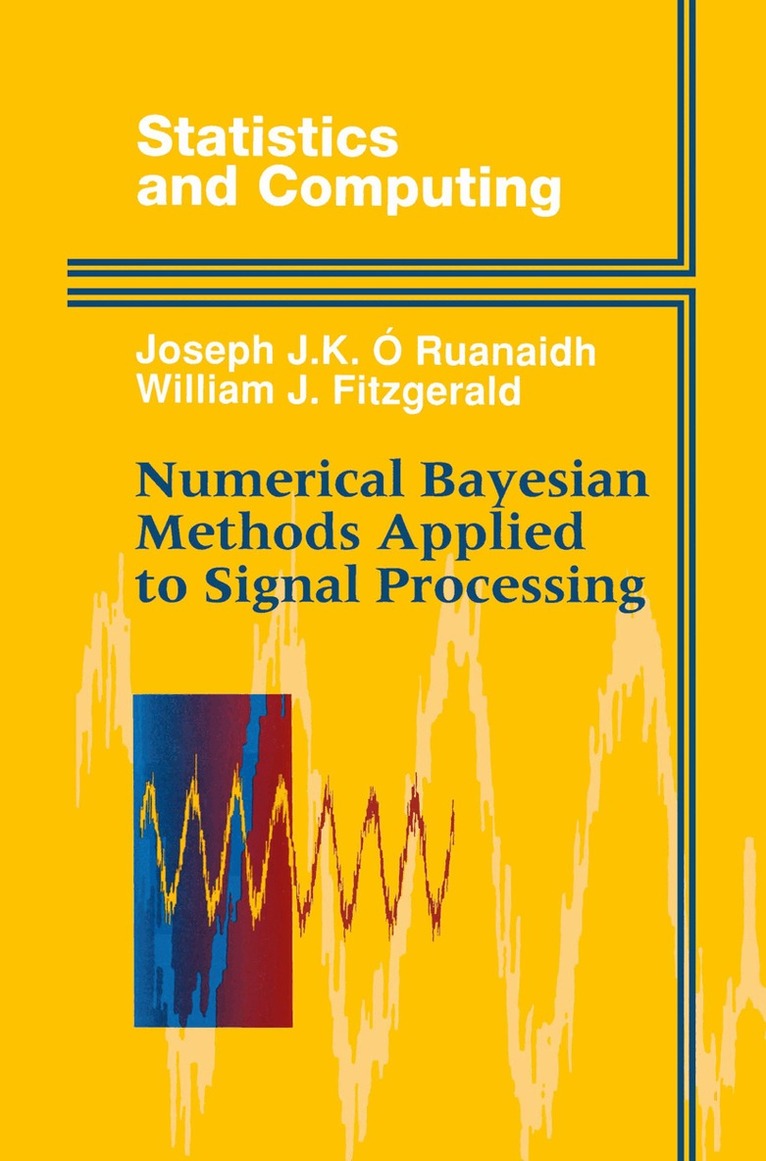
    Numerical Bayesian Methods Applied to Signal Processing

    AvJoseph J.K. O Ruanaidh,William J. Fitzgerald

    Häftad, Engelska, 2012

    Del i serien Statistics and Computing

    2 166 kr

    Beställningsvara. Skickas inom 10-15 vardagar. Fri frakt över 249 kr.

    Fler format och utgåvor

    Inbunden

    2 166 kr

    Beskrivning

    This book is concerned with the processing of signals that have been sam­ pled and digitized. The fundamental theory behind Digital Signal Process­ ing has been in existence for decades and has extensive applications to the fields of speech and data communications, biomedical engineering, acous­ tics, sonar, radar, seismology, oil exploration, instrumentation and audio signal processing to name but a few [87]. The term "Digital Signal Processing", in its broadest sense, could apply to any operation carried out on a finite set of measurements for whatever purpose. A book on signal processing would usually contain detailed de­ scriptions of the standard mathematical machinery often used to describe signals. It would also motivate an approach to real world problems based on concepts and results developed in linear systems theory, that make use of some rather interesting properties of the time and frequency domain representations of signals. While this book assumes some familiarity with traditional methods the emphasis is altogether quite different. The aim is to describe general methods for carrying out optimal signal processing.

    Produktinformation

    • Utgivningsdatum:2012-10-23
    • Mått:155 x 235 x 15 mm
    • Vikt:406 g
    • Format:Häftad
    • Språk:Engelska
    • Serie:Statistics and Computing
    • Antal sidor:244
    • Förlag:Springer-Verlag New York Inc.
    • ISBN:9781461268802

    Utforska kategorier

    • Systemvetenskap och AI inom Data och IT
    • Matematisk statistik inom Naturvetenskap och teknik

    Innehållsförteckning

    • 1 Introduction.- 2 Probabilistic Inference in Signal Processing.- 2.1 Introduction.- 2.2 The likelihood function.- 2.3 Bayesian data analysis.- 2.4 Prior probabilities.- 2.5 The removal of nuisance parameters.- 2.6 Model selection using Bayesian evidence.- 2.7 The general linear model.- 2.8 Interpretations of the general linear model.- 2.9 Example of marginalization.- 2.10 Example of model selection.- 2.11 Concluding remarks.- 3 Numerical Bayesian Inference.- 3.1 The normal approximation.- 3.2 Optimization.- 3.3 Integration.- 3.4 Numerical quadrature.- 3.5 Asymptotic approximations.- 3.6 The Monte Carlo method.- 3.7 The generation of random variates.- 3.8 Evidence using importance sampling.- 3.9 Marginal densities.- 3.10 Opportunities for variance reduction.- 3.11 Summary.- 4 Markov Chain Monte Carlo Methods.- 4.1 Introduction.- 4.2 Background on Markov chains.- 4.3 The canonical distribution.- 4.4 The Gibbs sampler.- 4.5 The Metropolis-Hastings algorithm.- 4.6 Dynamical sampling methods.- 4.7 Implementation of simulated annealing.- 4.8 Other issues.- 4.9 Free energy estimation.- 4.10 Summary.- 5 Retrospective Changepoint Detection.- 5.1 Introduction.- 5.2 The simple Bayesian step detector.- 5.3 The detection of changepoints using the general linear model.- 5.4 Recursive Bayesian estimation.- 5.5 Detection of multiple changepoints.- 5.6 Implementation details.- 5.7 Multiple changepoint results.- 5.8 Concluding Remarks.- 6 Restoration of Missing Samples in Digital Audio Signals.- 6.1 Introduction.- 6.2 Model formulation.- 6.3 The EM algorithm.- 6.4 Gibbs sampling.- 6.5 Implementation issues.- 6.6 Relationship between the three restoration methods.- 6.7 Simulations.- 6.8 Discussion.- 6.9 Concluding remarks.- 7 Integration in Bayesian Data Analysis.- 7.1 Polynomial data.-7.2 Decay problem.- 7.3 General model selection.- 7.4 Summary.- 8 Conclusion.- 8.1 A review of the work.- 8.2 Further work.- A The General Linear Model.- A.1 Integrating out model amplitudes.- A.1.1 Least squares.- A.1.2 Orthogonalization.- A.2 Integrating out the standard deviation.- A.3 Marginal density for a linear coefficient.- A.4 Marginal density for standard deviation.- A.5 Conditional density for a linear coefficient.- A.6 Conditional density for standard deviation.- B Sampling from a Multivariate Gaussian Density.- C Hybrid Monte Carlo Derivations.- C.1 Full Gaussian likelihood.- C.2 Student-t distribution.- C.3 Remark.- D EM Algorithm Derivations.- D.l Expectation.- D.2 Maximization.- E Issues in Sampling Based Approaches to Integration.- E.1 Marginalizing using the conditional density.- E.2 Approximating the conditional density.- E.3 Gibbs sampling from the joint density.- E.4 Reverse importance sampling.- F Detailed Balance.- F.1 Detailed balance in the Gibbs sampler.- F.2 Detailed balance in the Metropolis Hastings algorithm..- F.3 Detailed balance in the Hybrid Monte Carlo algorithm..- F.4 Remarks.- References.