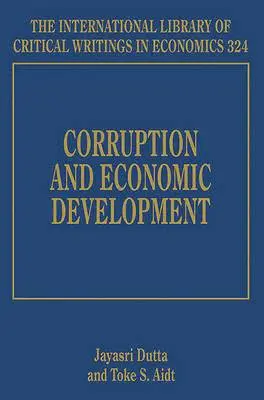
Del 324 i serien The International Library of Critical Writings in Economics series
6 452 kr
Beställningsvara. Skickas inom 5-8 vardagar. Fri frakt över 249 kr.
Beskrivning
Produktinformation
- Utgivningsdatum:2016-11-25
- Mått:169 x 244 x undefined mm
- Format:Inbunden
- Språk:Engelska
- Serie:The International Library of Critical Writings in Economics series
- Förlag:Edward Elgar Publishing Ltd
- ISBN:9781783471201
Utforska kategorier
Mer om författaren
Edited by Jayasri Dutta, Professor of Economics, University of Birmingham, UK and Toke S. Aidt, University Senior Lecturer, University of Cambridge, UK
Recensioner i media
‘The distinctive feature of this new collection of articles on corruption and development is its coverage of the recent empirical literature, which is where most of the notable research advances in the area have occurred over the past decade. The editors provide a thoughtful assessment of the theoretical literature and how it connects with the emerging empirical contributions.’
Innehållsförteckning
- Contents:AcknowledgementsIntroduction Jayasri Dutta and Toke AidtPART ISURVEYS1. Pranab Bardhan (1997), ‘Corruption and Development: A Review of Issues’, Journal of Economic Literature, XXXV (3), September, 1320–462. Jakob Svensson (2005), ‘Eight Questions about Corruption’, Journal of Economic Perspectives, 19 (3), Summer, 19–42, A1–A33. Toke S. Aidt (2003), ‘Economic Analysis of Corruption: A Survey’, Economic Journal, 113 (491), November, F632–F6524. Vito Tanzi (1998), ‘Corruption Around the World: Causes, Consequences, Scope, and Cures’, IMF Staff Papers, 45 (4), December, 559–94PART IIMEASUREMENT 5. Daniel Kaufmann, Aart Kraay and Massimo Mastruzzi (2006), ‘Measuring Governance Using Cross-Country Perceptions Data’, in Susan Rose-Ackerman (ed.), International Handbook on the Economics of Corruption, Chapter 2, Cheltenham, UK and Northampton, MA, USA: Edward Elgar Publishing, 52–1046. James E. Foster, Andrew W. Horowitz and Fabio Méndez (2012), ‘An Axiomatic Approach to the Measurement of Corruption: Theory and Applications’, World Bank Economic Review, 26 (2), June, 217–357. Benjamin A. Olken (2009), ‘Corruption Perceptions vs. Corruption Reality’, Journal of Public Economics, 93 (7-8), August, 950–648. Axel Dreher, Christos Kotsogiannis and Steve McCorriston (2007), ‘Corruption Around the World: Evidence from a Structural Model’, Journal of Comparative Economics, 35 (3), September, 443–66PART IIITHEORY9. Francis T. Lui (1985), ‘An Equilibrium Queuing Model of Bribery’, Journal of Political Economy, 93 (4), August, 760–8110. Andrei Shleifer and Robert W. Vishny (1993), ‘Corruption’, Quarterly Journal of Economics, 108 (3), August, 599–61711. Toke S. Aidt and Jayasri Dutta (2008), ‘Policy Compromises: Corruption and Regulation in a Democracy’, Economics and Politics, 20 (3), November, 335–6012. Christopher Bliss and Rafael Di Tella (1997), ‘Does Competition Kill Corruption?’, Journal of Political Economy, 105 (5), October, 1001–2313. Gary S. Becker and George J. Stigler (1974), ‘Law Enforcement, Malfeasance, and Compensation of Enforcers’, Journal of Legal Studies, 3 (1), January, 1–1814. Jean Tirole (1986), ‘Hierarchies and Bureaucracies: On the Role of Collusion in Organizations’, Journal of Law, Economics, and Organization, 2 (2), Fall, 181–21415. Daron Acemoglu and Thierry Verdier (2000) ‘The Choice between Market Failures and Corruption’, American Economic Review, 90 (1), March, 194–21116. Jens Chr. Andvig and Karl Ove Moene (1990), ‘How Corruption May Corrupt’, Journal of Economic Behavior and Organization, 13 (1), 63–7617. Theo Eicher, Cecilia García-Peñalosa and Tanguy van Ypersele (2009), ‘Education, Corruption, and the Distribution of Income’, Journal of Economic Growth, 14 (3), September, 205–3118. Bård Harstad and Jakob Svensson (2011), ‘Bribes, Lobbying, and Development’, American Political Science Review, 105 (1), February, 46–63PART IVCROSS NATIONAL EVIDENCE ON THE CAUSES OF CORRUPTION19. Daniel Treisman (2007), ‘What Have We Learned About the Causes Of Corruption from Ten Years of Cross-National Empirical Research?’, Annual Review of Political Science, 10, 211–4420. Sascha O. Becker, Peter H. Egger and Tobias Seidel (2009), ‘Common Political Culture: Evidence on Regional Corruption Contagion’, European Journal of Political Economy, 25 (3), September, 300–1021. Nauro F. Campos and Francesco Giovannoni (2007), ‘Lobbying, Corruption and Political Influence’, Public Choice, 131 (1-2), April, 1–21PART VEVIDENCE ON THE CORRUPTION-DEVELOPMENT NEXUS 22. Paolo Mauro (1995), ‘Corruption and Growth’, Quarterly Journal of Economics, 110 (3), August, 681–71223. Nathaniel H. Leff (1964), ‘Economic Development Through Bureaucratic Corruption’, American Behavioral Scientist, 8 (3), November, 8–1424. Pierre-Guillaume Méon and Laurent Weill (2010), ‘Is Corruption an Efficient Grease?’, World Development, 38 (3), March, 244–5925. Martin Paldam (2002), ‘The Cross-Country Pattern of Corruption: Economics, Culture and the Seesaw Dynamics’, European Journal of Political Economy, 18 (2), June, 215–4026. Toke Aidt, Jayasri Dutta and Vania Sena (2008), ‘Governance Regimes, Corruption and Growth: Theory and Evidence’, Journal of Comparative Economics, 36 (2), June, 195–22027. Erich Gundlach and Martin Paldam (2009), ‘The Transition of Corruption: From Poverty to Honesty’, Economics Letters, 103 (3), June, 146–8PART VILAB, FIELD AND QUASI-NATURAL EXPERIMENTS 28. Ritva Reinikka and Jakob Svensson (2004), ‘Local Capture: Evidence from a Central Government Transfer Program in Uganda’, Quarterly Journal of Economics, 119 (2), May, 679–70529. Benjamin A. Olken (2007), ‘Monitoring Corruption: Evidence from a Field Experiment in Indonesia’, Journal of Political Economy, 115 (2), April, 200–4930. Raymond Fisman and Edward Miguel (2007), ‘Corruption, Norms, and Legal Enforcement: Evidence from Diplomatic Parking Tickets’, Journal of Political Economy, 115 (6), December, 1020–4831. Abigail Barr and Danila Serra (2010), ‘Corruption and Culture: An Experimental Analysis’, Journal of Public Economics, 94 (11–12), December, 862–6932. Ritwik Banerjee, Tushi Baul and Tanya Rosenblat (2015), ‘On Self Selection of the Corrupt into the Public Sector’, Economics Letters, 127, February, 43–633. Claudio Ferraz and Frederico Finan (2008), ‘Exposing Corrupt Politicians: The Effects of Brazil's Publicly Released Audits on Electoral Outcomes’, Quarterly Journal of Economics, 123 (2), May, 703–45Index
Du kanske också är intresserad av
Sustainable Maritime Transportation and Exploitation of Sea Resources
Enrico Rizzuto, Carlos Guedes Soares
6 455 kr
Japanese Economy In Retrospect, The: Selected Papers By Gary R Saxonhouse (In 2 Volumes)
STERN ROBERT M, Robert M Stern, Gavin Wright, Hugh Patrick
6 456 kr