• Fri frakt över 249 kr
  • •
  • Snabba leveranser
  • •
  • Billiga böcker
Kundservice

Du är på sajten för privatpersoner.

Företag, bibliotek eller offentlig verksamhet?

Du handlar på classic.bokus.com, där alla dina funktioner finns intakta.
Till classic.bokus.com
Bokus logotyp. Gå till startsidan.
  • Erbjudanden
  • Student
  • Topplistor
  • Barn & ungdom
  • Bokus Play
  • E-böcker
  • Ljudböcker
  • Pocketböcker
  • Spel och pussel

Pocketfynda! Hundratals böcker för 49 kr/st →

Sidfot

Mina sidor

    Hjälp

    • Kundservice
    • Vanliga frågor och svar
    • Frakt och leverans
    • Retur vid ångerrätt
    • Reklamera vara
    • Betalning
    • Köpvillkor
    • Allmänna villkor
    • Information om webbplatsens tillgänglighet

    Om Bokus

    • Om oss
    • Pressrum
    • För studenter
    • För företag
    • För bibliotek och offentlig verksamhet
    • För leverantörer
    • Hållbarhet

    Populärt

    • Aktuella erbjudanden
    • Presentkort
    • Studentlitteratur
    • Nya böcker
    • Topplistor
    • Signerade böcker
    • Engelska böcker

    Inspiration

    • Boktips
    • BookTok
    • Barnbokskaraktärer
    • Populära författare
    Logotyp för Bokus
    Följ oss på Facebook (extern länk)Följ oss på Instagram (extern länk)Följ oss på YouTube (extern länk)Följ oss på TikTok (extern länk)
    bokus @ CookiesAnpassa cookiesIntegritetspolicyKöpvillkor
    Till Citymail hemsida (extern länk)Till Budbee hemsida (extern länk)Till Postnord hemsida (extern länk)Till Schenker hemsida (extern länk)Till Early Bird hemsida (extern länk)Till Walleys hemsida (extern länk)
    1. Naturvetenskap och teknik
    2. Geovetenskap
    3. Miljövetenskap och miljöpolitik

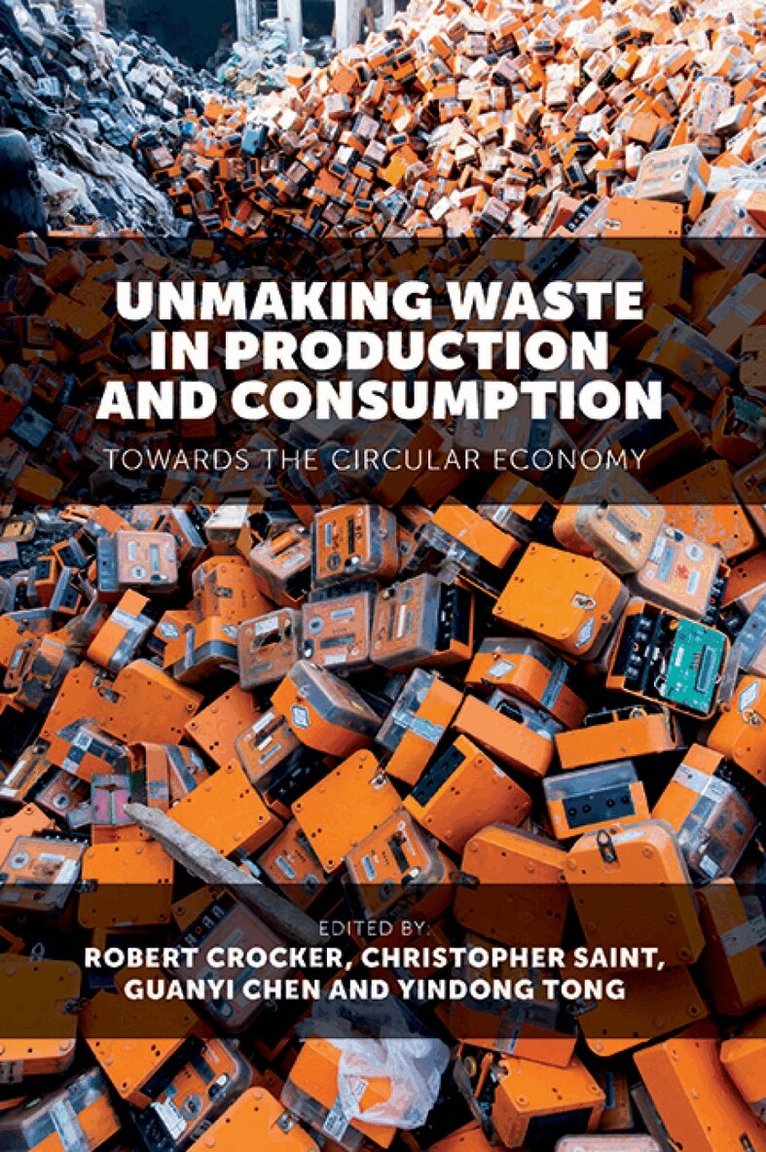
    Unmaking Waste in Production and Consumption

    Towards The Circular Economy

    AvRobert Crocker,Christopher Saint

    Inbunden, Engelska, 2018

    1 124 kr

    Beställningsvara. Skickas inom 5-8 vardagar. Fri frakt över 249 kr.

    Beskrivning

    The legacies of a century of fossil-fuel based development andoverconsumption, of treating the environment as a waste sink for industryand agriculture, have left devastating impacts on the earth’s air, water andland, and these are directly implicated in Climate Change. In response, anumber of global institutions and nations, including the European Unionand China, have committed themselves to the development of a ‘circulareconomy’. This will require a transformation of today’s ‘linear economy’ of‘make, use and dispose’ as the market dictates, into a Circular Economy. The aim of the Circular Economy is to decouple economic growth fromresource and energy use through iterative, systemic social, economic andtechnological reform. This book presents new theoretical and practicalinsights into this concept, based on case studies from both the developingand developed world, with an emphasis on economic and materialtransformation, design for reuse and waste reduction, industrial ‘symbiosis’(the planned circulation of resources and energy within an industrial setting),and social innovation and entrepreneurship. Four central themes emerge through the essays presented here: theimportance of ‘restorative design’ in transforming resource flows throughboth production and consumption, the value of understanding andenumerating wastes in more detail to enable their reuse, the central roleof advancing technology and applied science to further this transformationof materials for reuse, and finally, a reconfiguration of design, consumptionand retail, so that the present ‘linear’ economy of ‘make, use and trash’ canbe replaced with a more ‘circular’ model.

    Produktinformation

    • Utgivningsdatum:2018-09-13
    • Mått:152 x 229 x 23 mm
    • Vikt:656 g
    • Format:Inbunden
    • Språk:Engelska
    • Antal sidor:376
    • Förlag:Emerald Publishing Limited
    • ISBN:9781787146204

    Utforska kategorier

    • Miljövetenskap och miljöpolitik inom Naturvetenskap och teknik

    Mer om författaren

    Robert Crocker is Deputy Director of the China-Australia Centre for Sustainable Urban Development at the University of South Australia. Christopher Saint is the Director of the China-Australia Centre for Sustainable Urban Development, and Dean, Research and Innovation, of the Information Technology, Engineering and Environment Division at the University of South Australia. Guanyi Chen is Chair and Professor of Bioenergy and Environment, Dean of the School of Environmental Science and Engineering Director of the China-Australia Centre for Sustainable Urban Development at Tianjin University. Yindong Tong is Deputy Director of the China-Australia Centre for Sustainable Urban Development, and Associate Professor of Environmental Science at the School of Environmental Science and Engineering, Tianjin University.

    Recensioner i media

    Environmental scientists, engineer, and activists analyze the concept of the circular economy, emphasizing the different contexts in which the circulation of materials through the economy takes place. They cover history, theory, and experience; consumption, design, and behavior; waste and resource recovery; and technology and systems innovation. Their topics include from Spaceship Earth to the circular economy: the problem of consumption, circular by design: a model for engaging small and medium fashion and textile companies with strategies for designed reuse, renewing materials: implementing three-dimensional printing and distributed recycling in Samoa, towards an agile circular economy for the building industry, and re-valuing construction materials and components through design for disassembly.

    Innehållsförteckning

    • Preface: Professor Li’an Hou - Academic, Chinese Academy of Engineering Introduction. Robert Crocker, Christopher Saint, Guanyi Chen, and Yindong Tong  Part 1: History, Theory and Experience 1. From ‘Spaceship Earth’ to the Circular Economy: The Problem of Consumption; Robert Crocker 2. Can Economics assist the Transition to the Circular Economy?; Martin Shanahan 3. China’s Policies for promoting a Circular Economy: Past-Decade Experiences, Future Plans and Success Stories; Xu Zhao 4. Biosolids: The Growing Potential for Use; Norman Goh, Michael P Short, Nanthi S Bolan, and Christopher P Saint Part 2: Consumption, Design and Behaviour 5. Considering ‘Waste Value’ in the Circular Economy; Helene Cherrier, Meltme Türe, and Nil Özçağlar-Toulouse6. Circular by design: A Model for engaging Fashion / Textile SMEs with Strategies for Designed Reuse; Jen Ballie and Mel Woods 7. The ByeBuy! Shop: Testing Shopping Scapes in a Circular Economy; Kirsty Máté 8. What role for Social Enterprises in the Circular Economy?; Ruth Lane and Wayne Gumley 9. Developing Measures for the Waste Management Hierarchy: A South Australian Case Study; Anne Sharp, Lara Stocchi, Vaughan Levitzke and Marcia Kreinhold Part 3: Waste and Resource Recovery 10. Australian Regional Waste Footprints; Jacob Fry, Manfred Lenzen, Damien Giurco, and Stefan Pauliuk 11. Renewing Materials: Implementing 3D printing and Distributed Recycling in Samoa; Lionel Taito-Matamua, Simon Fraser, and Jeongbin Ok 12. The Current State of Scrap Utilization by Thai SMEs; Singh Intrachooto 13. Unmaking Waste in Construction in the EU and Asian Circular Economy: A Formal Institution Approach; Rita Yi Man Li, Li Meng, Tat Ho Leung, Jian Zuo, and Yuan Wang  14. Municipal Solid Waste Properties in China: A Comparison Study between Tibet, Beijing and Guangzhou; Wenchao Ma, Lina He, Zeng Dan, Guanyi Chen and Xuebin Lu  Part 4: Technology and Systems Innovation 15. Green Manufacturing – From Waste to Value Added Materials; Samane Maroufi, Claudia Echeverria, Farshid Pahlevani and Veena Sahajwalla 16. Towards an Agile Circular Economy for the Building Industry; Tim Mcginley 17. Research on the Sustainable Water Recycling System at Tianjin University’s New Campus; Sen Peng, Huiping Cui, and Min Ji 18. Re-Valuing Construction Materials and Components through Design for Disassembly; Philip Crowther 19. Construction and the Circular Economy: Smart and Industrialised Prefabrication; Abbas Elmualim, Sherif Mostafa, Nicholas Chileshe, Rameez Rameezdeen, and Kerry London Afterword: Vaughan Levitzke