• Fri frakt över 249 kr
  • •
  • Snabba leveranser
  • •
  • Billiga böcker
Kundservice

Du är på sajten för privatpersoner.

Företag, bibliotek eller offentlig verksamhet?

Du handlar på classic.bokus.com, där alla dina funktioner finns intakta.
Till classic.bokus.com
Bokus logotyp. Gå till startsidan.
  • Erbjudanden
  • Student
  • Topplistor
  • Barn & ungdom
  • Bokus Play
  • E-böcker
  • Ljudböcker
  • Pocketböcker
  • Spel och pussel

Pocketfynda! Hundratals böcker för 49 kr/st →

Sidfot

Mina sidor

    Hjälp

    • Kundservice
    • Vanliga frågor och svar
    • Frakt och leverans
    • Retur vid ångerrätt
    • Reklamera vara
    • Betalning
    • Köpvillkor
    • Allmänna villkor
    • Information om webbplatsens tillgänglighet

    Om Bokus

    • Om oss
    • Pressrum
    • För studenter
    • För företag
    • För bibliotek och offentlig verksamhet
    • För leverantörer
    • Hållbarhet

    Populärt

    • Aktuella erbjudanden
    • Presentkort
    • Studentlitteratur
    • Nya böcker
    • Topplistor
    • Signerade böcker
    • Engelska böcker

    Inspiration

    • Boktips
    • BookTok
    • Barnbokskaraktärer
    • Populära författare
    Logotyp för Bokus
    Följ oss på Facebook (extern länk)Följ oss på Instagram (extern länk)Följ oss på YouTube (extern länk)Följ oss på TikTok (extern länk)
    bokus @ CookiesAnpassa cookiesIntegritetspolicyKöpvillkor
    Till Citymail hemsida (extern länk)Till Budbee hemsida (extern länk)Till Postnord hemsida (extern länk)Till Schenker hemsida (extern länk)Till Early Bird hemsida (extern länk)Till Walleys hemsida (extern länk)
    1. Naturvetenskap och teknik
    2. Geovetenskap
    3. Miljövetenskap och miljöpolitik

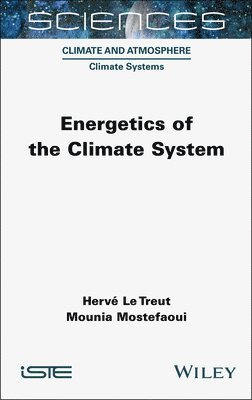
    Energetics of the Climate System

    AvHerve Le Treut,Mounia Mostefaoui

    Inbunden, Engelska, 2025

    Del i serien ISTE Invoiced

    1 723 kr

    Beställningsvara. Skickas inom 5-8 vardagar. Fri frakt över 249 kr.

    Beskrivning

    Energetics of the Climate System is derived from a course taught by Hervé Le Treut, who has been delivering this lecture series for decades to students at institutions such as the École Normale Supérieure, École Polytechnique, and Sorbonne University, along with students from other international institutions. This book offers a comprehensive understanding of the intricate energetics driving the Earth’s climate system.The goal was not only to capture the depth and complexity of this subject, but also to preserve the pedagogical brilliance and unique storytelling style of Hervé Le Treut. This work stands as both a tribute to his remarkable contributions and a reflection of his passion for teaching, having mentored generations of climatologists, engineers, and economists, many of whom – including the co-author Mounia Mostefaoui – have greatly benefited from his guidance.The text retains elements of an oral presentation to evoke the professor’s distinctive voice and teaching approach. The book is structured into five chapters, each independent and deeply interconnected, and is complemented by an appendix of exercises to reinforce its material.

    Produktinformation

    • Utgivningsdatum:2025-08-29
    • Mått:156 x 234 x 21 mm
    • Vikt:776 g
    • Format:Inbunden
    • Språk:Engelska
    • Serie:ISTE Invoiced
    • Antal sidor:352
    • Förlag:ISTE Ltd
    • ISBN:9781789452303

    Utforska kategorier

    • Miljövetenskap och miljöpolitik inom Naturvetenskap och teknik
    • Meteorologi och klimatologi inom Naturvetenskap och teknik

    Mer om författaren

    Hervé Le Treut worked as IPSL Director for IPCC between 2008 and 2019. He built his internationally recognized research career at Polytechnique, Sorbonne University and ENS, France. He co-created AcclimaTerra and received several distinctions. He is a knight of the Legion of Honor.Mounia Mostefaoui graduated from Polytechnique and completed her PhD in physics of climate change at LMD-IPSL, France. Her advisors were Hervé Le Treut and Philippe Ciais. She was Expert Reviewer for the AR6 IPCC report and participated in several COPs as a speaker in the IPCC Pavilion.

    Innehållsförteckning

    • Preface ixChapter 1 A Description of the Main Constraints Regulating the Earth Climate 11.1 Generalities about the atmosphere and the ocean 11.1.1 The atmosphere 41.1.2 A brief comparison between some oceans and the atmosphere’s main orders of magnitude 91.2 A global view of radiative processes 91.3 Past climate history 181.4 A global evaluation of climate stability 321.4.1 Let us consider the first term of equation [1.8] 331.4.2 Let us consider the second term of equation [1.8] 371.4.3 A global estimate of climate stability considering another source of complexity: the greenhouse effect 431.5 Conclusion 47Chapter 2 The Vertical Dimension of the Energy Processes of the Climate System: Radiative Processes and Radiative–Convective Models 492.1 Radiative processes: generalities 502.2 Absorption and greenhouse effect 522.3 The role of convection 622.3.1 Where does the - F ± comes from? 642.4 Diffusion of solar radiation 78Chapter 3 The Horizontal Motion of Atmospheric and Oceanic Transport 933.1 Energy budget at the top of the atmosphere 933.2 Energy exchanges with the surface 983.3 Transport by the atmosphere and the ocean 1133.4 Vertical and horizontal transports: the links 1173.4.1 What is stable stratification? 1243.5 Conclusion 141Chapter 4 A Transition from Quasi-Equilibrium to Forcing from Anthropogenic Source: A Cartography of Predictable Phenomena, Uncertainties and Feedback Related to the Climate Response to Anthropogenic Disturbance 1434.1 A transitory evolution 1444.1.1 Presentation of the Intergovernmental Panel on Climate Change (IPCC) and its missions 1474.1.2 A focus on IPCC productions 1484.1.3 Examples of IPCC production impacts 1504.1.4 Complexity, a main feature of the Earth climate system transitory evolution 1514.2 Global temperature change and the role of feedbacks 1784.2.1. About models’ uncertainties and radiative forcing associated with CO 2 1854.2.2 The water vapor feedback 1884.2.3 The albedo feedback 1894.2.4 The cloud feedback 1904.2.5 The lapse-rate feedback 1924.3 Measured and anticipated impacts: what is predictable? 1974.3.1 Three generations of model assessments directed toward climate change 1984.3.2 Socio-economic pathways (SSP) in AR6 2054.3.3. Articulation between SSP scenarios from AR 6 and RCP scenarios from AR5 2074.3.4 As for the most probable trajectory currently followed 2104.3.5 Main novelties for the seventh IPCC Assessment Report 2134.3.6 Method for the evaluation of a probability in IPCC reports 214Chapter 5 From Scientific Diagnostic to Decision-Making 2355.1 The role of uncertainties on assessing global warming, accounting for natural variability and estimating climate impacts 2365.1.1 Process studies and uncertainties 2605.1.2 From natural variability to climate impacts 2795.1.3 Zoom about uncertainties and the IPCC 2815.1.4 Process of uncertainty evaluations by the IPCC as detailed in the Fifth Assessment Report (AR5) 2835.1.5 Process of uncertainty evaluations by the IPCC as detailed in the Sixth Assessment Report (AR6) 2875.1.6 Method for the evaluation of a probability in IPCC reports 2895.2 From global to local climate features: a key shift for the interaction between science and decision-making 2905.3 From scientific diagnosis to political decision-making 3005.4 A word of conclusion 301Appendix 303References 327List of Authors 339Index 341