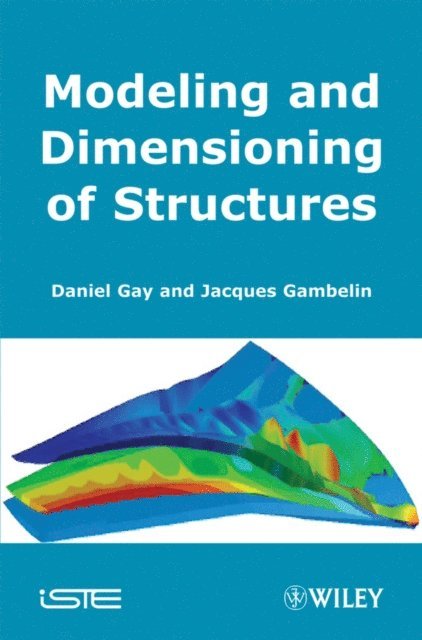
Modeling and Dimensioning of Structures
An Introduction
Inbunden, Engelska, 2008
3 499 kr
Beställningsvara. Skickas inom 5-8 vardagar. Fri frakt över 249 kr.
Beskrivning
This book provides the main topics currently used for the calculus of structures. The reference establishes a link between the traditional approach on the strength of materials and the present finite element method, details the main aspects of practical modeling, and explores numerous case studies.
Produktinformation
- Utgivningsdatum:2008-06-06
- Mått:158 x 231 x 46 mm
- Vikt:1 202 g
- Format:Inbunden
- Språk:Engelska
- Antal sidor:640
- Förlag:ISTE Ltd and John Wiley & Sons Inc
- ISBN:9781848210400
Utforska kategorier
Mer om författaren
Daniel Gay was Director of the Laboratory of Mechanical Design at the University of Toulouse, France, for more than 15 years. He published numerous papers in international scientific journals and several books on composites materials. Jacques Gambelin is Professor of Mechanical Design at the University of Toulouse, France, and taught structural design andcalculus for aeronautical applications for more than 20 years.
Innehållsförteckning
- Preface xviiPart 1. Level 1 1Chapter 1. The Basics of Linear Elastic Behavior 31.1. Cohesion forces 41.2. The notion of stress 61.2.1. Definition 61.2.2. Graphical representation 71.2.3. Normal and shear stresses 81.3. Hooke’s law derived from a uniaxially applied force 91.3.1. The stretch test 91.3.2. Linear mechanical behavior 121.3.3. Elastic mechanical behavior 121.3.4. Interpretation of the test at a macroscopic level 131.3.5. Interpretation of the test at a mesoscopic level 131.3.6. Interpretation of the test at a microscopic level 161.3.7. Summary 181.4. Plane state of stresses 201.4.1. Definition 201.4.2. Behavior relationships for state of plane stresses 221.4.3. Summary 351.5. Particular case of straight beams 361.5.1. Preliminary observations 361.5.2. Effects linked to the resultant forces and moments 38Chapter 2. Mechanical Behavior of Structures: An Energy Approach 512.1. Work and energy 512.1.1. Elementary work developed by a force 512.1.2. Elementary work developed by a moment 522.2. Conversion of work into energy 532.2.1. Potential energy of deformation 532.2.2. Potential energy for a spring 552.3. Some standard expressions for potential deformation energy 582.3.1. Deformation energies in a straight beam 582.3.2. Deformation energy under plane stresses 742.4. Work produced by external forces on a structure 812.4.1. Beam under plane bending subjected to two forces 822.4.2. Beam in plane bending subject to “n” forces 992.4.3. Generalization to any structure 1032.4.4. Summary 1122.5. Links of a structure with its surroundings 1132.5.1. Example 1132.5.2. Generalization 1182.6. Stiffness of a structure 1192.6.1. Preliminary note 1192.6.2. Stiffness matrix 1212.6.3. Examples 1212.6.4. Influence of the positioning 1252.6.5. Deformation energy and stiffness matrix 139Chapter 3. Discretization of a Structure into Finite Elements 1433.1. Preliminary observations 1433.1.1. Problem faced 1433.1.2. Practical obtaining of the deformation energy for a complex structure 1443.1.3. Local and global coordinates 1473.2. Stiffness matrix of some simple finite elements 1533.2.1. Truss element loaded under traction (or compression) 1533.2.3. Beam element under plane bending 1683.2.4. Triangular element for the plane state of stresses 1783.3. Getting the global stiffness matrix of a structure 1913.3.1. Objective 1913.3.2. Mechanism of the assembly of elementary matrices 1913.3.1. Introduction 2013.4. Resolution of the system {F}={K}??{d} 2033.4.1. Linkage conditions 2033.4.2. Generalization of the method 2053.5. Different types of finite elements available in industrial software 207Chapter 4. Applications: Discretization of Simple Structures 2094.1. Stiffness matrix of a spring 2094.1.1. Helical spring 2094.1.2. Spiral spring. 2114.2. Assembly of elements 2134.2.1. Example 1 2134.2.2. Example 2 2174.2.3. Example 3 2224.2.4. Assembly of a truss element and a beam element under simple plane bending 2284.3. Behavior in the global coordinate system 2324.3.1. Plane assembly of two truss elements 2324.4. Bracket 2464.4.1. Objectives 2464.4.2. Modelizing 2474.4.3. Calculation of the elementary stiffness matrix in the global system 2524.4.4. Assembly of the global stiffness matrix [K]str 2564.4.5. Establishing the linkage and loading conditions 2594.4.6. Resolution of the linear system Fstr = [K]strdstr 2604.4.7. Additional study of the behavior of the bracket 2624.4.8. Using computing software 267Part 2. Level 2 269Chapter 5. Other Types of Finite Elements 2715.1. Return to local and global coordinate systems 2715.1.1. Transfer matrix 2715.1.2. Summary 2735.2. Complete beam element (any loading case) 2745.2.1. Preliminary comments 2745.2.2. Obtaining the stiffness matrix in the local coordinate system 2765.2.3. Improvement in performances of this beam element 2835.2.4. Summary 2885.3. Elements for the plane state of stress 2915.3.1. Triangular element 2915.3.2. Quadrilateral element in plane state of stress 2955.4. Plate element 3005.4.1. Preliminary notes 3005.4.2. Resultant forces and moments for cohesion forces 3025.4.3. Plate element in bending 3055.4.4. Complete plate element 3105.5. Elements for complete states of stresses 3155.5.1. Preliminary notes 3155.5.2. Solid tetrahedric element 3185.5.3. Solid parallelepipedic element 3215.6. Shell elements 3275.6.1. Preliminaries 3275.6.2. Specific case of axisymmetric shells 3285.6.3. Axisymmetric shell element with axisymmetric boundaries 329Chapter 6. Introduction to Finite Elements for Structural Dynamics 3316.1. Principles and characteristics of dynamic study 3326.1.1. Example 1 3326.1.2. Example 2 3386.2. Mass properties of beams 3466.2.1. Finite beam element in dynamic bending plane 3466.2.2. Discretization of a beam for dynamic bending 3506.2.3. Other types of dynamic behaviors of a beam 3576.3. Generalization 3636.4. Summary 364Chapter 7. Criteria for Dimensioning 3657.1. Designing and dimensioning 3657.2. Dimensioning in statics 3707.2.1. The two types of criteria 3707.2.2. Elasticity limit criterion 3737.2.3. Non-rupture criterion 3827.3. Dimensioning in fatigue 3937.3.1. Fatigue phenomenon 3937.3.2. Fatigue test 3947.3.3. Modeling of the fatigue 3977.3.4. Estimation of fatigue strength 399Chapter 8. Practical Aspects of Finite Element Modeling 4078.1. Use of finite element software 4078.1.1. Introduction 4078.1.2. Summary tables of the properties of elements 4088.1.3. Connection between elements of different types 4158.1.4. Other practical aspects 4208.2. Example 1: machine-tool shaft 4328.2.1. Simulation exercise 4328.2.2. Data 4338.2.3. Successive steps of modeling 4348.3. Example 2: thin-walled structures 4408.3.1. Model based on beam elements 4418.3.2. Model in plate elements 4488.3.3. Model in beam and plate elements 4498.4. Example 3: modeling of a massive structure 4508.4.1. Problem 4508.4.2. Steps of modeling 4518.4.3. Comments on the validity of the model 4568.5. Summary of the successive modeling steps 4578.5.1. Preliminary analysis 4578.5.2. Model verification and validation 4588.5.3. Corresponding use of the software 460Part 3. Supplements 463Chapter 9. Behavior of Straight Beams 4659.1. The “straight beam” model 4669.1.1. Definition 4669.1.2. Main or “principal” axis of a cross-section 4669.1.3. Applied loadings 4689.1.4. Cohesion force and moment on a current cross-section 4699.1.5. Hypothesis of the beam theory 4749.1.6. Microscopic equilibrium 4799.2. Mesoscopic equilibrium or equilibrium extended to a whole cross-section 4829.3. Behavior relations and stresses 4869.3.1. Normal resultant 4869.3.2. Torsional loading 4909.3.3. Pure bending 5149.3.4. Plane bending with shear resultant 5309.3.5. Any loading 5499.4. Application: example of detailed calculation of the resultant forces and moments of cohesive forces5519.4.1. Preliminary static analysis 5519.4.2. Resultant force and moment on every cross-section 553Chapter 10. Additional Elements of Elasticity 56310.1. Reverting to the plane state of stresses 56310.1.1. Influence of the coordinate system 56310.1.2. Principal directions and stresses 56610.1.3. Mohr graphical representation 56810.1.4. Summary 57510.1.5. Some remarkable plane states of stresses with their Mohr representation 57610.1.6. Experimental evaluation of deformations to define stresses 58810.1.7. Deformation energy in principal axes 59310.2. Complete state of stresses 59310.2.1. Principal directions and stresses 59310.2.2. Stresses in any x , y , z axes 59410.2.3. Deformations 59710.2.4. Behavior relations 59910.2.5. Strain potential energy 60410.2.6. Summary 60910.2.7. Components of the strain potential energy 612Chapter 11. Structural Joints 61911.1. General information on connections by means of cylindrical fasteners 62011.1.1. Contact pressure 62011.1.2. General information on riveting 62211.1.3. General information on bolted joints 62411.1.4. Deterioration of riveted and bolted joints 62611.2. Bolted joint 63111.2.1. Simplified case where the tightening is neglected 63111.2.2. Case of pre-tightening 65411.3. Riveted joint 66611.3.1. Hypotheses 66611.3.2. Characteristics of the modeled joining interface 66611.3.3. Forces on each attachment 66711.3.4. Graphic representation of the shear stresses 66811.3.5. Summary 67011.4. Welded joints 67111.4.1. Preliminary observations and hypotheses 67111.4.2. Determination of the stresses in the weld bead cross-section 67311.4.3. Summary 68611.4.4. Example 688Chapter 12. Mathematical Prerequisites 69112.1. Matrix calculus 69112.1.1. General information 69112.1.2. Matrix operations 69212.1.3. Quadratic form 69612.1.4. Eigenvalues and eigenvectors of a matrix 69712.2. Change in orthonormal coordinate system 69812.2.1. Case of coplanar coordinate systems 69812.2.2. Cases of any general coordinate systems 699Appendix A. Modeling of Common Mechanical Joints 703A.1. Definition 703A.1.1. Monolithic unit 703A.1.2. Joints 703A.1.3. Perfect joints 704A.2. Common standardized mechanical joints (ISO 3952) 704Appendix B. Mechanical Properties of Materials 711B.1. Mechanical properties of some materials used for structures 711B.1.1. Steels and casting 711B.1.2. Non-ferrous metals 712Appendix C. List of Summaries 713Bibliography 717
Hoppa över listan


Du kanske också är intresserad av
Oxford Reading Tree: Floppy's Phonics Decoding Practice: Oxford Level 5: Pack A Class Pack of 36
Paul Shipton, Becca Heddle, Narinder Dhami, Rachel Russ, Katie Dale, Isabel Thomas
Häftad, 2022
3 499 kr
Handbook on Medical Tourism and Patient Mobility
Neil Lunt, Daniel Horsfall, Johanna Hanefeld
Inbunden, 2015
3 499 kr
Handbook of Middle Management Strategy Process Research
Steven W. Floyd, Bill Wooldridge
Inbunden, 2017
3 499 kr