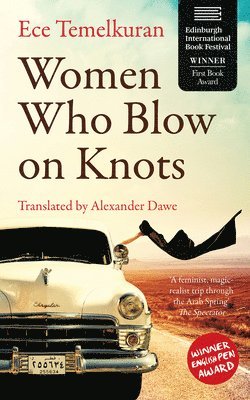
'A feminist, magic-realist trip through the Arab Spring' The Spectator'Temelkuran has zest, and heart, and guts, to spare... a beach-read with brains and bounce' Boyd Tonkin'If you can't think of a better road story than Thelma and Louise, you should read this novel' OEzlem Ezer -- Publisher: Parthian BooksA run-away success in Turkey, Women Who Blow on Knots has been translated into several languages and this is its first publication in English, translated by Alexander Dawe with the support of a well-deserved English PEN translation award. It is a great door-stopper of a book, an epic undertaking for author, translator and reader alike, but don't be put off. Be brave. Be patient. It's worth it.On the surface, this is the story of a women's road trip with a mission, but it is also a richly textured narrative operating on many levels. The book it calls to mind for me is Umberto Eco's The Name of the Rose, which was such a huge word-of-mouth success in the 1980s - a page-turning mystery story underpinned by layer upon layer of knowledge and erudition. There are similarities here. Women Who Blow on Knots is an adventure, a journey of discovery that will take you deep into the Libyan desert, the Arab Spring, the story of Dido and Aeneas, and a whole world of women's stories stretching across the seas and the millennia.Three women meet by chance at the Dar el-Medina Hotel in Tunis: Maryam, an Egyptian academic who has been among the protesters in Tahrir Square; Amira, a Tunisian dancer and internet activist who has just arrived from New York; and the unnamed narrator, a Turkish journalist who has recently lost her job and travelled to Tunis to write about the Arab Spring that began in Kasbah Square. Also by chance, they make the acquaintance of 'the magnificent, one-and-only Madam Lilla', who lives in the adjacent villa and invites them first to dine with her and then to accompany her on an extraordinary road trip through Libya, Egypt and Lebanon. She is clearly on a mission, an old woman tracking down a man she once loved in a distant land. Each for her own reasons, the three younger women agree. 'Trust me,' Madam Lilla tells them. 'You're setting out on the journey of a lifetime. Enjoy it while you can.' It is a trip that will change all of their lives.In Turkish, 'women who blow on knots' are women of power, and the book is full of powerful women who refuse to surrender: Saida, the female leader of the Amazigh militia in Libya; the women and girls who make sweets and poems to send to men fighting on the front line against Gaddafi, who blow their love and magic on each package; Nana Fatima and her daughter, who keep a refuge for women, hidden deep in the desert; Tin Abutut, who plans to kill Madam Lilla to avenge her mother; Dido, and all 'the mother goddesses and women who ruled these lands hundreds of years ago'.There are stories within stories within stories here - histories and secrets, loves and losses, stories of betrayal and revenge, and sometimes of redemption. The road trip is a journey of discovery, a pilgrimage during which the women, like all pilgrims, tell each other stories, so that as they travel they learn not only about each other, but also more about themselves. And in so doing, they too become women of power. -- Suzy Ceulan Hughes @ www.gwales.com