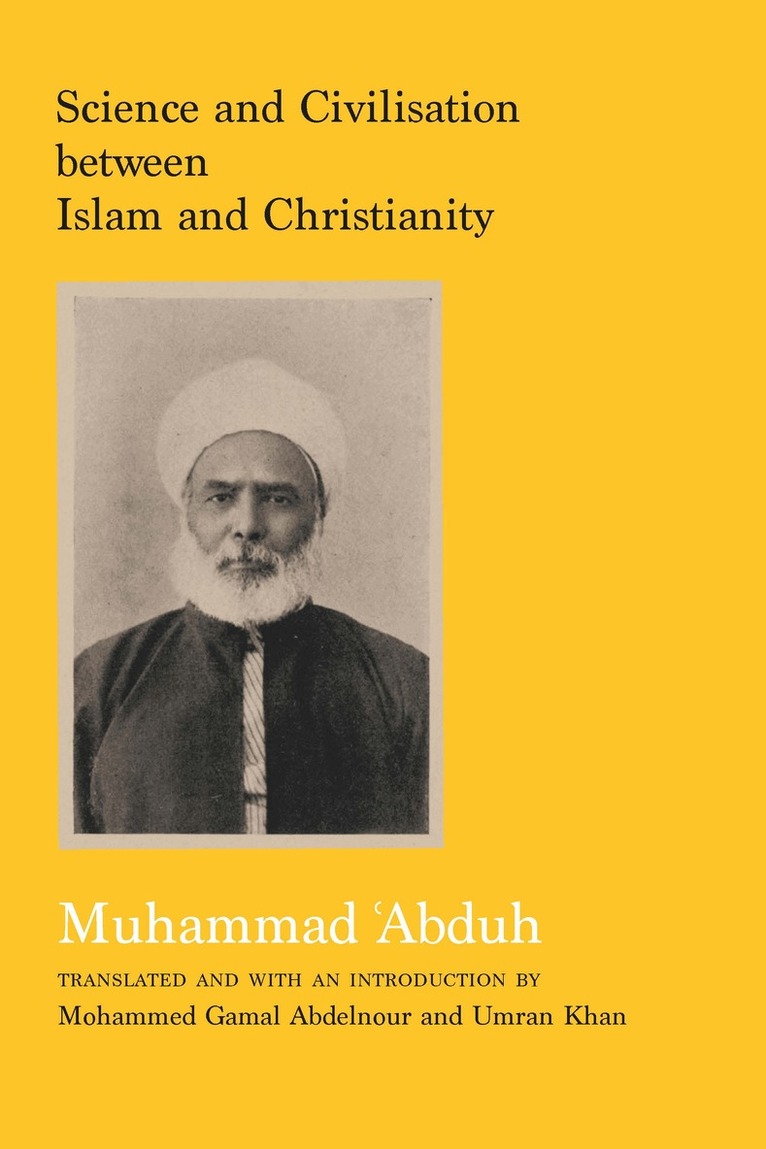
Science and Civilisation between Islam and Christianity
675 kr
Beställningsvara. Skickas inom 7-10 vardagar. Fri frakt över 249 kr.
Beskrivning
Produktinformation
- Utgivningsdatum:2025-02-20
- Mått:156 x 234 x 22 mm
- Vikt:366 g
- Format:Inbunden
- Språk:Engelska
- Serie:Interfaith Series
- Antal sidor:192
- Förlag:GINGKO
- Medarbetare:MuhammadAbdel Haleem
- ISBN:9781914983245
- Översättare:Mohamed Gamal Abdelnour, Umran Khan, Mohammed Gamal Abdelnour
Utforska kategorier
Mer om författaren
Mohamed Gamal Abdelnour is a faculty member at the Faculty of Usul al-Din, Al-Azhar University (Cairo) and a research fellow at the department of philosophy, University of York, U.K. He received his primary, secondary and undergraduate education at Al-Azhar, where he memorized the Qur'an at the age of eleven, deeply studied the various disciplines of the Islamic tradition, and graduated as valedictorian of his class with a bachelor's in Islamic Studies and Philosophy in 2011 (Al-Azhar University, Cairo). He holds an MA in Catholic Theology (Durham University, U.K.) and a PhD in Comparative Theology (SOAS University of London).Umran Khan obtained a BA Arabic and History from SOAS, University of London. He works as an Arabic-English translator, editor and proofreader. He also writes on Islamic history and politics, having written for the online magazine Muslim Matters on Islam in the Indian subcontinent and an award-winning essay on Muslim Intellectual Life in 8th Century Baghdad for Hamad Bin Khalifa University, Qatar. He teaches Arabic and Islamic History at the Hounslow Jamia Masjid & Islamic Centre and is currently the programme manager at Al-Salam Institute, London, an institute specialising in teaching Arabic and the Islamic sciences.Muhammad 'Abduh (1849-1905) was a religious scholar, philosopher, jurist, and reformer, who led the late 19th-century movement in Egypt and other Muslim societies to revitalize Islamic teachings and institutions in the modern world.Muhammad A. S. Abdel Haleem is the King Fahd Professor of Islamic Studies and director of the Centre for Islamic Studies at the School of Oriental and African Studies of London University, as well as editor of the Journal of Qur'anic Studies. His Quran translation is one of the most commonly cited in the field. David Thomas is an Emeritus Professor of Christianity and Islam at the University of Birmingham and a priest in the Church of England. Throughout his career, he has combined teaching and research in Islamic thought and Christian-Muslim relations with church involvement at the parish, diocesan and national levels.
Recensioner i media
This is a most important translation, for it widens the available corpus of Muhammad ʿAbduh’s writings for English-speaking readers. ʿAbduh presents a view of Christianity from an Islamic perspective that is timely and challenging. This is a significant book for Muslims and for Christians.—Professor Gavin D’Costa, University of Bristol‘Translations are essential in helping different communities to understand one anothers’ thinking. This work by Muhammad ‘Abduh explicitly addresses the issue of Muslim-Christian mutual perceptions, yet ironically has never before been translated into any European language. So this new and clear translation is to be welcomed –not least by those who find themselves described, and may want to engage with the ideas presented. After all, the exchanges of over one hundred years ago can sound strangely contemporary’.— Dr Martin Whittingham, Academic Dean, The Centre for Muslim-Christian Studies, Oxford Muhammad ʿAbduh has long been a polarising figure in modern Islamic thought, often criticised as a ‘reformer’ accused of undermining tradition in his engagement with modernity. This first translation of Science and Civilisation: Between Islam and Christianity presents a corrective, offering a clear and accessible presentation of ʿAbduh’s nuanced and forward-looking ideas. It showcases his ability to address the challenges of modernity without compromising the richness of the Islamic tradition, underscoring his enduring relevance in contemporary discourse. Love or hate ʿAbduh, this vital contribution to Islamic studies more broadly and Islam and Science in particular, will be invaluable for academics and readers seeking to engage with the complexities of his intellectual legacy.—Dr. Shoaib Ahmed Malik, Lecturer in Science and Religion
Innehållsförteckning
- Foreword ixPreface xiAcknowledgements xiiiTranslators’ Introduction xviiI Biographical context xviiII Intellectual content: apology or epistemology? xxiiIII A note on the translation xxxiIslam, Muslims, and Colonialismin response to Gabriel Hanotaux 1Semitic and Aryan civilisations 1Hanotaux on predestination and transcendence 7Transcendence vs anthropomorphism 12Addressing Hanotaux’s critique of Muslim realities 20Islam’s role in governance and society 24Ottoman–European relations 35Reflections 40The Persecution of Knowledge and Civilisation underChristianity in response to Farah Antun 41The succinct response 43The detailed response 45Denial of inter-fighting between Muslims due to differencesof belief 45Muslims’ tolerance with scholars, researchers, and philosophersfrom all groups 47Scholars and philosophers who enjoyed the good graces of thecaliphs 48The Essence of Christianity 53Introduction 53The first principle of Christianity: miracles 53The second principle of Christianity: the authority of the priests 55The third principle of Christianity: asceticism 55The fourth principle of Christianity: belief in the incomprehensible 56The fifth principle of Christianity: that the Holy Scriptures containeverything which mankind needs to know for this life andthe next 57The sixth principle of Christianity: demarcating between Christiansand others – including those with similar beliefs 58The results and effects of these principles 58Christianity’s opposition to science 61The surveillance of publications and the Inquisition 63Christian persecution of Muslims, Jews, and scholars in general 65Principle of authority for clergymen over the masses 66Church opposition to hypodermic injections 67Opposition to painless labour 67Opposition to civil authority and freedom of belief 67Opposition to scientific associations and books 68Protestantism and reform 68Separation of church and state in Christianity 70Muslim belief about the Messiah and Christianity 71The Essence of Islam Towards Science and Philosophy inAccordance with its Principles 75Introduction to the first principle 75The first principle of Islam: rational enquiry to attain faith 79The second principle of Islam: preference of reason over the apparentmeaning of revelation when there is a contradiction 79The third principle: a principle of judgement in Islam: avoidingexcommunication 80The fourth principle of Islam: consideration of God’s universal lawsin creation 80The fifth principle of Islam: the overthrow of religious authority 82The sixth principle of Islam: protecting Islam by defensive war toavoid compulsion in religion 86The seventh principle of Islam: amicability of opposing beliefs 89The eighth principle of Islam: combining the interest of this lifeand the hereafter 90Outcomes of these principles and their effects on Muslims 95Muslim engagement with literary and rational sciences 96Their engagement with cosmology at the beginning of the secondcentury 97Their development of public and private libraries 98Their development of colleges for sciences and the method ofteaching within them 99Western sciences and their discoveries 100Caliphs and rulers taking scholars and scholarly production bythe hand 104Removing two doubts and explaining the reality of the so-calledpersecution 105Islam today and judging Islam based on Muslims’ conduct 108Renan’s view on Islam 111Muslim stagnation and its causes 113Europe’s Acquisition of Civilisation from Islam and the Reasonsfor its General Prominence 135The first reason: associations 135The second reason: religious pressure 136The third reason: revolution 137The fourth reason: leaving Christianity 137A return to Islam’s tolerance 138Knowledge’s dependence on religion and the contagion of bigotryamongst Muslims 140Neglect of the statements of the earliest Muslims and the state of thereligious sciences and their students 142Knowledge’s affiliation with Islam and its disassociation from allelse 144The callers to Islam 145The imitator is always below the imitated 146Reform and reformers 147The difference between the two types of fanaticism 148Hanotaux’s recent opinion 148Policy of the English regarding tolerance 150Conclusion 151Bibliography 153Index 157
Du kanske också är intresserad av
- Signerad!
- -30%
- 4 för 3
Brevbäraren i Lizzanello
Francesca Giannone
Pocket, 2026
99 kr