• Fri frakt över 249 kr
  • •
  • Snabba leveranser
  • •
  • Billiga böcker
Kundservice

Du är på sajten för privatpersoner.

Företag, bibliotek eller offentlig verksamhet?

Du handlar på classic.bokus.com, där alla dina funktioner finns intakta.
Till classic.bokus.com
Bokus logotyp. Gå till startsidan.
  • Erbjudanden
  • Nyheter
  • Student
  • Topplistor
  • Barn & ungdom
  • Bokus Play
  • E-böcker
  • Pocketböcker
  • Spel & pussel

10% rabatt på allt med kod NYSTART10 →

Sidfot

Mina sidor

    Hjälp

    • Kundservice
    • Vanliga frågor och svar
    • Frakt och leverans
    • Retur vid ångerrätt
    • Reklamera vara
    • Betalning
    • Köpvillkor
    • Allmänna villkor
    • Information om webbplatsens tillgänglighet

    Om Bokus

    • Om oss
    • Pressrum
    • För studenter
    • För företag
    • För bibliotek och offentlig verksamhet
    • För leverantörer
    • Hållbarhet

    Populärt

    • Aktuella erbjudanden
    • Presentkort
    • Studentlitteratur
    • Nya böcker
    • Topplistor
    • Signerade böcker
    • Engelska böcker

    Inspiration

    • Boktips
    • BookTok
    • Populära bokserier
    • Barnbokskaraktärer
    • Populära författare
    Logotyp för Bokus
    Följ oss på Facebook (extern länk)Följ oss på Instagram (extern länk)Följ oss på YouTube (extern länk)Följ oss på TikTok (extern länk)
    bokus @ CookiesAnpassa cookiesIntegritetspolicyKöpvillkor
    Till Citymail hemsida (extern länk)Till Budbee hemsida (extern länk)Till Postnord hemsida (extern länk)Till Schenker hemsida (extern länk)Till Early Bird hemsida (extern länk)Till Walleys hemsida (extern länk)
    1. Naturvetenskap och teknik
    2. Matematik och naturvetenskap
    3. Kemi
    4. Fysikalisk kemi

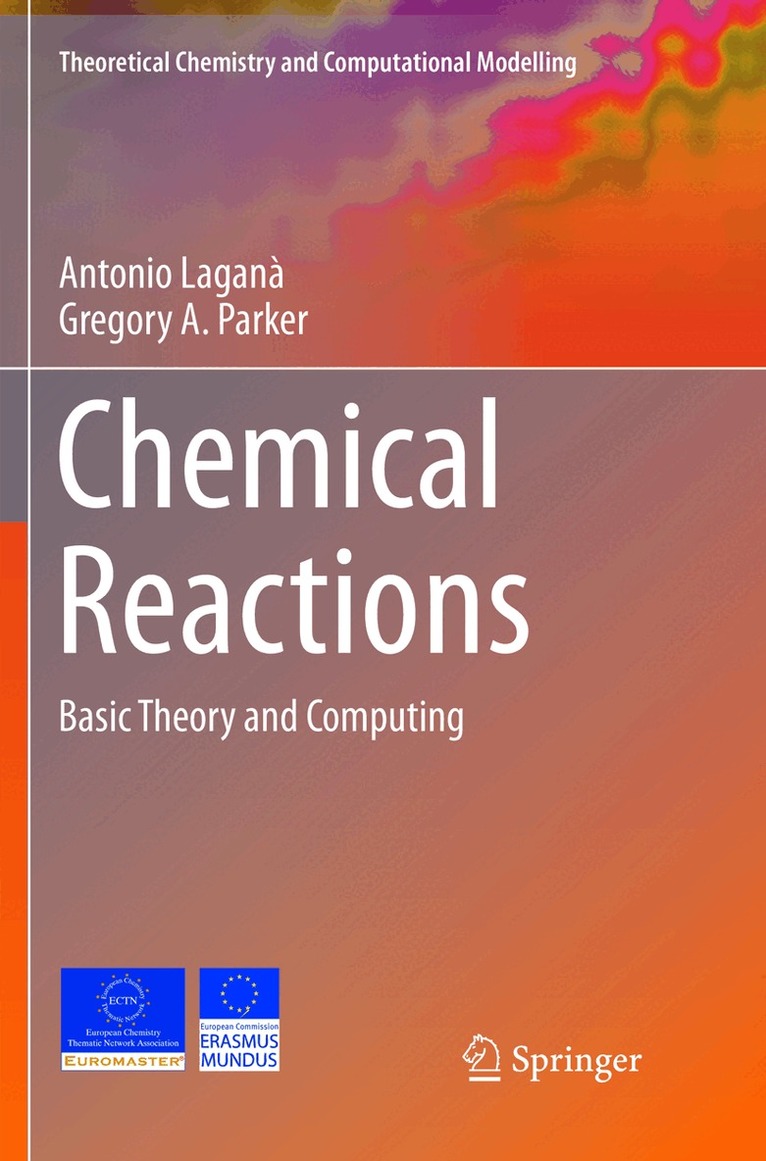
    Chemical Reactions

    Basic Theory and Computing

    AvAntonio Laganà,Gregory A. Parker

    Häftad, Engelska, 2019

    Del i serien Theoretical Chemistry and Computational Modelling

    707 kr

    Beställningsvara. Skickas inom 10-15 vardagar. Fri frakt över 249 kr.

    Fler format och utgåvor

    Inbunden

    1 085 kr

    Beskrivning

    This graduate textbook, written by experienced lecturers, features the study and computation of efficient reactive processes. The text begins with the problem of determining the chemical reaction properties by first decomposing complex processes into their elementary components. Next, the problem of two colliding mass points is investigated and relationships between initial conditions and collision outcomes are discussed. The failure of classical approaches to match experimental information is discussed and a quantum formulation of the calculation of the properties of two colliding bodies is provided. The authors go onto describe how the formalism is extended to structured collision partners by discussing the methods used to compute the electronic structure of polyelectronic reactants and products and the formalism of atom diatom reactions. Additionally, the relationships between the features of the potential energy surface and the outcomes of the reactive dynamics, are discussed. Methods for computing quantum, classical, and semi-classical reactive probabilities based on the already discussed concepts and tools are also featured and the resulting main typical reactive behaviors are analyzed. Finally, the possibility of composing the computational tools and technologies needed to tackle more complex simulations as well as the various competences and distributed computing infrastructure needed for developing synergistic approaches to innovation are presented.

    Produktinformation

    • Utgivningsdatum:2019-06-04
    • Mått:155 x 235 x 12 mm
    • Vikt:388 g
    • Format:Häftad
    • Språk:Engelska
    • Serie:Theoretical Chemistry and Computational Modelling
    • Antal sidor:208
    • Förlag:Springer International Publishing AG
    • ISBN:9783319872995

    Utforska kategorier

    • Fysikalisk kemi inom Naturvetenskap och teknik
    • Oorganisk kemi inom Naturvetenskap och teknik

    Mer om författaren

    Antonio Laganà is Professor of Inorganic Chemistry at the University of Perugia. After his (Theoretical and Computational) Chemistry degree he has been postdoc at the University of Manchester (1977-78) and Visiting Researcher at several Laboratories and Universities (ECSEC, Caltech, Cambridge, Los Alamos, Salamanca, Bristol, CERN, EPCC, Vitoria, FORTH, Barcelona, CNUCE). He has been Director of two NATO workshops and has organized several International Schools and Conferences (among which Molec, Molecular Beams, Gas Kinetics, Stereodynamics, Computational Chemistry, Parallel computing, International Conference on Computational Science and its Applications) His research work has developed in the fields of electronic structure, molecular scattering, dynamics and kinetics, parallel and distributed scientific algorithms, high performance and high throughput computations with particular emphasis to distributed research and education community environments and tools. He has published morethan 400 papers and authored 10 books.Prof. Laganà chairs the Computational Chemistry Division of EUCHEMS, the Virtual Research Community CMMST (Chemistry, Molecular & Materials Sciences and Technologies) of EGI.eu and the Virtual Education Community Standing Committee of ECTN. He has chaired in the past the ECTN Association (2007-2009), the COST Chemistry technical committee (2003-07), the Chemistry Department of the Perugia University (2002-13), the Computer Centre of the University of Perugia (1996-2001) and the Italian Interdivisional group of Computational Chemistry.Prof. Greg Parker is the George Lynn Cross Research Professor at the Homer L. Dodge Department of Physics and Astronomy in the university of Oklahoma. He obtained his B.S and PhD from Brigham Young University, USA. Prof. Parker is the recipient of the following awards: the George Lynn Cross Research Professorship and the  Regents' Award for Superior Research & Creative Activity.

    Innehållsförteckning

    • From the phenomenology of chemical reactions to the study of two body collisions.- A quantum approach to the two body problem.- Ab initio electronic structure for few body systems.- The treatment of few body reactions.- Complex reactive applications: a forward look to Open Science.- Appendices.