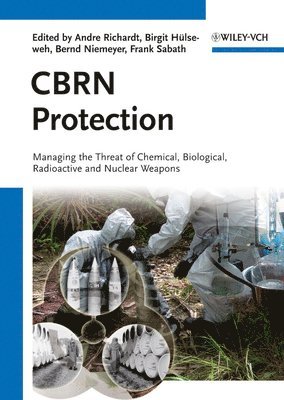
CBRN Protection
Managing the Threat of Chemical, Biological, Radioactive and Nuclear Weapons
AvAndre Richardt,Andre Richardt
854 kr
Skickas . Fri frakt över 249 kr.
Beskrivning
Produktinformation
- Utgivningsdatum:2012-11-14
- Mått:178 x 249 x 31 mm
- Vikt:1 247 g
- Format:Inbunden
- Språk:Engelska
- Antal sidor:514
- Förlag:Wiley-VCH Verlag GmbH
- ISBN:9783527324132
Utforska kategorier
Mer om författaren
Andre Richardt has obtained his academic degrees from University Cologne in 1991 (Dipl. Degree in Genetics), Albert-Ludwigs-University, Freiburg (Dr. rer. nat Degree in Microbiology) in 1997 and Helmut-Schmidt-University, Hamburg (Dr. habil Degree in Biotechnology) in 2006. Currently, he is head of Biological and Chemical Decontamination business area at the Bundeswehr Research Institute for Protective Technologies and NBC Protection in Munster, Germany. Most of his career he has been working for the German Armed Forces in the field of CBRN-protection. From 2004 to 2005 he worked at dstl, PortonDown, Great Britain. In the special field catalytic decontamination of biological and chemical warfare agents he has been working for over ten years in national and international working-groups. His current research interests include investigations of non-thermal inactivation of biological and chemical agents as well as the control of the efficiency of a decontamination process. Currently, he is also a lecturer at the Helmut-Schmidt-University, Hamburg and he tutors young officers in the field of CBRN-protection. He is a member in several working groups dealing with fundamental technical and scientific aspects of CBRN protection. Dr. Birgit Hülseweh studied Biology at the Heinrich-Heine-University of Düsseldorf, Germany with a focus on Microbiology, Molecularbiology and Organic Chemistry. There she received her Diploma in 1990 and did her doctoral thesis (PhD) at the Institute of Microbiology.From 1994 to 1998 she was as a post-doc at the Max-Planck Institute for Molecular Physiology in Dortmund, Germany and for another 4 year period she worked as a scientific assistant at the University of Essen-Duisburg, Germany. From 2001 to 2002 she was the head of the scientific laboratory of Alpha Technology GmbH in Cologne, Germany, a biotech company, which dealt with the spotting, production and electrical read-out of microarrays for microbial diagnostics. In 2003 she joined as a senior scientist the department of Virology at the Bundeswehr Research Institute for Protective Technologies and NBC Protection in Munster, Germany. Her research focuses on innovative technologies for the identification of microorganisms and her scientific interests include all aspects of real-time-PCR methods, array applications as well as innovative applications of nanotechnology. Dr. Hülseweh has extensive experience in Molecular and Cellular Biology as well as in Immunology and Biochemistry. She is the author of diverse peer reviewed scientific publications and tutors several PhD-students. She has been working as scientific advisor in national and international working-groups and takes care for several international scientific co-operations. Bernd Niemeyer studied Chemical Engineering and obtained his German Diploma degree (Dipl.-Ing.) at the University Erlangen-Nuremberg, Germany in 1986. His following PhD work focused in the field of bio engineering at the same University. He obtained his PhD-degree in 1990. As Post-doc he visited the Department of Scientific and Industrial Research (DSIR) in Lower Hutt (New Zealand) for one year and researched into separation technologies for health and chemical engineering topics. After his comeback he worked for the Deutsche Aerospace AG (later named DaimlerChrysler Aerospace AG) and the company Thermoselect Suedwest GmbH. He designed, constructed and commissioned new waste treatment plants for ammunition disposal (newly invented process) as well as for municipal waste processing.Since 1996 he leads the Chair of "Process Engineering with focus on Separation Technology" at the Helmut-Schmidt-University / University of the Federal Armed Forces Hamburg in combination with the Research Group "Molecular Recognition and Separation" at the Helmholtz-Zentrum Geesthacht, Centre for Material Science and Coastal Research.His research interests are applicable for CBRN-safety (analyses and decontamination of biological warfare agents as well as protection, detection and decontamination of chemical warfare agents), environmental engineering (waste as well as off-gas treatment, like odorous removal), biotechnology (enzyme catalysis and separation of valuables) as well as chemical processing (process design and separation of substances from reaction mixtures). The main methods applied are mainly adsorptive separation technologies, oxidative processes, and development of analytical and sensor systems. Frank Sabath received the Dipl.-Ing. Degree in electrical engineering from the University of Paderborn, Paderborn, Germany, in 1993, and the Dr.-Ing. degree from the Leibniz University of Hannover, Hannover, Germany, in 1998.From 1993 to 1998, he was with the C-Lab, a Joint Research and Development Institute of the University of Paderborn and the Siemens Nixdorf Informationssysteme AG, Paderborn, Germany, where his responsibilities included research activities on numerical field calculation and the radiation analysis of printed circuit boards. Since 1998, he has been with the Federal Office of Defense Technology and Procurement (BWB). Currently, he is head of the division on Balanced Nuclear Protection Measures and Nuclear Hardening, Electro-Magnetic Effects, Fire Protection of the Bundeswehr Research Institute for Protective Technologies and NBC-Protection (WIS), Munster, Germany. He is the author or coauthor of more than 110 papers published in international journals and conference proceedings. His research interests include investigations of electromagnetic field theory, High-Power Electromagnetics, investigations of short pulse interaction on electronics, and impulse radiation.Dr. Sabath served as Ultra Wide Band (UWB) co-chairman of the EUROEM 2004, Magdeburg, Germany as well of the EUROEM 2008, Lausanne, Switzerland. He has been the Editor-in-chief for several Ultra-Wideband, Short-Pulse electromagnetics books. Currently he is an Associate Editor of the IEEE Transactions on EMC, member of the board of directors of the IEEE EMC Society and chair of the IEEE Germany Section EMC Society Chapter. Due to his outstanding service the EMC Society presented him the Laurence G. Cumming Award in 2009 and the Honored Member Award in 2012. He is a Member of the IEEE Electromagnetic Compatibility (EMC), Antennas and Propagation (AP), Microwaves Theory and Techniques (MTT) societies, and a member of URSI Commission E.
Innehållsförteckning
- Foreword XVPreface XVIIAbout the Editors XIXList of Contributors XXIIIPart I History and Treaties in CBRN -- Warfare and Terrorism 11 A Glance Back -- Myths and Facts about CBRN Incidents 3Andre Richardt and Frank Sabath1.1 Introduction 31.2 History of Chemical Warfare 41.3 Introduction to Biological Warfare 131.4 Introduction to Radiological and Nuclear Warfare 222 International Treaties -- Only a Matter for Diplomats? 39Martin Schaarschmidt2.1 Introduction to the Minefield of Negotiations 392.2 Why It Is so Difficult to Implement International Regulations? 422.3 Historic Development of Treaties -- the Link to the Incidents 462.4 Today's System of Treaties -- a Global Network 472.5 Nuclear Weapons 542.6 Organizations 632.7 Conclusions and Where Does the Road Lead? 64Part II CBRN Characteristics -- Is There Something Inimitable? 673 Chemical Agents -- Small Molecules with Deadly Properties 69Hans-Jurgen Altmann, Silke Oelze, and Bernd Niemeyer3.1 Are Special Properties Required for Chemical Warfare Agents? 693.2 How can we Classify Chemical Warfare Agents? 713.3 Properties of Chemical Warfare Agents 783.4 Choking and Irritant Agents 973.5 Incapacitating Agents 993.6 Dissemination Systems of Chemical Warfare Agents 993.7 Conclusions and Outlook 1014 Characteristics of Biological Warfare Agents -- Diversity of Biology 103Birgit Hulseweh4.1 What Is Special? 1044.2 Types of Biological Agents 1044.3 Risk Classification of Biological and Biological Warfare Agents 1104.4 Routes of Entry 1144.5 Origin, Spreading, and Availability 1184.6 The Biological Event -- Borderline to Pandemics, Endemics, and Epidemics 1214.7 The Bane of Biotechnology -- Genetically Engineered Pathogens 1214.8 Conclusions and Outlook 1235 Characteristics of Nuclear and Radiological Weapons 125Ronald Rambousky and Frank Sabath5.1 Introduction to Nuclear Explosions 1265.2 Direct Effects 1335.3 Indirect Effects 1495.4 Radiological Weapons 159Part III CBRN Sensors -- Key Technology for an Effective CBRN Countermeasure Strategy 1676 Why Are Reliable CBRN Detector Technologies Needed? 169Birgit Hulseweh, Hans-Jurgen Marschall, Ronald Rambousky, and Andre Richardt6.1 Introduction 1696.2 A Concept to Track CBRN Substances 1706.3 Low-Level Exposure and Operational Risk Management 1756.4 Conclusions and Outlook 1777 Analysis of Chemical Warfare Agents -- Searching for Molecules 179Andre Richardt, Martin Jung, and Bernd Niemeyer7.1 Analytical Chemistry -- the Scientific Basis for Searching Molecules 1807.2 Standards for Chemical Warfare Agent Sensor Systems and Criteria for Deployment 1827.3 False Alarm Rate and Limit of Sensitivity 1847.4 Technologies for Chemical Warfare Agent Sensor Systems 1857.5 Testing of Chemical Warfare Agent Detectors 2037.6 Conclusions and Future Developments 2068 Detection and Analysis of Biological Agents 211Birgit Hulseweh and Hans-Jurgen Marschall8.1 What Makes the Difference? 2128.2 The Ideal Detection and Identification Platform 2158.3 Bioaerosols: Particulate and Biological Background 2168.4 Aerosol Detection -- A Tool for Threat Monitoring 2178.5 Sampling of Biological Agents 2238.6 Identification of Biological Warfare Agents 2298.7 Developing and Upcoming Technologies 2388.8 Conclusions 2399 Measurement of Ionizing Radiation 243Ronald Rambousky9.1 Why Is Detection of Ionizing Radiation So Important? 2449.2 Physical Quantities used to Describe Radioactivity and Ionizing Radiation 2489.3 Different Measuring Tasks Concerning Ionizing Radiation 2519.4 Basics of Radiation Detectors 2569.5 Gamma Dose Rate and Detection of Gamma Radiation 2669.6 Conclusions and Outlook 271Part IV Technologies for Physical Protection 27310 Filter Technology -- Clean Air is Required 275Andre Richardt and Thomas Dawert10.1 Filters -- Needed Technology Equipment for Collective and Individual Protection 27510.2 General Considerations 27610.3 What are the Principles for Filtration and Air-Cleaning? 27810.4 Test Methods 28610.5 Selection Process for CBRN Filters 29010.6 Conclusions and Outlook 29211 Individual Protective Equipment -- Do You Know What to Wear? 295Karola Hagner and Friedrich Hesse11.1 Basics of Individual Protection 29611.2 Which Challenges for Individual Protection Equipment (IPE) Can Be Identified? 29611.3 The Way to Design Individual Protective Equipment 29811.4 Function 29911.5 Ergonomics -- a Key Element for Individual Protection Equipment 30111.6 Donning and Doffing -- Training Is Required 30511.7 Overview of IPE Items -- They Have to Act in Concert 30611.8 Quality Assurance 32611.9 Workplace Safety 32711.10 Future Prospects 32712 Collective Protection -- A Secure Area in a Toxic Environment 331Andre Richardt and Bernd Niemeyer12.1 Why Is Collective Protection of Interest? 33212.2 Collective Protection Systems -- Required for Different Scenarios 33712.3 Basic Design 34112.4 Conclusions and Outlook 348Part V Cleanup after a CBRN Event 35113 Decontamination of Chemical Warfare Agents -- What is Thorough? 353Hans Jurgen Altmann, Martin Jung, and Andre Richardt13.1 What Is Decontamination? 35313.2 Dispersal and Fate of Chemical Warfare Agents 35413.3 Decontamination Media for Chemical Warfare Agents 35613.4 Selected Chemical Warfare Agents and Decont Reaction Schemes 36913.5 Soman (GD) 37213.6 VX 37213.7 Catalysis in Decontamination 37313.8 Decont Procedures 37513.9 Conclusions and Outlook 38014 Principles and Practice of Disinfection of Biological Warfare Agents -- How Clean is Clean Enough? 383Andre Richardt and Birgit Hulseweh14.1 General Principles of Disinfection and Decontamination 38414.2 Mechanisms of Action of Biocides against Microorganisms 38514.3 Levels of Disinfection 39014.4 Biological Target Sites of Selected Biocides 39314.5 The Spores Problem 39514.6 Inactivation as Kinetic Process 39914.7 Evaluation of Antimicrobial Efficiency 40114.8 Carrier Tests versus Suspension Tests 40314.9 Resistance to Biocide Inactivation -- a Growing Concern 40514.10 New and Emerging Technologies for Disinfection 40814.11 "Is Clean Clean Enough'' or "How Clean Is Clean Enough''? 40815 Radiological/Nuclear Decontamination -- Reduce the Risk 411Nikolaus Schneider15.1 Why Is Radiological/Nuclear Decontamination So Special? 41215.2 Contamination 41415.3 Decontamination 41815.4 Conclusions and Outlook 428Part VI CBRN Risk Management -- Are We Prepared to Respond? 43116 Preparedness 433Marc-Michael Blum, Andre Richardt, and Kai Kehe16.1 Introduction to Risk Management 43316.2 Key Elements Influencing a Counter-CBRN Strategy 43616.3 A Special Strategy for CBRN 43816.4 Proliferation Prevention 45616.5 Active Countermeasures 45816.6 If Things Get Real: Responding to a CBRN Event 45916.7 Research 47316.8 Aftermath Action -- Lessons Learned 47416.9 Conclusions and Outlook 475References 476Index 479
Du kanske också är intresserad av
Ultra-Wideband, Short Pulse Electromagnetics 9
Armin Kaelin, Farhad Rachidi, D.V. Giri, Frank Sabath
5 030 kr
Ultra-Wideband, Short-Pulse Electromagnetics 7
Daniel Nitsch, Uwe Schenk, Eric L. Mokole, Frank Sabath
3 948 kr
High-Power Radio Frequency Effects on Electronic Systems
D.V. Giri, Richard Hoad, Frank Sabath
Inbunden, 2020
1 421 kr
Ultra-Wideband, Short-Pulse Electromagnetics 7
Frank Sabath, Eric L. Mokole, Uwe Schenk, Daniel Nitsch
Inbunden, 2007
3 263 kr
Ultra-Wideband, Short Pulse Electromagnetics 9
Frank Sabath, D.V. Giri, Farhad Rachidi, Armin Kaelin
Inbunden, 2010
4 132 kr
Ultra-Wideband, Short Pulse Electromagnetics 9
Frank Sabath, D.V. Giri, Farhad Rachidi, Armin Kaelin
Häftad, 2016
4 128 kr