• Fri frakt över 249 kr
  • •
  • Snabba leveranser
  • •
  • Billiga böcker
Kundservice

Du är på sajten för privatpersoner.

Företag, bibliotek eller offentlig verksamhet?

Du handlar på classic.bokus.com, där alla dina funktioner finns intakta.
Till classic.bokus.com
Bokus logotyp. Gå till startsidan.
  • Erbjudanden
  • Student
  • Topplistor
  • Barn & ungdom
  • Bokus Play
  • E-böcker
  • Ljudböcker
  • Pocketböcker
  • Spel och pussel

5% studentrabatt – använd koden KURSBOK27 →

Sidfot

Mina sidor

    Hjälp

    • Kundservice
    • Vanliga frågor och svar
    • Frakt och leverans
    • Retur vid ångerrätt
    • Reklamera vara
    • Betalning
    • Köpvillkor
    • Allmänna villkor
    • Information om webbplatsens tillgänglighet

    Om Bokus

    • Om oss
    • Pressrum
    • För studenter
    • För företag
    • För bibliotek och offentlig verksamhet
    • För leverantörer
    • Hållbarhet

    Populärt

    • Aktuella erbjudanden
    • Presentkort
    • Studentlitteratur
    • Nya böcker
    • Topplistor
    • Signerade böcker
    • Engelska böcker

    Inspiration

    • Boktips
    • BookTok
    • Barnbokskaraktärer
    • Populära författare
    Logotyp för Bokus
    Följ oss på Facebook (extern länk)Följ oss på Instagram (extern länk)Följ oss på YouTube (extern länk)Följ oss på TikTok (extern länk)
    bokus @ CookiesAnpassa cookiesIntegritetspolicyKöpvillkor
    Till Citymail hemsida (extern länk)Till Budbee hemsida (extern länk)Till Postnord hemsida (extern länk)Till Schenker hemsida (extern länk)Till Early Bird hemsida (extern länk)Till Walleys hemsida (extern länk)
    1. Data och IT
    2. Systemvetenskap och AI

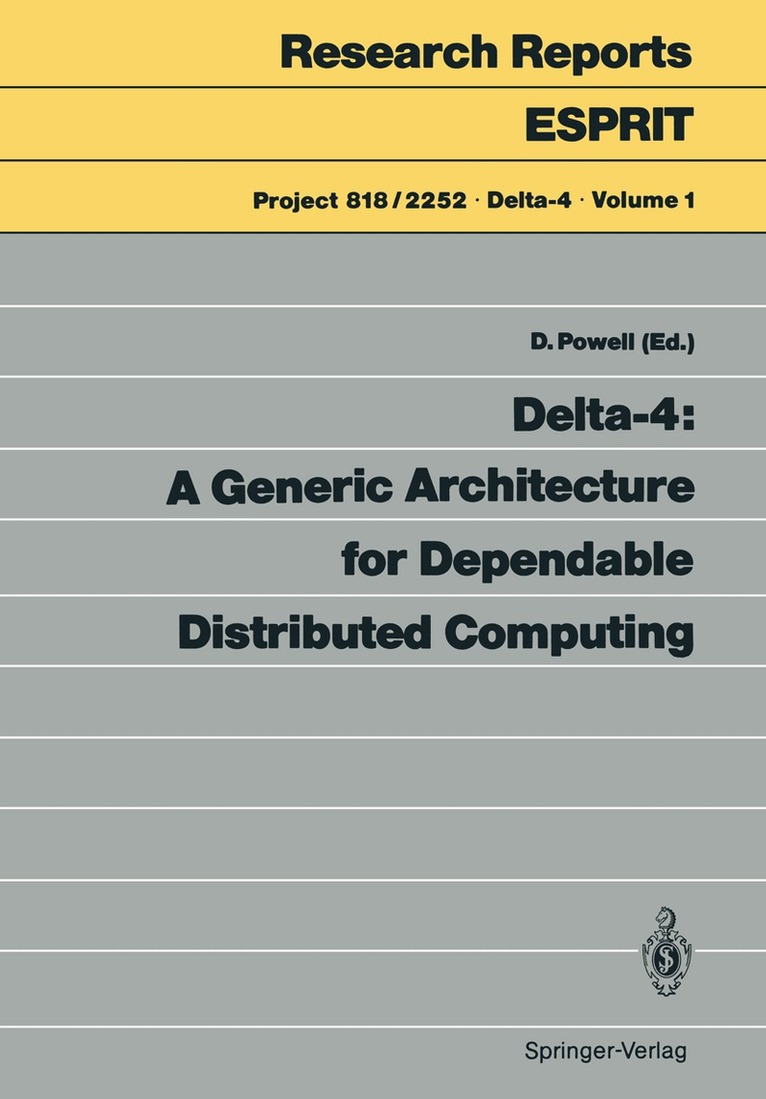
    Delta-4: A Generic Architecture for Dependable Distributed Computing

    AvDavid Powell

    Häftad, Engelska, 1991

    Del i serien Research Reports Esprit

    559 kr

    Beställningsvara. Skickas inom 10-15 vardagar. Fri frakt över 249 kr.

    Beskrivning

    Delta-4 is a 5-nation, 13-partner project that has been investigating the achievement of dependability in open distributed systems, including real-time systems. This book describes the design and validation of the distributed fault-tolerant architecture developed within this project. The key features of the Delta-4 architecture are: (a) a distributed object-oriented application support environment; (b) built-in support for user-transparent fault­ tolerance; (c) use of multicast or group communication protocols; and (d) use of standard off­ the-shelf processors and standard local area network technology with minimum specialized hardware. The book is organized as follows: The first 3 chapters give an overview of the architecture's objectives and of the architecture itself, and compare the proposed solutions with other approaches. Chapters 4 to 12 give a more detailed insight into the Delta-4 architectural concepts. Chapters 4 and 5 are devoted to providing a firm set of general concepts and terminology regarding dependable and real-time computing. Chapter 6 is centred on fault-tolerance techniques based on distribution. The description of the architecture itself commences with a description of the Delta-4 application support environment (Deltase) in chapter 7. Two variants of the architecture - the Delta-4 Open System Architecture (OSA) and the Delta-4 Extra Performance Architecture (XPA) - are described respectively in chapters 8 and 9. Both variants of the architecture have a common underlying basis for dependable multicasting, i. e.

    Produktinformation

    • Utgivningsdatum:1991-11-13
    • Mått:170 x 244 x 27 mm
    • Vikt:848 g
    • Format:Häftad
    • Språk:Engelska
    • Serie:Research Reports Esprit
    • Antal sidor:484
    • Förlag:Springer-Verlag Berlin and Heidelberg GmbH & Co. KG
    • ISBN:9783540549857

    Utforska kategorier

    • Systemvetenskap och AI inom Data och IT

    Innehållsförteckning

    • 1. Requirements and Objectives.- 1.1. Fields of Application.- 1.2. Architectural Attributes.- 2. Overview of the Architecture.- 2.1. Dependability and Real-Time Concepts.- 2.2. Dependability and Real-Time in Delta-4.- 2.3. Architectural Sub-Systems.- 2.4. Software Environment and Management Issues.- 2.5. Validation.- 3. Comparison with other Approaches.- 3.1. Commercial Fault-Tolerance Techniques.- 3.2. Comparison of Approaches by Concept/Technique.- 3.3. Comparison of Approaches by Target System Characteristics.- 3.4. Case Studies.- 3.5. Conclusion.- 4. Dependability Concepts.- 4.1. Basic Definitions.- 4.2. On the Introduction of Dependability as a Generic Concept.- 4.3. On System Function, Behavior, Structure and Specification.- 4.4. The Impairments to Dependability.- 4.5. The Means for Dependability.- 4.6. The Attributes of Dependability.- 5. Real-Time Concepts.- 5.1. Concepts and Definitions.- 5.2. Delta-4 Approach to Real-Time.- 5.3. Real-Time Communications Protocols.- 5.4. Summary of Real-Time System Requirements.- 5.5. Conclusions.- 6. Distributed Fault-Tolerance.- 6.1. Related Work.- 6.2. Node Hardware Characteristics.- 6.3. Models of Distributed Computation.- 6.4. Replicated Software Components.- 6.5. Active Replication.- 6.6. Passive Replication.- 6.7. Semi-Active Replication.- 6.8. Group Management and Fault Treatment.- 6.9. Communications Support.- 6.10. Conclusion.- 7. Delta-4 Application Support Environment (Deltase).- 7.1. Purpose and Background.- 7.2. Computational Model.- 7.3. Engineering Model.- 7.4. Deltase Support for Distributed Fault-Tolerance.- 7.5. Engineering Support for Fault-Tolerance.- 7.6. Dependable Databases.- 8. Open System Architecture (OSA).- 8.1. Multipoint Communication System (MCS).- 8.2. System Administration.- 9. Extra PerformanceArchitecture (XPA).- 9.1. Objectives and Definitions.- 9.2. Overview.- 9.3. Real-time and Performance.- 9.4. Dependability and Computational Models.- 9.5. Support for Distributed Real-Time Computing.- 9.6. XPA as an Integrated Machine.- 9.7. System Administration.- 10. The Atomic Multicast protocol (AMp).- 10.1. Notions about Reliable Group Communication.- 10.2. Related Work.- 10.3. System Architecture.- 10.4. Summary of xAMp Services.- 10.5. The Abstract Network.- 10.6. Two-Phase Accept Protocol.- 10.7. Performance and Real-Time.- 10.8. Implementation Issues.- 11. Fail-Silent Hardware for Distributed Systems.- 11.1. Fail-Silent Node Models.- 11.2. A Comparative Evaluation.- 11.3. Concluding Remarks.- 12. Input/Output: Interfacing the Real World.- 12.1. Inter-working with non-Delta-4 systems.- 12.2. Inter-working with the Physical Environment.- 12.3. Summary.- 13. Security.- 13.1. Principles of Intrusion-Tolerance.- 13.2. Fragmentation-Scattering Applied to File Archiving.- 13.3. Intrusion-Tolerant Security Server.- 13.4. Selection and Implementation of an Authorization Policy.- 13.5. Future Extensions.- 14. Software-Fault Tolerance.- 14.1. A Brief History — the State of the Art.- 14.2. Software-Fault Tolerance for Delta-4.- 14.3. Support Mechanisms and Features.- 14.4. Specifying Software Components for Software-fault Tolerance — Tradeoffs in an Object Environment.- 14.5. Concluding Remarks.- 15. Validation.- 15.1. Overview.- 15.2. Protocol Validation.- 15.3. Fault Injection.- 15.4. Dependability Evaluation.- 15.5. Software Reliability.- Annexes.- A. Safety-Critical and Safety-Related Systems.- B. Deterministic UNIX.- C. Statistical Effects with Schedules of many Activities.- D. Assigning Precedence Parameters.- E. Formal Failure Mode Assumptions.- F. AssumptionCoverage.- G. Propagate-before-Validate Error Processing Technique.- H. Interface between XPA and OSA.- I. Timing Characteristics of Preemption Points.- J. Formal Presentation of AMp.- K. Models for the Representation of Reactive Systems.- L. Service Specifications.- M. Co-existence with non-Delta-4 Stations on the same LAN.- Glossary of Abbreviations.- References.- Author Affiliations.- The Delta-4 Consortium.