• Fri frakt över 249 kr
  • •
  • Snabba leveranser
  • •
  • Billiga böcker
Kundservice

Du är på sajten för privatpersoner.

Företag, bibliotek eller offentlig verksamhet?

Du handlar på classic.bokus.com, där alla dina funktioner finns intakta.
Till classic.bokus.com
Bokus logotyp. Gå till startsidan.
  • Erbjudanden
  • Student
  • Topplistor
  • Barn & ungdom
  • Bokus Play
  • E-böcker
  • Ljudböcker
  • Pocketböcker
  • Spel och pussel

Pocketfynda! Hundratals böcker för 49 kr/st →

Sidfot

Mina sidor

    Hjälp

    • Kundservice
    • Vanliga frågor och svar
    • Frakt och leverans
    • Retur vid ångerrätt
    • Reklamera vara
    • Betalning
    • Köpvillkor
    • Allmänna villkor
    • Information om webbplatsens tillgänglighet

    Om Bokus

    • Om oss
    • Pressrum
    • För studenter
    • För företag
    • För bibliotek och offentlig verksamhet
    • För leverantörer
    • Hållbarhet

    Populärt

    • Aktuella erbjudanden
    • Presentkort
    • Studentlitteratur
    • Nya böcker
    • Topplistor
    • Signerade böcker
    • Engelska böcker

    Inspiration

    • Boktips
    • BookTok
    • Barnbokskaraktärer
    • Populära författare
    Logotyp för Bokus
    Följ oss på Facebook (extern länk)Följ oss på Instagram (extern länk)Följ oss på YouTube (extern länk)Följ oss på TikTok (extern länk)
    bokus @ CookiesAnpassa cookiesIntegritetspolicyKöpvillkor
    Till Citymail hemsida (extern länk)Till Budbee hemsida (extern länk)Till Postnord hemsida (extern länk)Till Schenker hemsida (extern länk)Till Early Bird hemsida (extern länk)Till Walleys hemsida (extern länk)
    1. Data och IT
    2. Systemvetenskap och AI
    3. Artificiell intelligens

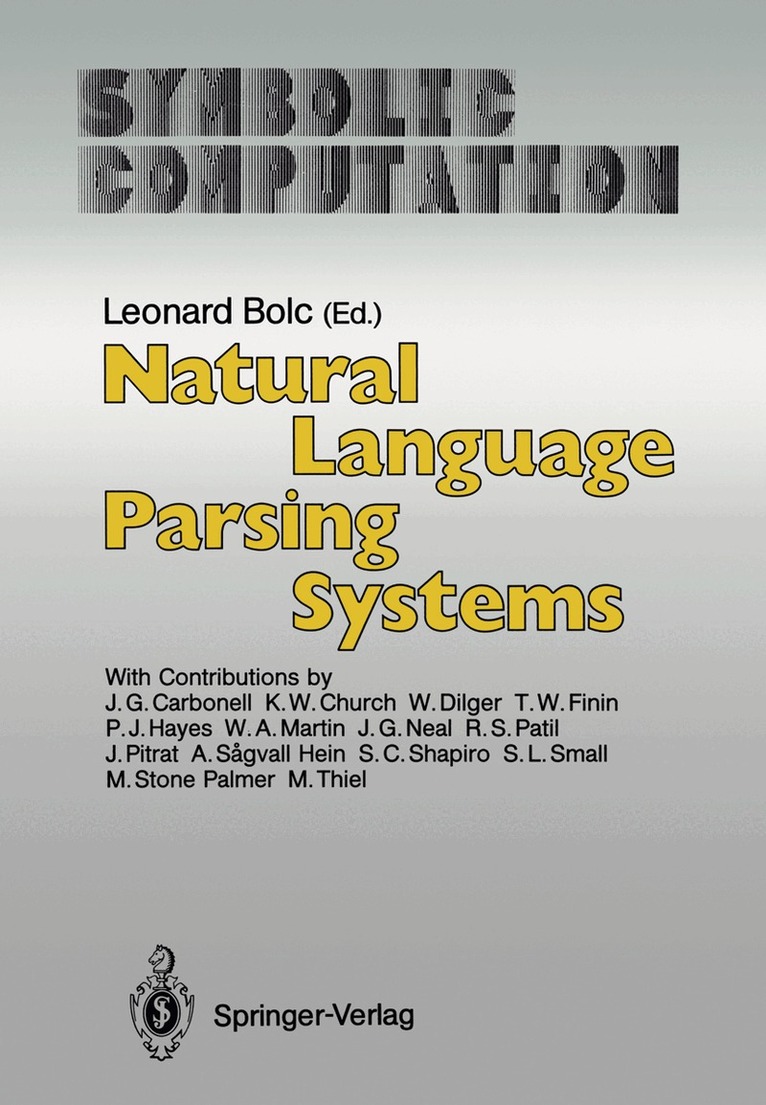
    Natural Language Parsing Systems

    AvLeonard Bolc

    Häftad, Engelska, 2011

    Del i serien Symbolic Computation

    1 110 kr

    Beställningsvara. Skickas inom 10-15 vardagar. Fri frakt över 249 kr.

    Beskrivning

    Up to now there has been no scientific publication on natural lan­ guage research that presents a broad and complex description of the current problems of parsing in the context of Artificial Intelli­ gence. However, there are many interesting results from this domain appearing mainly in numerous articles published in pro­ fessional journals. In view of this situation, the objective of this book is to enable scientists from different countries to present the results of their research on natural language parsing in the form of more detailed papers than would be possible in professional jour­ nals. This book thus provides a collection of studies written by well­ known scientists whose earlier publications have greatly contributed to the development of research on natural language parsing. Jaime G. Carbonell and Philip J. Hayes present in their paper "Robust Parsing Using Multiple Construction-Specific Strategies" two small experimental parsers, implemented to illustrate the advantages of a multi-strategy approach to parsers, with strategies selected according to the type of construction being parsed at any given time. This presentation is followed by the description of a parsing algorithm, integrating some of the best features of the two smaller parsers, including case-frame instantiation and partial pat­ tern-matching strategies.

    Produktinformation

    • Utgivningsdatum:2011-12-08
    • Mått:170 x 244 x 21 mm
    • Vikt:668 g
    • Format:Häftad
    • Språk:Engelska
    • Serie:Symbolic Computation
    • Antal sidor:367
    • Förlag:Springer-Verlag Berlin and Heidelberg GmbH & Co. KG
    • ISBN:9783642830327

    Utforska kategorier

    • Artificiell intelligens inom Data och IT

    Innehållsförteckning

    • Robust Parsing Using Multiple Construction-Specific Strategies.- 1 Introduction.- 2 Construction-Specific Flexible Parsing.- 3 The Representation of Ambiguity and Focused Interaction.- 4 Limited-Domain Language Definition.- 5 Parsing Data Base Queries and Updates.- 6 The CASPAR Parser.- 7 The DYPAR Parser.- 8 Combining the Strengths of CASPAR and DYPAR.- 9 Conclusion.- References.- Parsing with Logical Variables.- 1 Introduction.- 2 Definite Clause Grammars.- 3 Comparing DC and ATN Grammars.- 4 Replacing ATN Registers with ATN Variables.- 5 Conclusions.- References.- Knowledge-Based Parsing.- 1 Introduction.- 2 Core Knowledge and Representations.- 3 Increasing the System’s Language Capability Through Its Language Capability.- 4 Language Use-Mention Distinction.- 5 Summary.- Appendix: Chronological Summary of Input to the System as Presented in This Chapter.- References.- Using Declarative Knowledge for Understanding Natural Language.- 1 Introduction.- 2 The Knowledge.- 3 The Interpreter.- 4 Discussion.- 5 Conclusion.- References.- Weighted Parsing.- 1 The Need for Weighting.- 2 A Digression: Regulation Processes.- 3 Aspects of System Control.- 4 Types of Weighting.- 5 The Application of Weighting in an MT-System.- 6 Examples of the Application of Weighting.- 7 Computation of Weights.- 8 Evaluation of Weights.- References.- A Distributed Word-Based Approach to Parsing.- 1 Introduction.- 2 Background Motivations.- 3 The Parsing System.- 4 Example: “The man throws in the towel”.- 5 Word Expert Definition.- 6 Summary and Conclusions.- References.- Parsing by Means of Uppsala Chart Processor (UCP).- 1 Introduction.- 2 Background.- 3 Uppsala Chart Processor.- 4 Applications.- 5 Summary of Experience with UCP.- References.- Preliminary Analysis of a Breadth-First ParsingAlgorithm: Theoretical and Experimental Results.- 1 An Introduction to Chart Parsing.- 2 Taking Advantage of Restricted Grammars.- 3 Transformations and Lexical Rules.- 4 Experimental Results.- 5 Conclusion.- Appendix I Results with the MALHOTRA Corpus.- Appendix II Results with the LADDER-TODS Collection.- References.- Syntax Directed Translation in the Natural Language Information System PLIDIS.- 1 Some Notation and Basic Definitions.- 2 Tree Directed Grammars.- 3 Tree Transducers.- 4 Tree Directed Grammars and Tree Transducers.- References.