• Fri frakt över 249 kr
  • •
  • Snabba leveranser
  • •
  • Billiga böcker
Kundservice

Du är på sajten för privatpersoner.

Företag, bibliotek eller offentlig verksamhet?

Du handlar på classic.bokus.com, där alla dina funktioner finns intakta.
Till classic.bokus.com
Bokus logotyp. Gå till startsidan.
  • Erbjudanden
  • Student
  • Topplistor
  • Barn & ungdom
  • Bokus Play
  • E-böcker
  • Ljudböcker
  • Pocketböcker
  • Spel och pussel

Pocketfynda! Hundratals böcker för 49 kr/st →

Sidfot

Mina sidor

    Hjälp

    • Kundservice
    • Vanliga frågor och svar
    • Frakt och leverans
    • Retur vid ångerrätt
    • Reklamera vara
    • Betalning
    • Köpvillkor
    • Allmänna villkor
    • Information om webbplatsens tillgänglighet

    Om Bokus

    • Om oss
    • Pressrum
    • För studenter
    • För företag
    • För bibliotek och offentlig verksamhet
    • För leverantörer
    • Hållbarhet

    Populärt

    • Aktuella erbjudanden
    • Presentkort
    • Studentlitteratur
    • Nya böcker
    • Topplistor
    • Signerade böcker
    • Engelska böcker

    Inspiration

    • Boktips
    • BookTok
    • Barnbokskaraktärer
    • Populära författare
    Logotyp för Bokus
    Följ oss på Facebook (extern länk)Följ oss på Instagram (extern länk)Följ oss på YouTube (extern länk)Följ oss på TikTok (extern länk)
    bokus @ CookiesAnpassa cookiesIntegritetspolicyKöpvillkor
    Till Citymail hemsida (extern länk)Till Budbee hemsida (extern länk)Till Postnord hemsida (extern länk)Till Schenker hemsida (extern länk)Till Early Bird hemsida (extern länk)Till Walleys hemsida (extern länk)
    1. Data och IT
    2. Programmeringsböcker

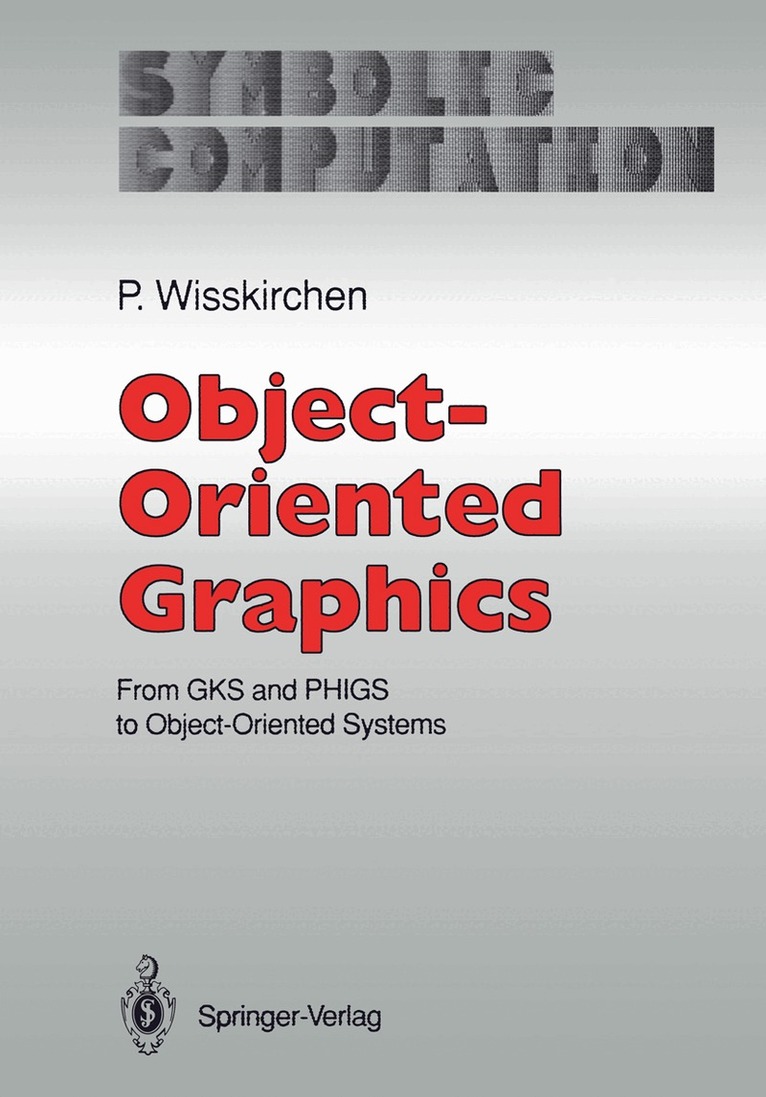
    Object-Oriented Graphics

    From GKS and PHIGS to Object-Oriented Systems

    AvPeter Wisskirchen

    Häftad, Engelska, 2011

    Del i serien Symbolic Computation

    1 110 kr

    Beställningsvara. Skickas inom 10-15 vardagar. Fri frakt över 249 kr.

    Fler format och utgåvor

    E-bok

    1 455 kr

    Beskrivning

    At present, object-oriented programming is emerging from the research labora­ tories and invading into the field of industrial applications. More and more products have been implemented with the aid of object-oriented programming techniques and tools, usually as extensions of traditional languages in hybrid development systems. Some of the better known examples are OSF-Motif, News, Objective-C on the NeXT computer, the C extension C++, and CLOS an object­ oriented extension of LISP. All of these developments incorporate interactive graphics. Effective object-oriented systems in combination with a graphics kernel­ does it mean that the field of computer graphics has now become merely an aspect of the object-oriented world? We do not think so. In spite of interesting individual developments, there are still no sound object-oriented graphics sys­ tems available. If it is desired to develop a complex graphics application embed­ ded in a window-oriented system then it is still necessary to work with elemen­ tary tools. What is to be displayed and interactively modified inside a window must be specified with a set of graphics primitives at a low level, or has to be written with a standardized graphics kernel system such as GKS or PHIGS, i. e. , by kernels specified and implemented in a non-object-oriented style. With the terms GKS and PHIGS we enter the world of international graphics standards. GKS and PHIGS constitute systems, not mere collections of graphics primitives.

    Produktinformation

    • Utgivningsdatum:2011-12-25
    • Mått:170 x 242 x 15 mm
    • Vikt:445 g
    • Format:Häftad
    • Språk:Engelska
    • Serie:Symbolic Computation
    • Antal sidor:236
    • Förlag:Springer-Verlag Berlin and Heidelberg GmbH & Co. KG
    • ISBN:9783642842498

    Utforska kategorier

    • Programmeringsböcker inom Data och IT

    Innehållsförteckning

    • 1 Introduction.- 1.1 Object-Oriented Languages and Tools.- 1.2 Guidelines for the Design of a Graphics System.- 1.3 Overview.- 2 Object-Oriented Concepts.- 2.1 Objects and Messages.- 2.2 The Class.- 2.3 Message Passing.- 2.4 Inheritance.- 2.5 The Smalltalk-80 Programming Environment.- 2.6 Summary of the Basic Concepts.- 3 Object-Oriented Interface Architecture.- 3.1 Application Framework as Generic Application.- 3.2 The Model-View-Controller Triad.- 4 Smalltalk-80 Graphics Kernel.- 4.1 Output Primitives.- 4.2 Generation and Display of Graphics Objects.- 5 GKS and Object-Oriented System Design.- 5.1 Goals of Standardization.- 5.2 A Short Review of the Main GKS Features.- 5.3 The Structure of a GKS Program.- 5.4 Object-Oriented Modifications.- 5.5 Guidelines for an Object-Oriented Kernel.- 5.6 An Extended Layer Model.- 5.7 Assignment of Attributes.- 5.8 Summary.- 6 Graphics Part Hierarchies.- 6.1 Introduction.- 6.2 Part Hierarchies and Computer Graphics.- 6.3 MacDraw and Part Hierarchies.- 7 PHIGS and Part Hierarchies.- 7.1 Drawbacks of the GKS Model.- 7.2 Motivation for an Extended Functionality.- 7.3 PHIGS Components.- 7.4 Modeling Part Hierarchies in PHIGS.- 8 GEO++.- 8.1 Goals and Motivation.- 8.2 GEO++ Model.- 8.3 Functional Overview by an Example.- 9 Programming Examples.- 9.1 Office Layout Application Programmed With PHIGS.- 9.2 Office Layout Application in GEO++.- 9.3 Comparison of the PHIGS and GEO++ Solution.- 9.4 Pick Object and Assign Attribute.- 9.5 Higher Level Hierarchies.- 9.6 Interactive Editing of a PolyLine.- 9.7 Examination and Comments.- 10 Using Inheritance.- 10.1 Inheritance in GEO++.- 10.2 Alternative Naming.- 10.3 Construction of a Part Hierarchy with Predefined Slots.- 10.4 Using Call-Backs.- 10.5 Accessing Parts.- 11 Prototypes and Delegation.-11.1 What are Prototypes?.- 11.2 Relevance for Computer Graphics.- 11.3 A Prototype Model for GEO++.- 12 GEO++ in Smalltalk-80.- 12.1 Internal Representation of a Group.- 12.2 Implementation of Parts.- 13 Additional Concepts and Tools.- 13.1 Additional Semantical Concepts.- 13.2 Connectivity.- 13.3 Graphics Constraints.- 13.4 Adding Semantics to a Graphics Kernel.- 13.5 Graphics and Hybrid Knowledge Representation.- 13.6 Computer Graphics and Hybrid Systems.- 14 Towards an Object-Oriented Standard?.- 14.1 Chances for an Object-Oriented New API.- 14.2 Requirements and Problems.- 14.3 Guidelines.- References.