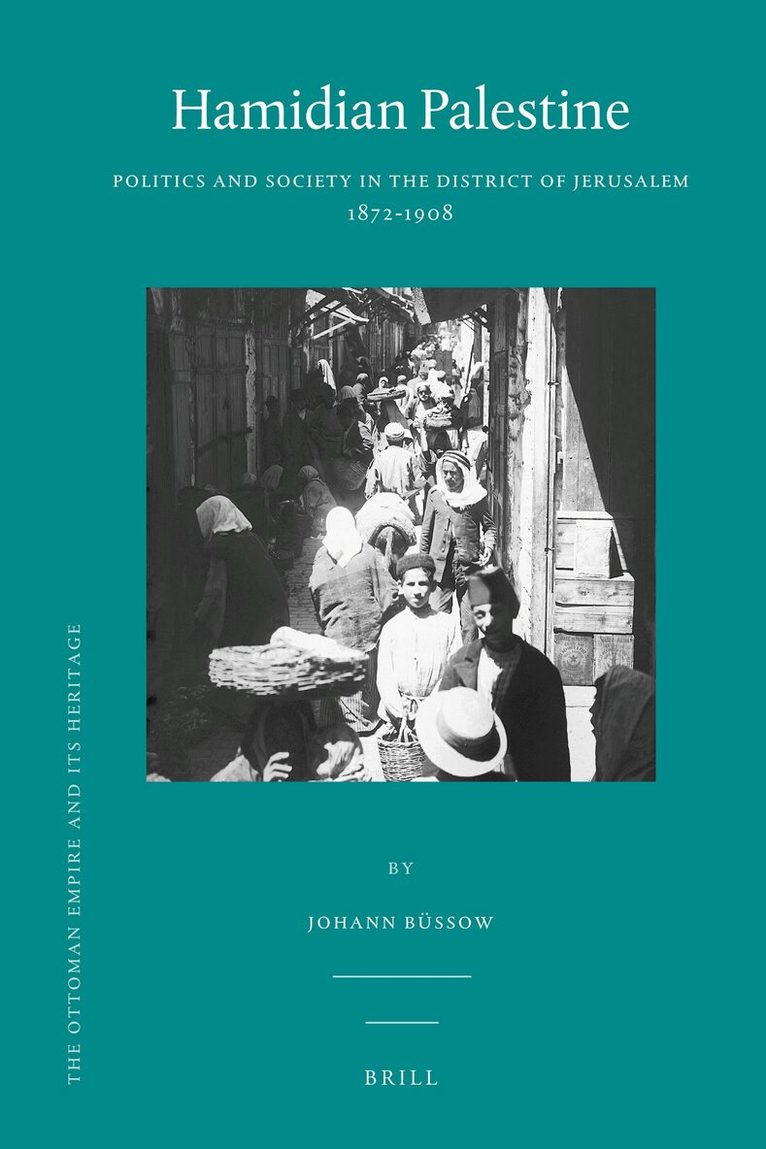
Hamidian Palestine
Politics and Society in the District of Jerusalem 1872-1908
Del 46 i serien Ottoman Empire and its Heritage
3 978 kr
Beställningsvara. Skickas inom 3-6 vardagar. Fri frakt över 249 kr.
Beskrivning
Produktinformation
- Utgivningsdatum:2011-08-11
- Mått:160 x 240 x 41 mm
- Vikt:1 258 g
- Format:Inbunden
- Språk:Engelska
- Serie:Ottoman Empire and its Heritage
- Antal sidor:620
- Förlag:Brill
- ISBN:9789004205697
Utforska kategorier
Mer om författaren
Johann Büssow, PhD (2008) in Middle Eastern Studies, Freie Universität Berlin, is a research associate at Martin-Luther-Universität Halle-Wittenberg, Germany. His fields of research include the social and political history of the modern Middle East and modern Islamic thought.
Recensioner i media
"....Ultimately, what this book offers, as Büssow himself acknowledges, is a ‘framework for inquiry into the societal history of late Ottoman Palestine’ (p. 515). I would add that this book provides an excellent point of departure for future projects on Hamidian Palestine that could take advantage of the wide range of resources that Büssow showcases, with the potential of challenging our understanding of that period. Finally, I believe this book is a must for every student of late Ottoman Palestine’s history. The sheer amount of information compiled and skillfully presented in four parts, along with very useful appendices, makes this book one of the most comprehensive English language resources available on this period." - Mostafa Minawi, Cornell University, in: Journal of Islamic Studies, May, 2013"By means of […] micro-histories, we are able to get a sense of how the gap between the Ottoman past and nationalist memory was a result of the disruptive experiences of the [First World W]ar […]. In Hamidian Palestine […] Johann Büssow takes a significant step towards closing this gap in the historiography by means of a comprehensive account of the state formation process in Palestine throughout the three decades preceding the Young Turk Revolution." - Akın Sefer, Northeastern University, in: New Perspectives on Turkey, no. 48 (2013), 129-140
Innehållsförteckning
- CONTENTSList of Figures ..................................................................................... ixList of Maps ........................................................................................ xiiiList of Text Boxes .............................................................................. xvList of Abbreviations ......................................................................... xviiMonths of the Islamic Hijrī Calendar, in Ottoman Turkish and Arabic ............ xixNote on Transliteration .................................................................... xxiAcknowledgements ............................................................................ xxiiiIntroduction ........................................................................................ 1Temporal and Geographic Scope of the Study ........................ 5Concepts ......................................................................................... 6Historiography ............................................................................... 13Sources ............................................................................................ 16Structure of the Study ................................................................... 36PART IIMPERIAL POLITICSChapter One The Making of a Province .................................... 41Drawing Boundaries: The Creation of the District of Jerusalem ...................... 41Building Institutions: Translating the Tanzimat Reforms in Local Contexts ... 59Formalised Avenues of Local Participation .............................. 71The District Government’s Budget ............................................. 81Conclusion ...................................................................................... 95PART IIEVERYDAY POLITICSChapter Two Making Spaces: Regionalisation through Everyday Practices ............. 103Chapter Three The Highlands ...................................................... 106Jerusalem and Jabal al-Quds ....................................................... 107Case StudyThe Memoirs of ʿUmar al-Ṣāliḥ al-Barghūthī: The Banī Zayd Region and its Political Leadership between Autonomy and Integration ................................... 111The City of Jerusalem ................................................................... 133Local Political Life ......................................................................... 134Conclusion ...................................................................................... 165Case StudyThe Memoirs of Wāṣif al-Jawhariyya: Communities, Hierarchies and Networks in Late Ottoman Jerusalem .... 168Conclusion ...................................................................................... 192Hebron and Jabal al-Khalīl ......................................................... 194Case StudyThe Family History of the Āl al-ʿAmla: Memories of Socio-Political Change in the Hebron Region .......... 203Conclusion ...................................................................................... 209Chapter Four The Coastal Plains ................................................. 211The Jaffa Region ............................................................................. 216Case StudyThe Memoirs of Yosef Eliyahu Chelouche: Between Old and New Worlds ............................................ 238Conclusion ...................................................................................... 256The Gaza Region ............................................................................ 258Case StudySuccess Stories from the Frontier Region of Gaza: The Ḥusaynī, Shawwā and Abū Khaḍra Families as Portrayed by ʿUthmān al-Ṭabbāʿ ........................................ 285Conclusion ...................................................................................... 301PART IIIELITE POLITICSChapter Five Central and Local Elites: A Conceptual Framework ........ 309Chapter Six Local Elites ................................................................. 316Continuity and Change in Local Elite-Formation ................... 316Resources ........................................................................................ 324Case StudyThe Education of ʿUmar al-Ṣāliḥ al-Barghūthī ..................... 342Political Roles and Functions of the aʿyān ............................... 356Being Noble: Representation and Distinction .......................... 375The Oligarchs and the Ottoman Government ......................... 392Conclusion ...................................................................................... 395Chapter Seven Central Elites ........................................................ 398Ottoman Officials: Families, Households, and Careers .......... 400Hamidian Governors and Their Perceptions of Palestine and the Palestinians ....... 405Conclusion ...................................................................................... 426PART IVWIDENING THE SCOPE OF POLITICSChapter Eight The Infrastructure of the Public Sphere ........... 435New Possibilities for Long-Distance Communication ............ 437Education ........................................................................................ 454Print Culture .................................................................................. 461Old and New Forms of Sociability ............................................. 470Chapter Nine Palestine as a Social Space ................................... 476Chapter Ten Repercussions of Empire-Wide Developments and the Politicisation of Everyday Concerns .... 484Chapter Eleven Government and Opposition in the Public Sphere ................................................. 496Conclusion .......................................................................................... 510Appendices .......................................................................................... 5171. Chronology of Palestinian History, 1872–1908 .................. 5172. Ottoman Administrators ........................................................ 5433. Budgets and Tax Revenue ...................................................... 5574. Currencies, Prices and Salaries .............................................. 563Glossary ............................................................................................... 565Bibliography ........................................................................................ 569Index .................................................................................................... 597
Du kanske också är intresserad av
Esprit civique et organisation citadine dans l'Empire ottoman (XVe-XXe siècles)
Nora Lafi
2 033 kr
Law and Division of Power in the Crimean Khanate (1532-1774)
Natalia Królikowska-Jedlińska
2 134 kr