• Fri frakt över 249 kr
  • •
  • Snabba leveranser
  • •
  • Billiga böcker
Kundservice

Du är på sajten för privatpersoner.

Företag, bibliotek eller offentlig verksamhet?

Du handlar på classic.bokus.com, där alla dina funktioner finns intakta.
Till classic.bokus.com
Bokus logotyp. Gå till startsidan.
  • Erbjudanden
  • Student
  • Topplistor
  • Barn & ungdom
  • Bokus Play
  • E-böcker
  • Ljudböcker
  • Pocketböcker
  • Spel och pussel

Pocketfynda! Hundratals böcker för 49 kr/st →

Sidfot

Mina sidor

    Hjälp

    • Kundservice
    • Vanliga frågor och svar
    • Frakt och leverans
    • Retur vid ångerrätt
    • Reklamera vara
    • Betalning
    • Köpvillkor
    • Allmänna villkor
    • Information om webbplatsens tillgänglighet

    Om Bokus

    • Om oss
    • Pressrum
    • För studenter
    • För företag
    • För bibliotek och offentlig verksamhet
    • För leverantörer
    • Hållbarhet

    Populärt

    • Aktuella erbjudanden
    • Presentkort
    • Studentlitteratur
    • Nya böcker
    • Topplistor
    • Signerade böcker
    • Engelska böcker

    Inspiration

    • Boktips
    • BookTok
    • Barnbokskaraktärer
    • Populära författare
    Logotyp för Bokus
    Följ oss på Facebook (extern länk)Följ oss på Instagram (extern länk)Följ oss på YouTube (extern länk)Följ oss på TikTok (extern länk)
    bokus @ CookiesAnpassa cookiesIntegritetspolicyKöpvillkor
    Till Citymail hemsida (extern länk)Till Budbee hemsida (extern länk)Till Postnord hemsida (extern länk)Till Schenker hemsida (extern länk)Till Early Bird hemsida (extern länk)Till Walleys hemsida (extern länk)
    1. Skönlitteratur
    2. Litteraturvetenskap
    3. Litteraturvetenskap

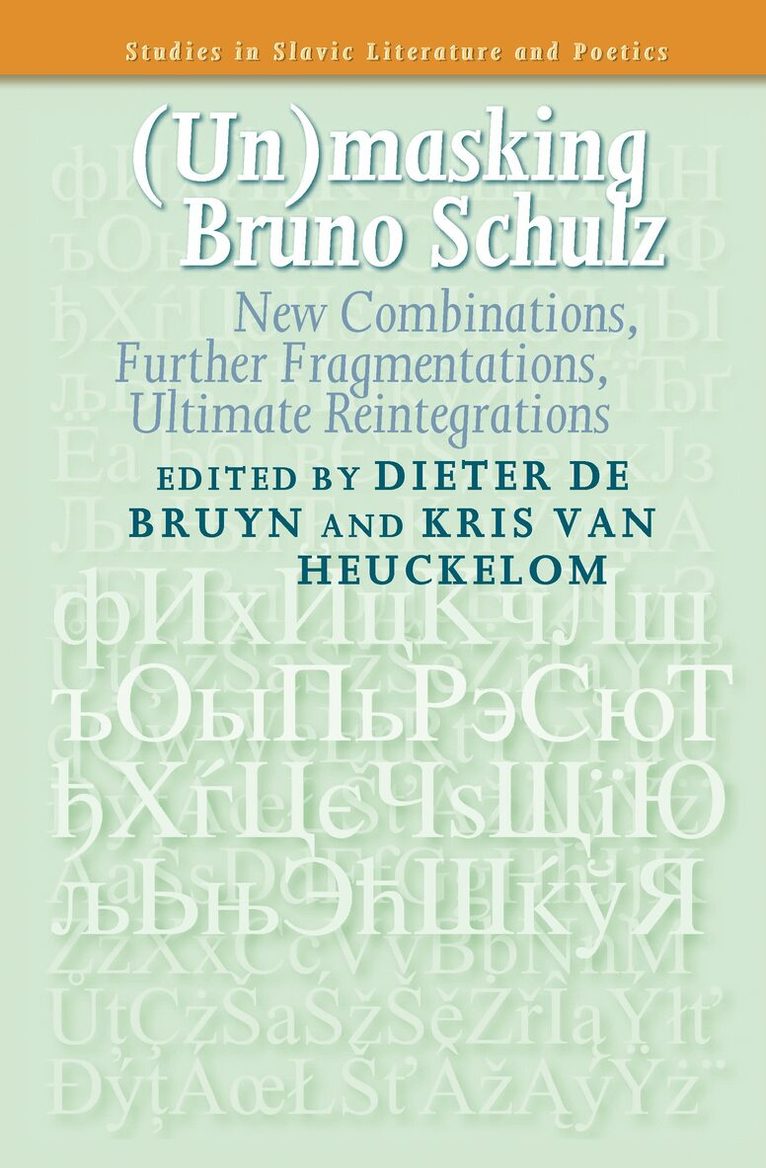
    (Un)masking Bruno Schulz

    New Combinations, Further Fragmentations, Ultimate Reintegrations

    Inbunden, Engelska, 2009

    Del 54 i serien Studies in Slavic Literature and Poetics

    3 044 kr

    Beställningsvara. Skickas inom 5-8 vardagar. Fri frakt över 249 kr.

    Beskrivning

    Whatever critical scalpel one selects for dissecting the literary works of Bruno Schulz (1892-1942), there will always be a certain degree of textual resistance which cannot be broken. Or in other words, taking off one of Schulz’s many masks, one will probably never avoid the impression that a new mask has emerged. This book contributes to the three most typical critical strategies of reading Schulz’s works (combinations, fragmentations, reintegrations) – being fully aware, of course, of the relativity of each particular approach. In addition, the book sets out to explore all of Schulz’s creative output (i.e. his stories as well as his graphic, epistolary and even literary critical works), as one of Schulz’s main goals was exactly to cross artificially set up boundaries between, among other things, different artistic media of expression. The book for the first time brings together leading Schulzologists (Jarzębski, Robertson, Sproede) and their prospective successors (Augsburger, Gorin, Kato, Suchańska-Drażyńska, Underhill, Wojda), established Polish academics (Dąbrowski, Markowski, Skwara, Weretiuk) and their foreign counterparts (De Bruyn, Gall, Meyer-Fraatz, Schulte, Zieliński), scholars primarily working on other authors (Anessi, Śliwa, Żurek) and those focusing on other art forms (Sánchez-Pardo, Watt). The editors’ introduction offers an overview of seven decades of Schulzology. The book is of interest for both readers with a general interest in (world) literature and/or a particular interest in Polish and Jewish studies.

    Produktinformation

    • Utgivningsdatum:2009-01-01
    • Mått:155 x 235 x 40 mm
    • Vikt:1 006 g
    • Format:Inbunden
    • Språk:Engelska
    • Serie:Studies in Slavic Literature and Poetics
    • Antal sidor:529
    • Förlag:Brill
    • ISBN:9789042026940

    Utforska kategorier

    • Litteraturvetenskap inom Skönlitteratur

    Recensioner i media

    "These essays shed additional light on Schulz’s body of work, provide a productive means of expanding on older themes, and open up a breadth of new questions and possible roads of academic inquiry. In sum, this volume forms a Schulzology compendium that sets a new standard in any language for the study of this enigmatic author." – Ewa Wampuszyc, University of North Carolina at Chapel Hill, in: Slavic and East European Journal 57/2 (2013), pp. 324-6"[…] there is an unusually high percentage of quality essays with innovative approaches […]. We should expect that the collected essays in this volume will set the standard for Schulz studies in English. We can also hope that it will have an impact on the Polish-language sphere." – Jessie Labov, The Ohio State University, in: The Russian Review 71/3 (June 2012), pp. 509-10

    Innehållsförteckning

    • Dieter De Bruyn & Kris Van Heuckelom: Introduction: Seven Decades of Schulzology New Combinations: LiteratureKaren Underhill: Ecstasy and Heresy: Martin Buber, Bruno Schulz, and Jewish Modernity Andrea Meyer-Fraatz: Exposing and Concealing Jewish Origin: Bruno Schulz and Bolesław Leśmian Sławomir Jacek Żurek: As One Kabbalist to Another… On Arnold Słucki’s Mystical Visions of the World in the Poem ‘Bruno Schulz’ Dieter De Bruyn: “The Lie Always Rises to the Surface like Oil”. Toward a Metafictional Reading of Karol Irzykowski’s Pałuba and Bruno Schulz’s Fiction Anna Śliwa: “I Drew a Plan of an Imaginary City”. The Phenomenon of the City in Bruno Schulz and Miron Białoszewski Alfred Gall: Mythopoetic Traditions and Inserted Treatises: Bruno Schulz and Danilo Kiš Dorota Wojda: Bruno Schulz and the Magical Realism of Gabriel García Márquez in One Hundred Years of Solitude New Combinations: ArtMarta Skwara: “A (Wo)man on a Sofa” in Bruno Schulz’s Art and Writings. Schulz as a “Painterly” and “Writerly” ArtistAriko Kato: The Early Graphic Works of Bruno Schulz and Sacher-Masoch’s Venus in Furs: Schulz as a Modernist Jan Zieliński: Zuloaga (Rilke?) SchulzEsther Sánchez-Pardo: Bruno Schulz and Djuna Barnes: Border-crossing and Artistic PracticeDaniel Watt: Bruno Schulz’s Incomparable Realities: From Literature to TheatricalityFurther FragmentationsMieczysław Dąbrowski: Aesthetics of Melancholy in Bruno Schulz’s WritingsJerzy Jarzębski: Bruno Schulz and Seductive DiscourseShlomit Gorin: Thinking About Absurdity with Bruno Schulz: Paradox and PotentialMarta Suchańska-Drażyńska: Jewish Mysticism – A Source of Similarities Between Bruno Schulz’s Writings and PsychoanalysisJörg Schulte: The Clepsydra of Empedocles and the Phenomena of Breath and Wind in Bruno Schulz’s FictionThomas Anessi: The Great Heresy of the Varsovian CenterOksana Weretiuk: The Ukrainian Reception of Bruno Schulz’s Writings: Paradox or Norm?Ultimate ReintegrationsMichał Paweł Markowski: Text and Theater. The Ironic Imagination of Bruno SchulzTheodosia Robertson: Bruno Schulz’s Intimate Communication: From the “True Viewer” of Xięga bałwochwalcza to the “True Reader” of ‘Księga’Alfred Sproede: Bruno Schulz: Between Avant-Garde and Hasidic RedemptionJanis Augsburger: Poetical Fluidization and Intellectual Eclecticism in Bruno Schulz’s WritingsIndex