Inbunden, Engelska, 2026
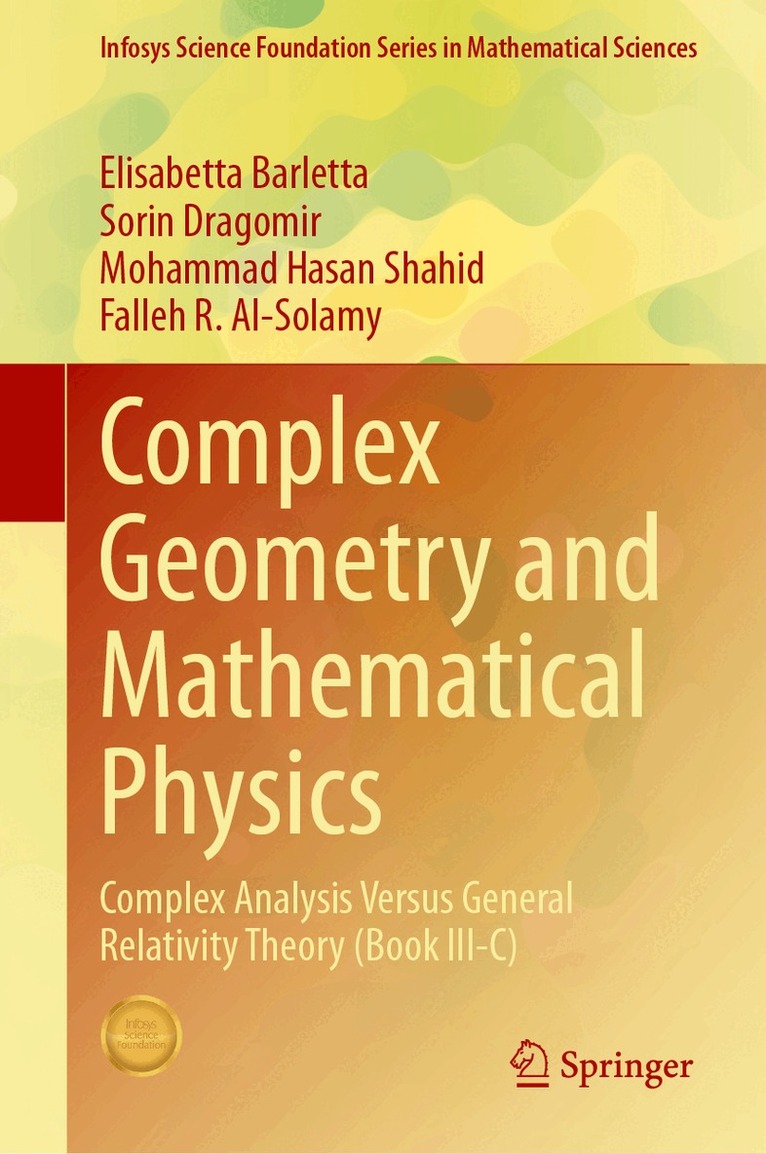
Complex Geometry and Mathematical Physics
Av Elisabetta Barletta, Sorin Dragomir, Mohammad Hasan Shahid, Falleh R. Al-Solamy
1476 kr
Ej publicerad ännu
Beskrivning
This book, Complex Geometry and Mathematical Physics: Complex Analysis versus General Relativity Theory (Book III-C), examines the impact of results from complex analysis and complex geometry on certain aspects of mathematical physics, such as quantization theory, with an emphasis on the novel aspects in A. Odzijewicz’s scientific creation, as related to the use of complex analysis tools (for example, weighted Bergman kernels) in the calculation of transition probability amplitudes from a classical state (identified to a coherent state) of a mechanical system. The third in a captivating series of three books, it is devoted to applying ideas and methods from GRG (that is, from the theory of singularities—classical and quantum—of spacetimes) to complex analysis. The other two books of the series are:Complex Geometry and Mathematical Physics: Lorentzian Geometry and Field Equations (Book III-A)Complex Geometry and Mathematical Physics: Classical and Quantum Singularities of Space-Times (Book III-B)"Complex Geometry and Mathematical Physics" is part of the ampler book project "Differential Geometry, Partial Differential Equations and Mathematical Physics", by the same Authors, and aims to demonstrate the interaction between complex analysis and complex geometry on one hand, and general relativity and (quantum) gravity theory on the other, with an emphasis on the modern and contemporary trends of applying ideas from GRG theory to certainproblems arising in complex analysis, such as the many pathologies of the Diederich–Fornæss worm domains.
Produktinformation
- Utgivningsdatum: 2026-10-28
- Mått: 155 x 235 x undefined mm
- Format: Inbunden
- Språk: Engelska
- Antal sidor: 226
- Förlag: Springer Verlag, Singapore
- Serie: Infosys Science Foundation Series
- ISBN: 9789819219384
Utforska kategorier
Betyg & recensioner
0 recensioner
Inga recensioner tillgängliga.