
B. de Spinoza - Böcker
Visar alla böcker från författaren B. de Spinoza. Handla med fri frakt och snabb leverans.
3 produkter
3 produkter

539 kr
Skickas inom 5-8 vardagar
The Oxford Philosophical Texts series consists of authoritative teaching editions of canonical texts in the history of philosophy from the ancient world down to modern times. Each volume provides a clear, well laid out text together with a comprehensive introduction by a leading specialist, giving the student detailed critical guidance on the intellectual context of the work and the structure and philosophical important of the main arguments and explain unfamiliar references and terminology, and a full bibliography and index are also included. The series aims to build up a definitive corpus of key texts in the Western philosophical tradition, which will from a reliable and enduring resource for students and teachers alike. Spinoza's Ethics is one of the classical texts of philosophy but is also one of the most difficult to understand because of the author's use of rigorous logical deduction and the geometrical framework within which his ideas are set. In Ethics, he discusses the nature of human beings and the way in which a rational person might live; the nature of God; and offers an account of true freedom and how it can be attained. This latest text in the Oxford Philosophical Texts series includes a new, lucid translation of the Ethics by G.H.R. Parkinson along with a comprehensive guide to the understanding of Spinoza's work. An extensive introduction includes: a short biography of Spinoza himself; the form of his writing including his own particular uses of definitions; an introductory guide through the philosophy of Ethics; and a summary of the contents of Ethics itself. Further aids include a glossary of terms, extensive notes to the text.
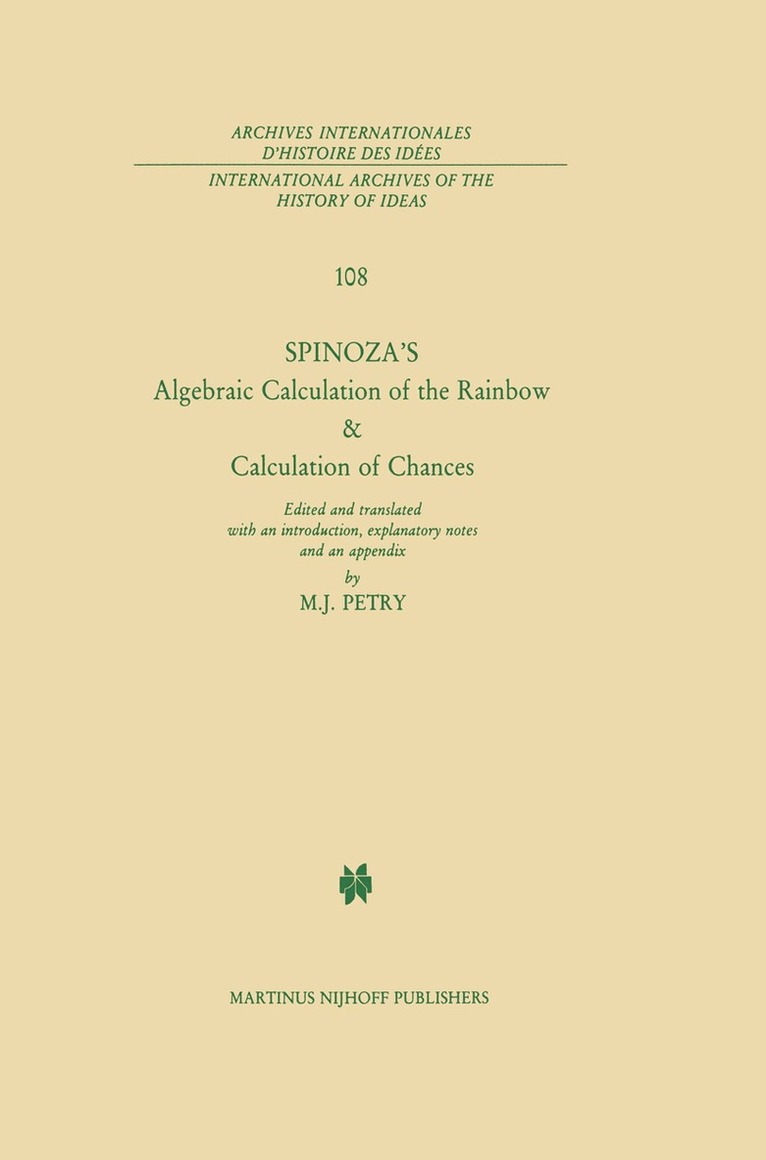
Spinoza’s Algebraic Calculation of the Rainbow & Calculation of Chances
Edited and Translated with an Introduction, Explanatory Notes and an Appendix by Michael J. Petry
Inbunden, Engelska, 1986
1 582 kr
Skickas inom 10-15 vardagar
A. THE TEXT The main importance of these two treatises lies in the insight they provide into Spinoza's conception of the relation between mathematics and certain disciplines not touched upon elsewhere in his major writings. The mathematics they involve are not the as those of the Ethics however, and the precise connection same between the geometrical order of this work and these excursions into optics and probability is by no means obvious. Add to this difficulty the knotty problems presented by their editorial his tory, dating and scientific background, and it is not perhaps surprising that in spite of the fact that they provide such an excellent illustration of Spinoza's reaction to certain important developments in the history of physics and mathematics, they should not, so far, have attracted much attention. They were first published in 1687 by Levyn van Dyck (d. 1695), official printer to the town council in The Hague. Printing anything by Spinoza was not without its risks, and it is probably significant that during the same year van Dyck should also have published a lengthy and elaborate refutation of Spinozism by 1 the pious and eccentric physician ]. F. Helvetius. Spinoza's name was omitted from the title-page, possibly because the editor or publisher thought that his reputation as an atheist might prejudice the sale of the booklet, and it was not until 1860 that the Amsterdam bookseller Frederik Muller (1817-1881) identified him as its author.
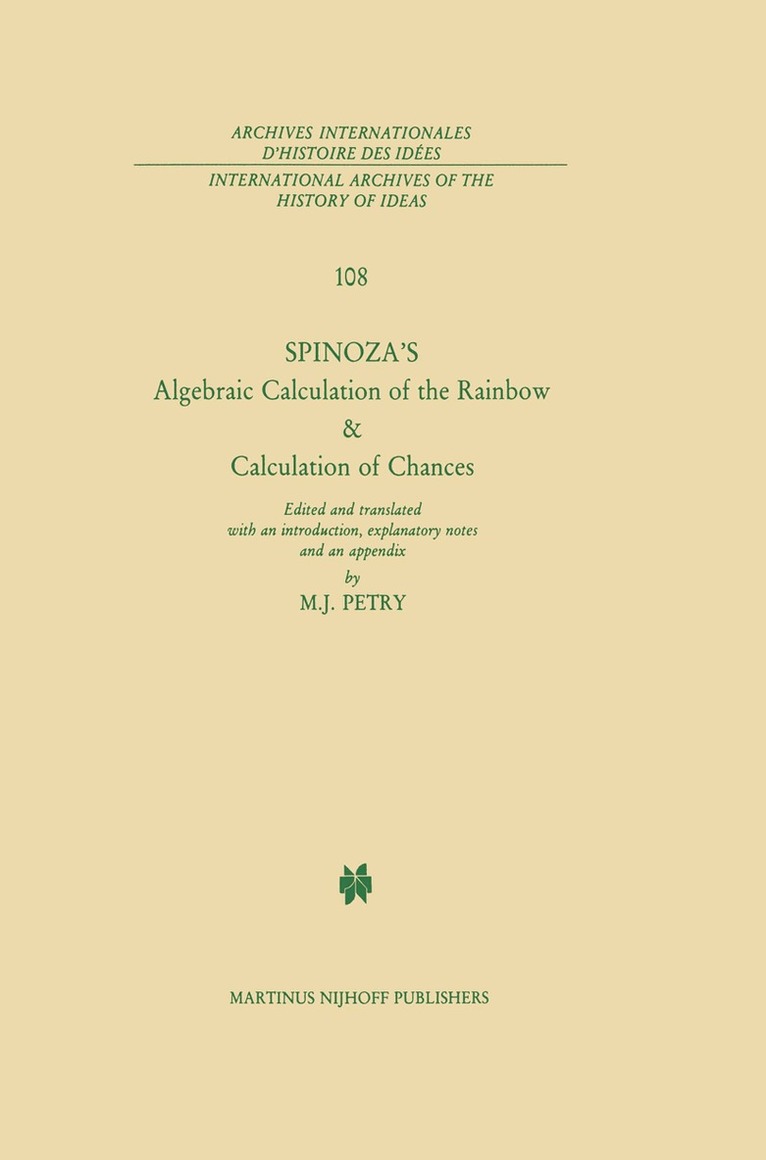
Spinoza’s Algebraic Calculation of the Rainbow & Calculation of Chances
Edited and Translated with an Introduction, Explanatory Notes and an Appendix by Michael J. Petry
Häftad, Engelska, 2011
1 582 kr
Skickas inom 10-15 vardagar
A. THE TEXT The main importance of these two treatises lies in the insight they provide into Spinoza's conception of the relation between mathematics and certain disciplines not touched upon elsewhere in his major writings. The mathematics they involve are not the as those of the Ethics however, and the precise connection same between the geometrical order of this work and these excursions into optics and probability is by no means obvious. Add to this difficulty the knotty problems presented by their editorial his tory, dating and scientific background, and it is not perhaps surprising that in spite of the fact that they provide such an excellent illustration of Spinoza's reaction to certain important developments in the history of physics and mathematics, they should not, so far, have attracted much attention. They were first published in 1687 by Levyn van Dyck (d. 1695), official printer to the town council in The Hague. Printing anything by Spinoza was not without its risks, and it is probably significant that during the same year van Dyck should also have published a lengthy and elaborate refutation of Spinozism by 1 the pious and eccentric physician ]. F. Helvetius. Spinoza's name was omitted from the title-page, possibly because the editor or publisher thought that his reputation as an atheist might prejudice the sale of the booklet, and it was not until 1860 that the Amsterdam bookseller Frederik Muller (1817-1881) identified him as its author.