
Colin F. Camerer - Böcker
Visar alla böcker från författaren Colin F. Camerer. Handla med fri frakt och snabb leverans.
4 produkter
4 produkter
1 030 kr
Skickas inom 7-10 vardagar
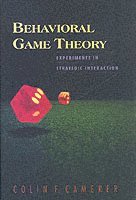
Game theory, the formalized study of strategy, began in the 1940s by asking how emotionless geniuses should play games, but ignored until recently how average people with emotions and limited foresight actually play games. This book marks the first substantial and authoritative effort to close this gap. Colin Camerer, one of the field's leading figures, uses psychological principles and hundreds of experiments to develop mathematical theories of reciprocity, limited strategizing, and learning, which help predict what real people and companies do in strategic situations. Unifying a wealth of information from ongoing studies in strategic behavior, he takes the experimental science of behavioral economics a major step forward. He does so in lucid, friendly prose. Behavioral game theory has three ingredients that come clearly into focus in this book: mathematical theories of how moral obligation and vengeance affect the way people bargain and trust each other; a theory of how limits in the brain constrain the number of steps of "I think he thinks ..." reasoning people naturally do; and a theory of how people learn from experience to make better strategic decisions.Strategic interactions that can be explained by behavioral game theory include bargaining, games of bluffing as in sports and poker, strikes, how conventions help coordinate a joint activity, price competition and patent races, and building up reputations for trustworthiness or ruthlessness in business or life. While there are many books on standard game theory that address the way ideally rational actors operate, Behavioral Game Theory stands alone in blending experimental evidence and psychology in a mathematical theory of normal strategic behavior. It is must reading for anyone who seeks a more complete understanding of strategic thinking, from professional economists to scholars and students of economics, management studies, psychology, political science, anthropology, and biology.
1 413 kr
Skickas inom 3-6 vardagar
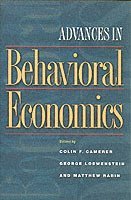
Twenty years ago, behavioral economics did not exist as a field. Most economists were deeply skeptical--even antagonistic--toward the idea of importing insights from psychology into their field. Today, behavioral economics has become virtually mainstream. It is well represented in prominent journals and top economics departments, and behavioral economists, including several contributors to this volume, have garnered some of the most prestigious awards in the profession. This book assembles the most important papers on behavioral economics published since around 1990. Among the 25 articles are many that update and extend earlier foundational contributions, as well as cutting-edge papers that break new theoretical and empirical ground. Advances in Behavioral Economics will serve as the definitive one-volume resource for those who want to familiarize themselves with the new field or keep up-to-date with the latest developments. It will not only be a core text for students, but will be consulted widely by professional economists, as well as psychologists and social scientists with an interest in how behavioral insights are being applied in economics.The articles, which follow Colin Camerer and George Loewenstein's introduction, are by the editors, George A. Akerlof, Linda Babcock, Shlomo Benartzi, Vincent P. Crawford, Peter Diamond, Ernst Fehr, Robert H. Frank, Shane Frederick, Simon Gachter, David Genesove, Itzhak Gilboa, Uri Gneezy, Robert M. Hutchens, Daniel Kahneman, Jack L. Knetsch, David Laibson, Christopher Mayer, Terrance Odean, Ted O'Donoghue, Aldo Rustichini, David Schmeidler, Klaus M. Schmidt, Eldar Shafir, Hersh M. Shefrin, Chris Starmer, Richard H. Thaler, Amos Tversky, and Janet L. Yellen.

Making Decisions About Liability And Insurance
A Special Issue of the Journal of Risk and Uncertainty
Inbunden, Engelska, 1993
1 625 kr
Skickas inom 10-15 vardagar
Two related trends have created novel challenges for managing risk in the United States. The first trend is a series of dramatic changes in liability law, as tort law has expanded to assign liability to defendants for reasons other than negligence. The unpredictability of future costs induced by changes in tort law may be partly responsible for the second major trend known as the "liability crisis" - the disappearance of liability protection in markets for particularly unpredictable risks. This book examines decisions people make about insurance and liability. An understanding of such decision making may help explain why the insurance crisis resulted from the new interpretations of tort law and what to do about it. The articles cover three kinds of decisions: consumer decisions to purchase insurance; insurer decisions about coverage they offer; and the decisions of the public about the liability rules they prefer, which are reflected in legislation and regulation. For each of these three kinds of decisions, normative theories, such as expected utility theory, can be used as benchmarks against which actual decisions are judged.

Making Decisions About Liability And Insurance
A Special Issue of the Journal of Risk and Uncertainty
Häftad, Engelska, 2012
1 625 kr
Skickas inom 10-15 vardagar
Two related trends have created novel challenges for managing risk in the United States. The first trend is a series of dramatic changes in liability law as tort law has expanded to assign liability to defendants for reasons other than negligence. The unpredictability of future costs induced by changes in tort law may be partly responsible for the second major trend known as the `liability crisis' - the disappearance of liability protection in markets for particularly unpredictable risks.This book examines decisions people make about insurance and liability. An understanding of such decision making may help explain why the insurance crisis resulted from the new interpretations of tort law and what to do about it. The articles cover three kinds of decisions: consumer decisions to purchase insurance; insurer decisions about coverage they offer; and the decisions of the public about the liability rules they prefer, which are reflected in legislation and regulation. For each of these three kinds of decisions, normative theories such as expected utility theory can be used as benchmarks against which actual decisions are judged.