
Costas Synolakis - Böcker
Visar alla böcker från författaren Costas Synolakis. Handla med fri frakt och snabb leverans.
4 produkter
4 produkter
426 kr
Skickas
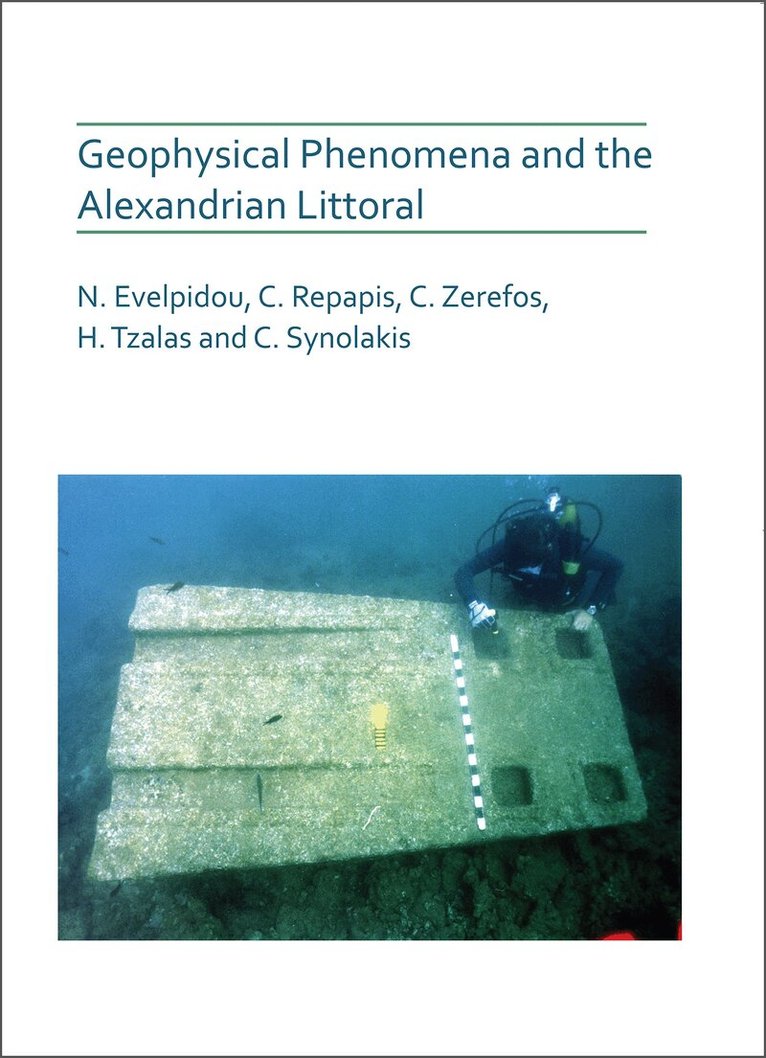
Alexandria is located on the Mediterranean coast of Egypt, bordered by Egypt’s Western Desert and the fertile Nile Delta. For many centuries, Alexandria was the major port city in the Eastern Mediterranean and it has been repeatedly struck by natural disasters, such as earthquakes, tsunamis and land subsidence, in its ~2400-year history. This book focuses on the geomorphological and archaeological evidence on the coastal zone of Alexandria, attempting to provide a comprehensive review of its evolution, taking into consideration long-term and short-term factors.The book provides an extensive background on the geomorphology and recent geoarchaeological history of Alexandria, discussing historical maps and natural disasters. In the coastal area of Alexandria there is numerous archaeological evidence, such as burial sites, quarry activities and ancient building remnants, as well as geomorphological features, all revealing a complex evolution of the coastal zone. New evidence, such as fish tanks and ship wrecks in order to discuss the Late Holocene evolution of the coastal zone. Detailed illustrations and maps accompany the book chapters providing the reader the opportunity to gain an extensive view of Alexandria’s features.
2 238 kr
Tillfälligt slut
Since September 1992, there has been an unprecedented number of major tsunami events. Chronologically, the ten sites were: Nicaragua, in September 1992; Flores, Indonesia, in December 1992; Okushiri, Japan, in July 1993; East Java, Indonesia, in June 1994; Shikotan, Russia, in October 1994; Mindoro, Philippines, in November 1994; Skagway, Alaska, in November 1994; East Timor, Indonesia, in May 1995; Irian Jaya, Indonesia, in February 1996; Chimbote, Peru, in February 1996. These tsunamis caused substantial damage and many casualties. Now is the time to review this extraordinary phenomenon so as to prepare for forthcoming tsunami events.The purpose of this book is to review and update our knowledge of long-wave runups and our recent experience in field surveys of tsunami runups. Comparisons of numerical, analytical, and physical prediction models are made using existing laboratory and field data. Also presented are state-of-the-art tsunami prediction models and detailed discussions on tsunami runup phenomena.
Del 4 - Advances In Coastal And Ocean Engineering
Advances In Coastal And Ocean Engineering, Volume 4
Inbunden, Engelska, 1999
1 429 kr
Tillfälligt slut
This volume consists of five excellent review papers. In the first paper, “A Review of Coastal Wave Modeling: The Physical and Mathematical Problems”, N E Huang presents a summary of the state-of-the-art of wave modeling in deep waters. He points out several shortcomings in existing modeling approaches and expresses the urgent need for developing a statistical theory of surface waves in shallow waters. Huang believes that the statistical theory can be formulated as the soliton turbulence. He also points out other important issues in wave modeling, including the air-sea interaction processes, and the physics of the wave-current and dissipation processes. In the second paper A C Radder focuses his discussion on the “Hamiltonian Dynamics of Water Waves”. He demonstrates that the Hamiltonian theory of surface waves can be formulated in terms of surface elevation and the velocity potential at the free surface as canonical variables. Several evolution equations, can be readily obtained. Radder also points out the need to develop a stochastic wave model in the shallow-water environment.The maximum runup is arguably the single most important parameter in the design of coastal structures and for the evaluation of the inundation potential of storm surges and tsunamis. C E Synolakis presents a thorough review of the “Exact Solutions of Shallow-Water Wave Equations”. For a single sloping beach, the evolution and runup of solitary, dipole, N and cnoidal waves are discussed. These solutions are then extended to more practical problems.The last two papers concern the flow and sediment motions near the seafloor. In their paper, “Boundary Layer and Sediment Dynamics Under Sea Waves”, P Blondeaux and G Vittori give an expert review of the recent contributions on the understanding of the interaction of the coherent vortex with cohesionless or partially cohesive sediments in a boundary layer. The formation and development of small-scale bedforms in the coastal regions are also discussed. Finally, in “Wave Scour Around Structures”, B M Sumer and J Fredsøe review the scouring processes around various types of structures. Many recent experimental data and theoretical developments are presented.
Del 10 - Advances In Coastal And Ocean Engineering
Advanced Numerical Models For Simulating Tsunami Waves And Runup
Inbunden, Engelska, 2008
1 473 kr
Tillfälligt slut
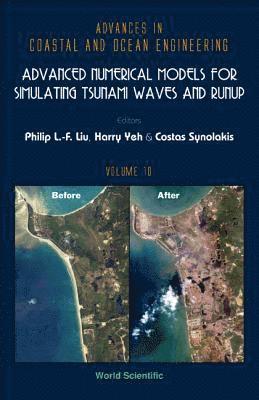
This review volume is divided into two parts. The first part includes five review papers on various numerical models. Pedersen provides a brief but thorough review of the theoretical background for depth-integrated wave equations, which are employed to simulate tsunami runup. LeVeque and George describe high-resolution finite volume methods for solving the nonlinear shallow water equations. The focus of their discussion is on the applications of these methods to tsunami runup.In recent years, several advanced 3D numerical models have been introduced to the field of coastal engineering to calculate breaking waves and wave-structure interactions. These models are still under development and are at different stages of maturity. Rogers and Dalrymple discuss the Smooth Particles Hydrodynamics (SPH) method, which is a meshless method. Wu and Liu present their Large Eddy Simulation (LES) model for simulating the landslide-generated waves. Finally, Frandsen introduces the lattice Boltzmann method with the consideration of a free surface.The second part of the review volume contains the descriptions of the benchmark problems with eleven extended abstracts submitted by the workshop participants. All these papers are compared with their numerical results with benchmark solutions.