
David W. Deamer - Böcker
Visar alla böcker från författaren David W. Deamer. Handla med fri frakt och snabb leverans.
11 produkter
11 produkter

973 kr
Skickas inom 5-8 vardagar
Our knowledge of our solar system has passed the point of no return. Increasingly, it seems possible that scientists will soon discover how life is created on habitable planets like Earth and Mars. Scientists have responded to a renewed public interest in the origin of life with research, but many questions still remain unanswered in the broader conversation. Other questions can be answered by the laws of chemistry and physics, but questions surrounding the origin of life are best answered by reasonable extrapolations of what scientists know from observing the Earth and its solar system. Origin of Life: What Everyone Needs to Know® is a comprehensive scientific guide on the origin of life. David W. Deamer sets out to answer the top forty questions about the origin of life, including: Where do the atoms of life come from? How old is Earth? What was the Earth like before life originated? Where does water come from? How did evolution begin? After he provides the informational answer for each question, there is a follow-up: How do we know? This question expands the horizon of the whole book, and provides scientific reasoning and explanations for hypotheses surrounding the origin of life. How scientists come to their conclusions and why we can trust these answers is an important question, and Deamer provides answers to each big question surrounding the origin of life, from what it is to why we should be curious.

216 kr
Skickas inom 5-8 vardagar
Our knowledge of our solar system has passed the point of no return. Increasingly, it seems possible that scientists will soon discover how life is created on habitable planets like Earth and Mars. Scientists have responded to a renewed public interest in the origin of life with research, but many questions still remain unanswered in the broader conversation. Other questions can be answered by the laws of chemistry and physics, but questions surrounding the origin of life are best answered by reasonable extrapolations of what scientists know from observing the Earth and its solar system. Origin of Life: What Everyone Needs to Know® is a comprehensive scientific guide on the origin of life. David W. Deamer sets out to answer the top forty questions about the origin of life, including: Where do the atoms of life come from? How old is Earth? What was the Earth like before life originated? Where does water come from? How did evolution begin? After he provides the informational answer for each question, there is a follow-up: How do we know? This question expands the horizon of the whole book, and provides scientific reasoning and explanations for hypotheses surrounding the origin of life. How scientists come to their conclusions and why we can trust these answers is an important question, and Deamer provides answers to each big question surrounding the origin of life, from what it is to why we should be curious.

659 kr
Skickas inom 5-8 vardagar
In Assembling Life, David Deamer addresses questions that are the cutting edge of research on the origin of life. For instance, how did non-living organic compounds assemble into the first forms of primitive cellular life? What was the source of those compounds and the energy that produced the first nucleic acids? Did life begin in the ocean or in fresh water on terrestrial land masses? Could life have begun on Mars? The book provides an overview of conditions on the early Earth four billion years ago and explains why fresh water hot springs are a plausible alternative to salty seawater as a site where life can begin. Deamer describes his studies of organic compounds that were likely to be available in the prebiotic environment and the volcanic conditions that can drive chemical evolution toward the origin of life. The book is not exclusively Earth-centric, but instead considers whether life could begin elsewhere in our solar system. Deamer does not propose how life did begin, because we can never know that with certainty. Instead, his goal is to understand how life can begin on any habitable planet, with Earth so far being the only known example.

930 kr
Skickas inom 10-15 vardagar
Update your knowledge of the chemical, biological, and physical properties of liquid-liquid interfaces with Liquid-Liquid Interfaces: Theory and Methods. This valuable reference presents a broadly based account of current research in liquid-liquid interfaces and is ideal for researchers, teachers, and students. Internationally recognized investigators of electrochemical, biological, and photochemical effects in interfacial phenomena share their own research results and extensively review the results of others working in their area.Because of its unusually wide breadth, this book has something for everyone interested in liquid-liquid interfaces. Topics include interfacial and phase transfer catalysis, electrochemistry and colloidal chemistry, ion and electron transport processes, molecular dynamics, electroanalysis, liquid membranes, emulsions, pharmacology, and artificial photosynthesis. Enlightening discussions explore biotechnological applications, such as drug delivery, separation and purification of nuclear waste, catalysis, mineral extraction processes, and the manufacturing of biosensors and ion-selective electrodes.Liquid-Liquid Interfaces: Theory and Methods is a well-written, informative, one-stop resource that will save you time and energy in your search for the latest information on liquid-liquid interfaces.
2 654 kr
Skickas inom 7-10 vardagar
This text is intended for use as an introduction to both the theory of surface science and its applications in modern biology and chemistry. The book attempts to explain the physical and chemical fundamentals of interfacial phenomena, and readers will find virtually all definitions and concepts needed to understand the role of interfaces in chemistry and biology.

4 934 kr
Skickas inom 10-15 vardagar
Update your knowledge of the chemical, biological, and physical properties of liquid-liquid interfaces with Liquid-Liquid Interfaces: Theory and Methods. This valuable reference presents a broadly based account of current research in liquid-liquid interfaces and is ideal for researchers, teachers, and students. Internationally recognized investigators of electrochemical, biological, and photochemical effects in interfacial phenomena share their own research results and extensively review the results of others working in their area.Because of its unusually wide breadth, this book has something for everyone interested in liquid-liquid interfaces. Topics include interfacial and phase transfer catalysis, electrochemistry and colloidal chemistry, ion and electron transport processes, molecular dynamics, electroanalysis, liquid membranes, emulsions, pharmacology, and artificial photosynthesis. Enlightening discussions explore biotechnological applications, such as drug delivery, separation and purification of nuclear waste, catalysis, mineral extraction processes, and the manufacturing of biosensors and ion-selective electrodes.Liquid-Liquid Interfaces: Theory and Methods is a well-written, informative, one-stop resource that will save you time and energy in your search for the latest information on liquid-liquid interfaces.
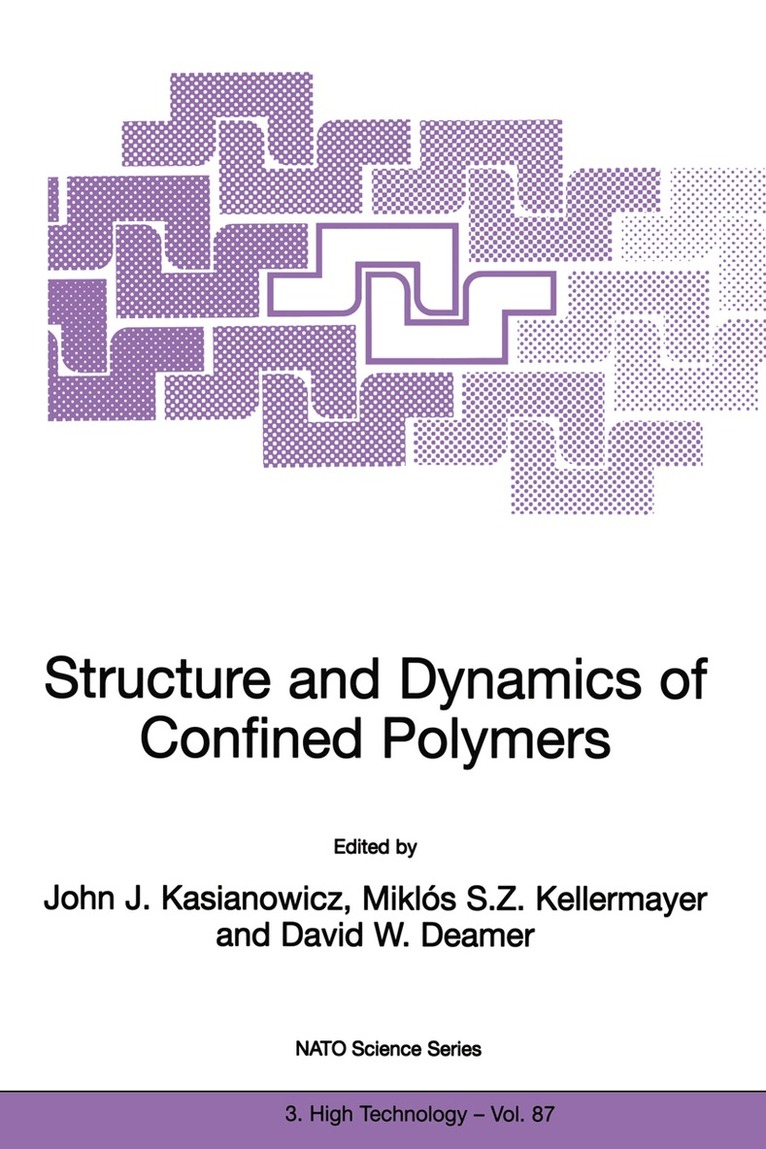
Structure and Dynamics of Confined Polymers
Proceedings of the NATO Advanced Research Workshop on Biological, Biophysical & Theoretical Aspects of Polymer Structure and Transport Bikal, Hungary 20–25 June 1999
Inbunden, Engelska, 2002
2 107 kr
Skickas inom 10-15 vardagar
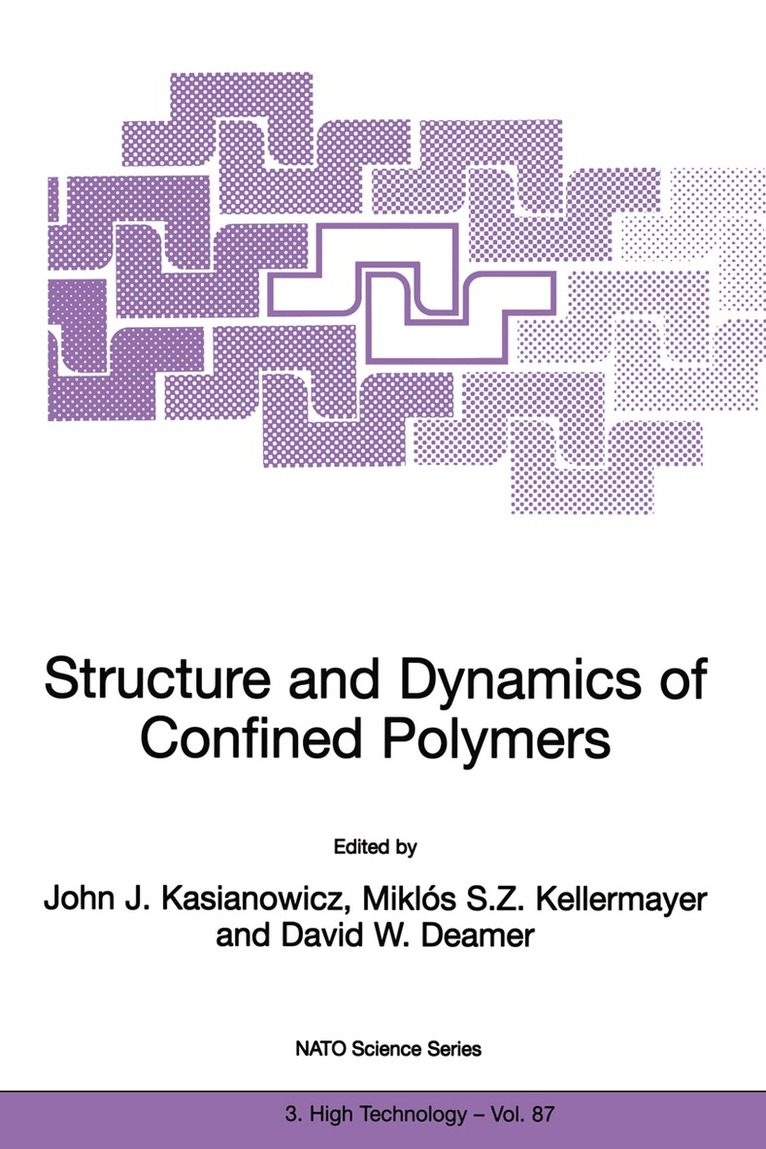
The primary goal of this text is to explore the physical properties of polymers in confined spaces at the nanometer scale, with a particular emphasis on determining the mechanisms by which polymers are transported through narrow interstices. A variety of pore structures that polymers can penetrate have been discovered, and it is now possible to probe the dynamics of the interactions between polymers and the penetrating molecules. The experimental and theoretical advances discussed include: mechanical properties of single molecules; detection and characterization of single polymers transported through narrow ion channels; direct measurement of the energetics and dynamics of polymer transport through a pore; statistical mechanical theories for single polymer transport through a narrow pore; novel polymer separations techniques not based on cross-linked gels; and physics of polymer-protein interactions. The book also explores potential scientific and technological applications that can exploit these systems, with the aim of stimulating new research in this highly multidisciplinary field.
2 107 kr
Skickas inom 10-15 vardagar
The primary goal of this text is to explore the physical properties of polymers in confined spaces at the nanometer scale, with a particular emphasis on determining the mechanisms by which polymers are transported through narrow interstices. A variety of pore structures that polymers can penetrate have been discovered, and it is now possible to probe the dynamics of the interactions between polymers and the penetrating molecules. The experimental and theoretical advances discussed include: mechanical properties of single molecules; detection and characterization of single polymers transported through narrow ion channels; direct measurement of the energetics and dynamics of polymer transport through a pore; statistical mechanical theories for single polymer transport through a narrow pore; novel polymer separations techniques not based on cross-linked gels; and physics of polymer-protein interactions. The book also explores potential scientific and technological applications that can exploit these systems, with the aim of stimulating new research in this highly multidisciplinary field.

553 kr
Skickas inom 10-15 vardagar
753 kr
Skickas
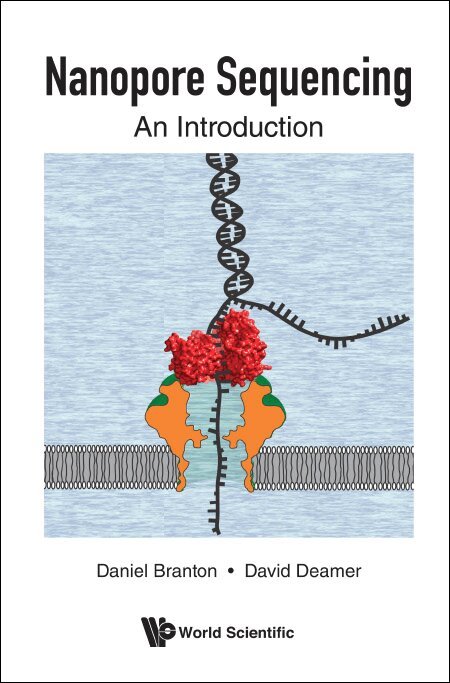
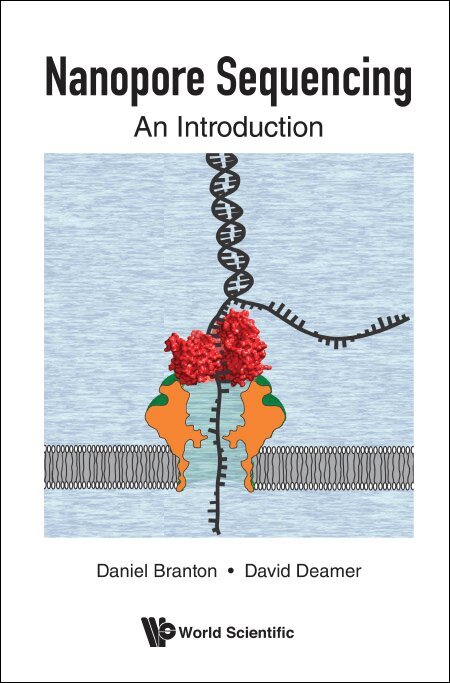
This is an introductory text and laboratory manual to be used primarily in undergraduate courses. It is also useful for graduate students and research scientists who require an introduction to the theory and methods of nanopore sequencing. The book has clear explanations of the principles of this emerging technology, together with instructional material written by experts that describes how to use a MinION nanopore instrument for sequencing in research or the classroom.At Harvard University the book serves as a textbook and lab manual for a university laboratory course designed to intensify the intellectual experience of incoming undergraduates while exploring biology as a field of concentration. Nanopore sequencing is an ideal topic as a path to encourage students about the range of courses they will take in Biology by pre-emptively addressing the complaint about having to take a course in Physics or Maths while majoring in Biology. The book addresses this complaint by concretely demonstrating the range of topics — from electricity to biochemistry, protein structure, molecular engineering, and informatics — that a student will have to master in subsequent courses if he or she is to become a scientist who truly understands what his or her biology instrument is measuring when investigating biological phenomena.
1 370 kr
Skickas inom 3-6 vardagar
This is an introductory text and laboratory manual to be used primarily in undergraduate courses. It is also useful for graduate students and research scientists who require an introduction to the theory and methods of nanopore sequencing. The book has clear explanations of the principles of this emerging technology, together with instructional material written by experts that describes how to use a MinION nanopore instrument for sequencing in research or the classroom.At Harvard University the book serves as a textbook and lab manual for a university laboratory course designed to intensify the intellectual experience of incoming undergraduates while exploring biology as a field of concentration. Nanopore sequencing is an ideal topic as a path to encourage students about the range of courses they will take in Biology by pre-emptively addressing the complaint about having to take a course in Physics or Maths while majoring in Biology. The book addresses this complaint by concretely demonstrating the range of topics — from electricity to biochemistry, protein structure, molecular engineering, and informatics — that a student will have to master in subsequent courses if he or she is to become a scientist who truly understands what his or her biology instrument is measuring when investigating biological phenomena.