
Eric N. Waltenburg - Böcker
Visar alla böcker från författaren Eric N. Waltenburg. Handla med fri frakt och snabb leverans.
5 produkter
5 produkter
928 kr
Skickas inom 10-15 vardagar
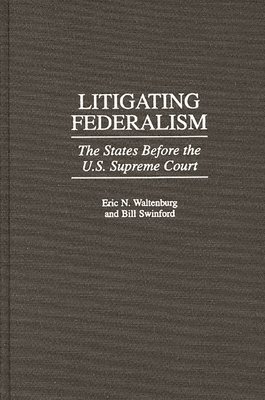
Waltenburg and Swinford provide a detailed and systematic examination of state government activity before the U.S. Supreme Court. They provide an explanatory model of state litigation behavior that both rests upon a solid theoretical perspective and places state decisions in a larger political context.After an examination of the evolution of U.S. constitutional law on issues of direct state concern, Waltenburg and Swinford focus most of their attention on qualitative and quanitative analyses of the behavior over time of states in all their roles before the Court. Scholars and other researchers interested in judicial decision-making, Constitutional Law, and inter-governmental relations will find this a particularly useful study.
1 932 kr
Skickas inom 10-15 vardagar
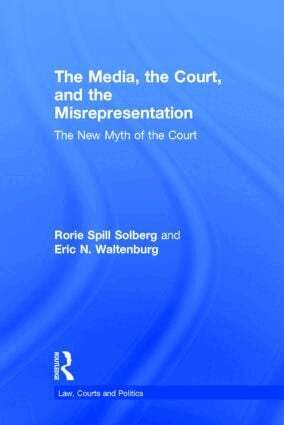
The Court’s decisions are interpreted and disseminated via the media. During this process, the media paints an image of the Court and its business. Like any artist, the media has license regarding what to cover and the amount of attention devoted to any aspect of the Court and its business. Some cases receive tremendous attention, while others languish on the back pages or are ignored. These selection effects create a skewed picture of the Court and its work, and might affect public attitudes toward the Court. Indeed, studies of media coverage of other governmental institutions reveal that when, and how, their policy decisions are covered has implications for the public’s understanding of, compliance with, support for, and cynicism about the policy.This book uncovers and describes this coverage and compares it to the confirmation hearings, the Court’s actual work, even its members. Rorie Spill Solberg and Eric N. Waltenburg analyze media coverage of nominations and confirmation hearings, the justices’ "extra-curricular" activities and their retirements/deaths, and the Court’s opinions, and compare this coverage to analyses of confirmation transcripts and the Court’s full docket. Solberg and Waltenburg contend that media now cover the Court and its personnel more similarly to its coverage of other political institutions. Journalists still regurgitate a mythology supported by the justices, a "cult of the robe," wherein unbiased and apolitical judges mechanically base their decisions upon the law and the Constitution. Furthermore, they argue the media also focus on the "cult of personality," wherein the media emphasize certain attributes of the justices and their work to match the public’s preferences for subject matter and content. The media’s portrayal, then, may undercut the Court’s legitimacy and its reservoir of good will.

Choosing Where to Fight
Organized Labor and the Modern Regulatory State, 1948-1987
Häftad, Engelska, 2001
376 kr
Tillfälligt slut
Examines how organized labor has decided where to pursue its interests.Choosing Where to Fight studies how organized labor decided to strategically locate its energies in national policy making. The idea that organized interests divide their efforts among different institutional settings is well known. Waltenburg, however, systematically uncovers the determinants of how labor has decided to engage in one particular policy making arena over another. He examines labor's actions between 1948 and 1987 in the National Labor Relations Board, the federal circuit courts, and Congress. Labor's choice of where to act, he argues, is an instance of rational decision making under risk. The basis of labor's expectations and preferences for one of these arenas depends on prior experiences and the presence of allies within the particular institution.
665 kr
Skickas inom 10-15 vardagar
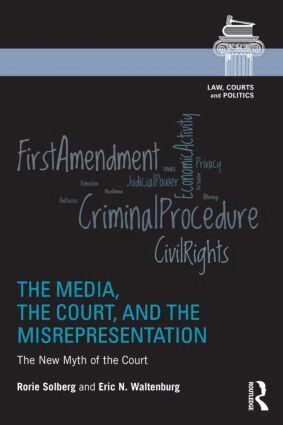
The Court’s decisions are interpreted and disseminated via the media. During this process, the media paints an image of the Court and its business. Like any artist, the media has license regarding what to cover and the amount of attention devoted to any aspect of the Court and its business. Some cases receive tremendous attention, while others languish on the back pages or are ignored. These selection effects create a skewed picture of the Court and its work, and might affect public attitudes toward the Court. Indeed, studies of media coverage of other governmental institutions reveal that when, and how, their policy decisions are covered has implications for the public’s understanding of, compliance with, support for, and cynicism about the policy.This book uncovers and describes this coverage and compares it to the confirmation hearings, the Court’s actual work, even its members. Rorie Spill Solberg and Eric N. Waltenburg analyze media coverage of nominations and confirmation hearings, the justices’ "extra-curricular" activities and their retirements/deaths, and the Court’s opinions, and compare this coverage to analyses of confirmation transcripts and the Court’s full docket. Solberg and Waltenburg contend that media now cover the Court and its personnel more similarly to its coverage of other political institutions. Journalists still regurgitate a mythology supported by the justices, a "cult of the robe," wherein unbiased and apolitical judges mechanically base their decisions upon the law and the Constitution. Furthermore, they argue the media also focus on the "cult of personality," wherein the media emphasize certain attributes of the justices and their work to match the public’s preferences for subject matter and content. The media’s portrayal, then, may undercut the Court’s legitimacy and its reservoir of good will.
612 kr
Skickas inom 5-8 vardagar