
Frank Stenger - Böcker
Visar alla böcker från författaren Frank Stenger. Handla med fri frakt och snabb leverans.
6 produkter
6 produkter
1 162 kr
Skickas inom 3-6 vardagar
This graduate text addresses the relationship between modern approximation theory and computational methods. It is a combination of expositions of basic classical methods of approximation leading to popular splines and new explicit tools of computation, including sinc methods, elliptic function methods, and positive operator approximation methods. This book will serve as a text for graduate courses in computer science and applied mathematics, and also as a reference for professionals.
1 078 kr
Skickas inom 10-15 vardagar
Handbook of Sinc Numerical Methods presents an ideal road map for handling general numeric problems. Reflecting the author’s advances with Sinc since 1995, the text most notably provides a detailed exposition of the Sinc separation of variables method for numerically solving the full range of partial differential equations (PDEs) of interest to scientists and engineers. This new theory, which combines Sinc convolution with the boundary integral equation (IE) approach, makes for exponentially faster convergence to solutions of differential equations. The basis for the approach is the Sinc method of approximating almost every type of operation stemming from calculus via easily computed matrices of very low dimension.The downloadable resources of this handbook contain roughly 450 MATLAB® programs corresponding to exponentially convergent numerical algorithms for solving nearly every computational problem of science and engineering. While the book makes Sinc methods accessible to users wanting to bypass the complete theory, it also offers sufficient theoretical details for readers who do want a full working understanding of this exciting area of numerical analysis.
2 960 kr
Skickas inom 10-15 vardagar
Handbook of Sinc Numerical Methods presents an ideal road map for handling general numeric problems. Reflecting the author’s advances with Sinc since 1995, the text most notably provides a detailed exposition of the Sinc separation of variables method for numerically solving the full range of partial differential equations (PDEs) of interest to scientists and engineers. This new theory, which combines Sinc convolution with the boundary integral equation (IE) approach, makes for exponentially faster convergence to solutions of differential equations. The basis for the approach is the Sinc method of approximating almost every type of operation stemming from calculus via easily computed matrices of very low dimension.The downloadable resources of this handbook contain roughly 450 MATLAB® programs corresponding to exponentially convergent numerical algorithms for solving nearly every computational problem of science and engineering. While the book makes Sinc methods accessible to users wanting to bypass the complete theory, it also offers sufficient theoretical details for readers who do want a full working understanding of this exciting area of numerical analysis.
1 276 kr
Skickas inom 10-15 vardagar
Many mathematicians, scientists, and engineers are familiar with the Fast Fourier Transform, a method based upon the Discrete Fourier Transform. Perhaps not so many mathematicians, scientists, and engineers recognize that the Discrete Fourier Transform is one of a family of symbolic formulae called Sinc methods. Sinc methods are based upon the Sinc function, a wavelet-like function replete with identities which yield approximations to all classes of computational problems. Such problems include problems over finite, semi-infinite, or infinite domains, problems with singularities, and boundary layer problems. Written by the principle authority on the subject, this book introduces Sinc methods to the world of computation. It serves as an excellent research sourcebook as well as a textbook which uses analytic functions to derive Sinc methods for the advanced numerical analysis and applied approximation theory classrooms. Problem sections and historical notes are included.
1 064 kr
Skickas inom 10-15 vardagar
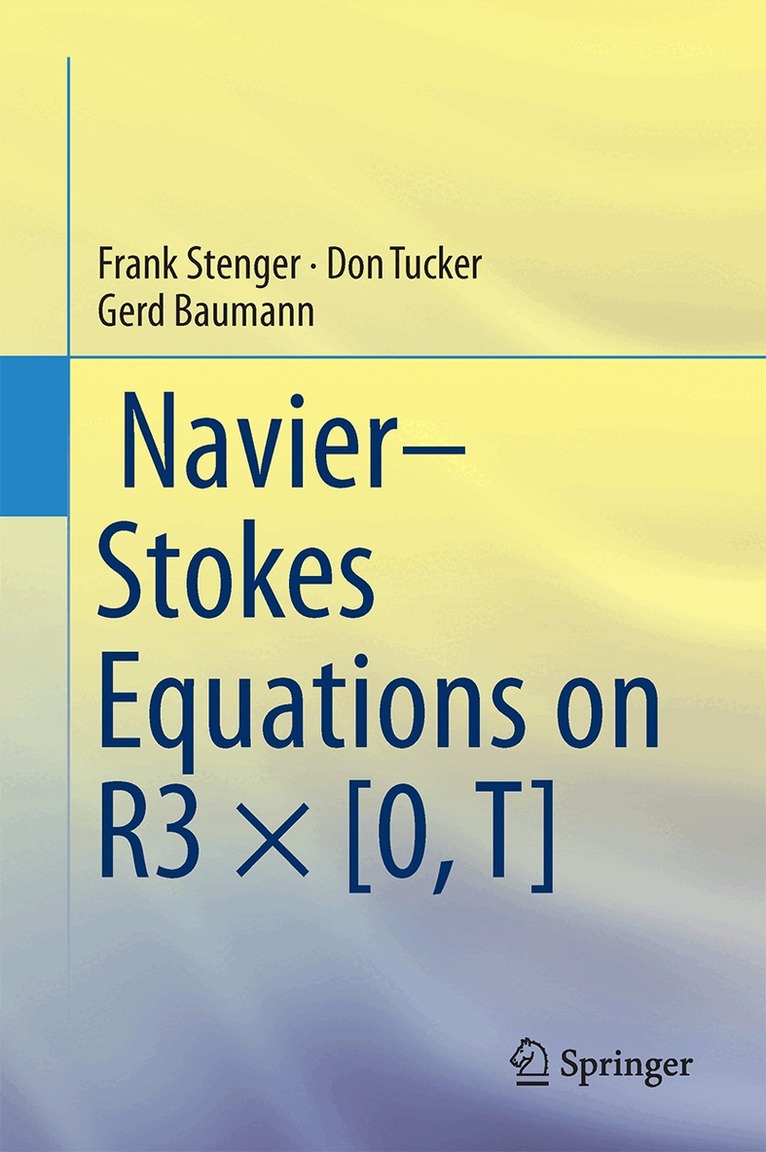
In this monograph, leading researchers in the world ofnumerical analysis, partial differential equations, and hard computationalproblems study the properties of solutions of the Navier–Stokes partial differential equations on (x, y, z,t) ∈ ℝ3 × [0, T]. Initially converting the PDE to asystem of integral equations, the authors then describe spaces A of analytic functions that housesolutions of this equation, and show that these spaces of analytic functionsare dense in the spaces S of rapidlydecreasing and infinitely differentiable functions. This method benefits fromthe following advantages:The functions of S arenearly always conceptual rather than explicitInitial and boundaryconditions of solutions of PDE are usually drawn from the applied sciences,and as such, they are nearly always piece-wise analytic, and in this case,the solutions have the same propertiesWhen methods ofapproximation are applied to functions of A they converge at an exponential rate, whereas methods ofapproximation applied to the functions of S converge only at a polynomial rateEnables sharper bounds onthe solution enabling easier existence proofs, and a more accurate andmore efficient method of solution, including accurate error boundsFollowing the proofs of denseness, the authors prove theexistence of a solution of the integral equations in the space of functions A ∩ ℝ3 × [0, T], and provide an explicit novelalgorithm based on Sinc approximation and Picard–like iteration for computingthe solution. Additionally, the authors include appendices that provide acustom Mathematica program for computing solutions based on the explicitalgorithmic approximation procedure, and which supply explicit illustrations ofthese computed solutions.
1 064 kr
Skickas inom 10-15 vardagar
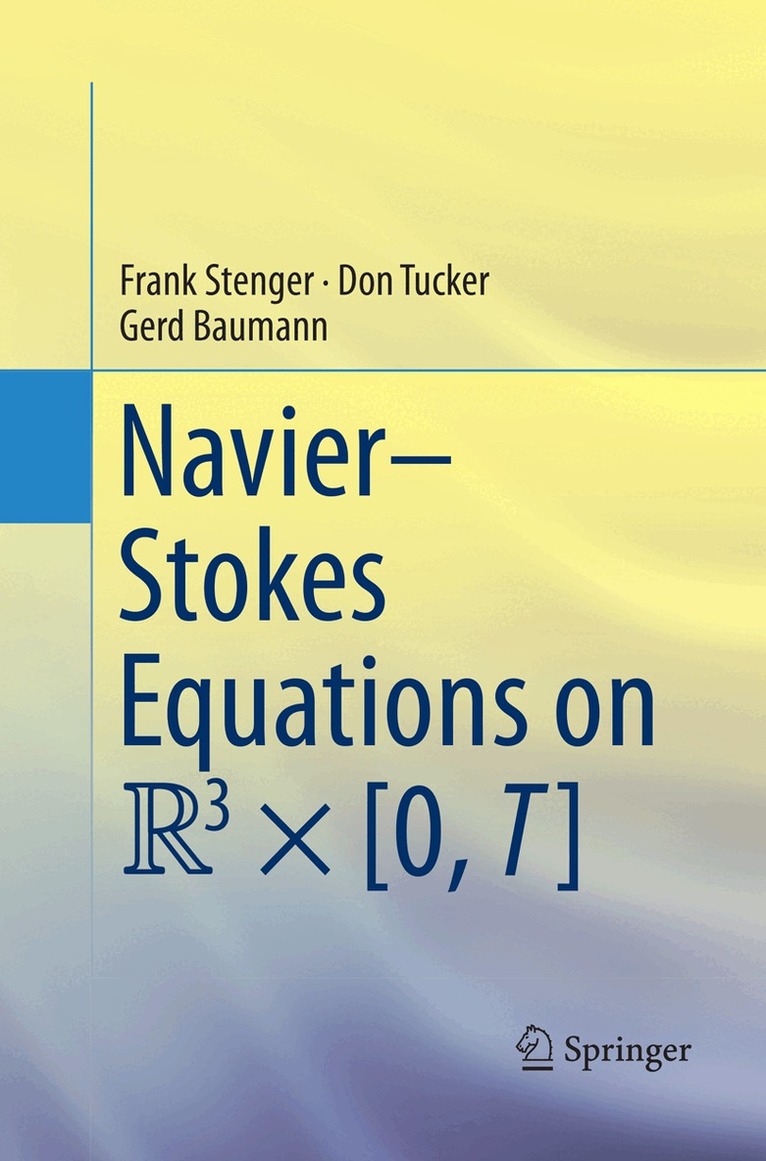
In this monograph, leading researchers in the world ofnumerical analysis, partial differential equations, and hard computationalproblems study the properties of solutions of the Navier–Stokes partial differential equations on (x, y, z,t) ∈ ℝ3 × [0, T]. Initially converting the PDE to asystem of integral equations, the authors then describe spaces A of analytic functions that housesolutions of this equation, and show that these spaces of analytic functionsare dense in the spaces S of rapidlydecreasing and infinitely differentiable functions. This method benefits fromthe following advantages:The functions of S arenearly always conceptual rather than explicitInitial and boundaryconditions of solutions of PDE are usually drawn from the applied sciences,and as such, they are nearly always piece-wise analytic, and in this case,the solutions have the same propertiesWhen methods ofapproximation are applied to functions of A they converge at an exponential rate, whereas methods ofapproximation applied to the functions of S converge only at a polynomial rateEnables sharper bounds onthe solution enabling easier existence proofs, and a more accurate andmore efficient method of solution, including accurate error boundsFollowing the proofs of denseness, the authors prove theexistence of a solution of the integral equations in the space of functions A ∩ ℝ3 × [0, T], and provide an explicit novelalgorithm based on Sinc approximation and Picard–like iteration for computingthe solution. Additionally, the authors include appendices that provide acustom Mathematica program for computing solutions based on the explicitalgorithmic approximation procedure, and which supply explicit illustrations ofthese computed solutions.