
Franz Huber - Böcker
Visar alla böcker från författaren Franz Huber. Handla med fri frakt och snabb leverans.
13 produkter
13 produkter
442 kr
Skickas inom 5-8 vardagar
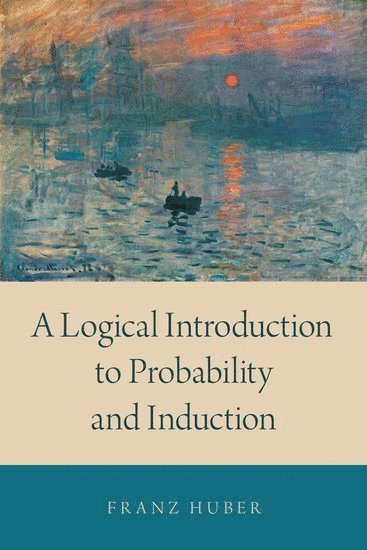
A Logical Introduction to Probability and Induction is a textbook on the mathematics of the probability calculus and its applications in philosophy.On the mathematical side, the textbook introduces these parts of logic and set theory that are needed for a precise formulation of the probability calculus. On the philosophical side, the main focus is on the problem of induction and its reception in epistemology and the philosophy of science. Particular emphasis is placed on the means-end approach to the justification of inductive inference rules.In addition, the book discusses the major interpretations of probability. These are philosophical accounts of the nature of probability that interpret the mathematical structure of the probability calculus. Besides the classical and logical interpretation, they include the interpretation of probability as chance, degree of belief, and relative frequency. The Bayesian interpretation of probability as degree of belief locates probability in a subject's mind. It raises the question why her degrees of belief ought to obey the probability calculus. In contrast to this, chance and relative frequency belong to the external world. While chance is postulated by theory, relative frequencies can be observed empirically.A Logical Introduction to Probability and Induction aims to equip students with the ability to successfully carry out arguments. It begins with elementary deductive logic and uses it as basis for the material on probability and induction. Throughout the textbook results are carefully proved using the inference rules introduced at the beginning, and students are asked to solve problems in the form of 50 exercises. An instructor's manual contains the solutions to these exercises as well as suggested exam questions.The book does not presuppose any background in mathematics, although sections 10.3-10.9 on statistics are technically sophisticated and optional. The textbook is suitable for lower level undergraduate courses in philosophy and logic.
1 252 kr
Skickas inom 5-8 vardagar
A Logical Introduction to Probability and Induction is a textbook on the mathematics of the probability calculus and its applications in philosophy.On the mathematical side, the textbook introduces these parts of logic and set theory that are needed for a precise formulation of the probability calculus. On the philosophical side, the main focus is on the problem of induction and its reception in epistemology and the philosophy of science. Particular emphasis is placed on the means-end approach to the justification of inductive inference rules.In addition, the book discusses the major interpretations of probability. These are philosophical accounts of the nature of probability that interpret the mathematical structure of the probability calculus. Besides the classical and logical interpretation, they include the interpretation of probability as chance, degree of belief, and relative frequency. The Bayesian interpretation of probability as degree of belief locates probability in a subject's mind. It raises the question why her degrees of belief ought to obey the probability calculus. In contrast to this, chance and relative frequency belong to the external world. While chance is postulated by theory, relative frequencies can be observed empirically.A Logical Introduction to Probability and Induction aims to equip students with the ability to successfully carry out arguments. It begins with elementary deductive logic and uses it as basis for the material on probability and induction. Throughout the textbook results are carefully proved using the inference rules introduced at the beginning, and students are asked to solve problems in the form of 50 exercises. An instructor's manual contains the solutions to these exercises as well as suggested exam questions.The book does not presuppose any background in mathematics, although sections 10.3-10.9 on statistics are technically sophisticated and optional. The textbook is suitable for lower level undergraduate courses in philosophy and logic.
- Nyhet

929 kr
Kommande
In this novel approach to metaphysics, the philosophy of science, and philosophical logic, Franz Huber explores means-end derivations of the logics of default conditionals and counterfactuals, modal idealism about possible worlds, and the royal rule, a normative principle relating descriptive normality to conditional belief. Causality, Counterfactuals, and Belief develops typicality and causality models, allowing for characterizations of backtracking and causal counterfactuals, generalizations of structural equations and causal models, definitions of hard and soft interventions, as well as conditions under which counterfactuals and default conditionals can be tested.Distinct in its unifying methodological approach, Huber's exploration of means-end philosophy -- together with a critical discussion of the use of intuition in philosophy -- posits the discipline as both serious and normative, arguing that philosophical problems are deeply intertwined with one other. It explains the importance of logic to philosophy without identifying logic as a technical theory in itself.

1 010 kr
Skickas inom 5-8 vardagar
This is the first of two volumes on belief and counterfactuals. It provides an introduction to ranking theory, which is a powerful formal theory with a broad range of applications in different areas of analytic philosophy. Drawing on formal logic, ranking theory can account for degrees of belief, which can change with the introduction of new information. In Belief and Counterfactuals, Franz Huber applies ranking theory and belief revision to metaphysics and epistemology. Though based on his technical writings, the volume is intended to be as accessible as possible, in order to fully present the utility of ranking theory to a wide range of philosophical issues. The volume contains several novel arguments, accounts, and applications--including the consistency argument for ranking theory, the conditional theory of conditional belief, as well as solutions to the problems of conceptual belief change, logical learning, and learning conditionals. Huber also presents a defense of the instrumentalist understanding of normativity, or rationality, and an argument for the thesis that there are only hypothetical imperatives and no categorical imperatives. His distinctive use of means-end philosophy as a unifying methodological approach establishes a treatment of philosophy as a normative discipline, and of philosophical problems as entangled with one another. This position also explains the importance of logic to philosophy, without devolving into a separate technical theory.

Acoustic Communication in Insects and Anurans
Common Problems and Diverse Solutions
Häftad, Engelska, 2002
547 kr
Skickas inom 7-10 vardagar
Walk near woods or water on any spring or summer night and you will hear a bewildering (and sometimes deafening) chorus of frog, toad, and insect calls. How are these calls produced? What messages are encoded within the sounds, and how do their intended recipients receive and decode these signals? How does acoustic communication affect and reflect behavioral and evolutionary factors such as sexual selection and predator avoidance? H. Carl Gerhardt and Franz Huber address these questions among many others, drawing on research from bioacoustics, behavior, neurobiology, and evolutionary biology to present the first integrated approach to the study of acoustic communication in insects and anurans. They highlight both the common solutions that these very different groups have evolved to shared challenges, such as small size, ectothermy (cold-bloodedness), and noisy environments, as well as the divergences that reflect the many differences in evolutionary history between the groups. Throughout the book Gerhardt and Huber also provide helpful suggestions for future research.

1 067 kr
Skickas inom 10-15 vardagar
This book has grown out of a conference on "Degrees of Belief" that was held at the University of Konstanz in July 2004, organised by Luc Bovens, Wolfgang Spohn, and the editors. The event was supported by the German Research Fo- dation (DFG), the Philosophy, Probability, and Modeling (PPM) Group, and the CenterforJuniorResearchFellows(since2008:Zukunftskolleg)attheUniversityof Konstanz. The PPM Group itself - of which the editors were members at the time - was sponsored by a So a Kovalevskaja Award by the Alexander von Humboldt Foundation, the Federal Ministry of Education and Research, and the Program for the Investment in the Future (ZIP) of the German Government to Luc Bovens, who co-directed the PPM Group with Stephan Hartmann. The publication of this book received further support from the Emmy Noether Junior Research Group Formal Epistemology at the Zukunftskolleg and the Department of Philosophy at the U- versity of Konstanz, directed by Franz Huber, and funded by the DFG. We thank everyone involved for their support. Dedicated to the memory of Philippe Smets and Henry Kyburg. Konstanz, Germany Franz Huber Christoph Schmidt-Petri v Contents Belief and Degrees of Belief...1Franz Huber Part I Plain Belief and Degrees of Belief Beliefs, Degrees of Belief, and the Lockean Thesis...37 Richard Foley The Lockean Thesis and the Logic of Belief...49 James Hawthorne Partial Belief and Flat-Out Belief...75 Keith Frankish Part II What Laws Should Degrees of Belief Obey? Epistemic Probability and Coherent Degrees of Belief ...

Franz Hubers Neue Beobachtungen an Den Bienen Vollstandige Ausgabe Band I & II Zweihundertjahrausgabe (1814-2014)
Inbunden, Tyska, 2014
720 kr
Skickas inom 5-8 vardagar

Bauerntum Und Bauernbildung Im Neuen Reich
Grund Und Aufriss Einer Bauern Und Volkhaften Landpädagogik
Inbunden, Tyska, 1934
1 125 kr
Skickas inom 3-6 vardagar

141 kr
Skickas inom 3-6 vardagar

140 kr
Skickas inom 3-6 vardagar

128 kr
Skickas inom 3-6 vardagar

135 kr
Skickas inom 3-6 vardagar

1 067 kr
Skickas inom 10-15 vardagar
This book has grown out of a conference on "Degrees of Belief" that was held at the University of Konstanz in July 2004, organised by Luc Bovens, Wolfgang Spohn, and the editors. The event was supported by the German Research Fo- dation (DFG), the Philosophy, Probability, and Modeling (PPM) Group, and the CenterforJuniorResearchFellows(since2008:Zukunftskolleg)attheUniversityof Konstanz. The PPM Group itself - of which the editors were members at the time - was sponsored by a So a Kovalevskaja Award by the Alexander von Humboldt Foundation, the Federal Ministry of Education and Research, and the Program for the Investment in the Future (ZIP) of the German Government to Luc Bovens, who co-directed the PPM Group with Stephan Hartmann. The publication of this book received further support from the Emmy Noether Junior Research Group Formal Epistemology at the Zukunftskolleg and the Department of Philosophy at the U- versity of Konstanz, directed by Franz Huber, and funded by the DFG. We thank everyone involved for their support. Dedicated to the memory of Philippe Smets and Henry Kyburg. Konstanz, Germany Franz Huber Christoph Schmidt-Petri v Contents Belief and Degrees of Belief...1Franz Huber Part I Plain Belief and Degrees of Belief Beliefs, Degrees of Belief, and the Lockean Thesis...37 Richard Foley The Lockean Thesis and the Logic of Belief...49 James Hawthorne Partial Belief and Flat-Out Belief...75 Keith Frankish Part II What Laws Should Degrees of Belief Obey? Epistemic Probability and Coherent Degrees of Belief ...