
Jane E. Francis - Böcker
Visar alla böcker från författaren Jane E. Francis. Handla med fri frakt och snabb leverans.
5 produkter
5 produkter
613 kr
Skickas inom 7-10 vardagar
The changes in the Earth's climate over the past 600 million years, from the Cambrian to the Quaternary, come under scrutiny in this book, first published in 1992. The geological evidence for ancient climates is examined, such as the distribution of climate-sensitive sediments. The Earth's climate has changed many times throughout the Phanerozoic. Thus in this book the climate history has been divided into Warm and Cool modes, intervals when either the Earth was in a former 'greenhouse' state with higher levels of atmospheric CO2 and polar regions free of ice, or the global climate was cooler and ice was present in high latitudes. The studies presented here highlight the complex interactions between the carbon cycle, continental distribution, tectonics, sea level variation, ocean circulation and temperature change as well as other parameters. In particular, the potential of the carbon isotope records as an important signal of the past climates of the Earth is explored. This book will be useful to all students and researchers with an interest in palaeoclimates and palaeoenvironments.
1 508 kr
Skickas inom 7-10 vardagar
The changes in the Earth's climate over the past 600 million years, from the Cambrian to the Quaternary, come under scrutiny in this book, first published in 1992. The geological evidence for ancient climates is examined, such as the distribution of climate-sensitive sediments. The Earth's climate has changed many times throughout the Phanerozoic. Thus in this book the climate history has been divided into Warm and Cool modes, intervals when either the Earth was in a former 'greenhouse' state with higher levels of atmospheric CO2 and polar regions free of ice, or the global climate was cooler and ice was present in high latitudes. The studies presented here highlight the complex interactions between the carbon cycle, continental distribution, tectonics, sea level variation, ocean circulation and temperature change as well as other parameters. In particular, the potential of the carbon isotope records as an important signal of the past climates of the Earth is explored. This book will be useful to all students and researchers with an interest in palaeoclimates and palaeoenvironments.
Contextualizing Imperial Disruption and Upheavals and their Associated Research Challenges
Inbunden, Engelska, 2024
753 kr
Skickas
This volume follows on from papers presented at the 13th International Cretan Congress in 2022 and covers the period from the 1st century BC to 4th–5th centuries AD, with the articles in the volume set around the topic of upheavals and disruptions, and in particular those evidenced with the arrival of Rome, the creation of the Roman Province, along with those resulting from the dividing of the Roman Empire and the emergence of the Byzantine world. The volume is set against the background of the Roman conquest of Crete in 67 BC, which heralded the end of the power and control of the Greek city-states, which were themselves steeped in age-old traditions and governed by a variety of legal frameworks, some of which had their roots in Archaic times. The ensuing changes, when they arrived, took centuries to develop but resulted in the establishment of a Greco-Roman culture and society that was far removed from its Hellenistic predecessor. Roman Crete witnessed several significant periods of disruption and interventions that had a direct impact on daily life and society. These included the military invasion of the island by Rome, at one end of the period, and the AD 365 destructive earthquake at the other, but other interruptions also occurred: changes to religion and religious practices, including the introduction of Christianity; fluctuations in natural resources that affected agricultural production and thus local economies and trade; monetary devaluations in Rome; movements of populations; external shifts in trading networks; and multiple instances of tectonic activity in the Imperial period that caused damage and instability.
Foundations in Stone
the Hellenistic, Roman and Early Byzantine architecture of Crete
Inbunden, Engelska, 2026
1 201 kr
Kommande
Over the centuries, the architecture and structural remains of Hellenistic, Roman and Early Byzantine Crete have attracted the attention of many travelers as they have journeyed around the island. For some, this experience came as a result of Crete featuring as part of the Grand Tour during the 17th–19th centuries as visitors to the island viewed buildings and the remains of urban areas that have now become lost to us, and for which we must rely surviving journal entries, sketches and drawings of the likes of those of the Italian physician, naturalist and antiquarian, Onorio Belli, who visited Roman theaters around Crete in the 1580s. His observations, sketches and plans, like those of other travelers, remain an important part of research and investigation today. Parts of this landscape, though much more fragmented, were visible to I.F. Sanders and recorded in his 1982 foundational work, Roman Crete: An Archaeological Survey and Gazetteer of Late Hellenistic, Roman, and Early Byzantine Crete, though at the time, the lack of research, investigation and publication restricted his appraisal, dating and a detailed discussion of the architecture for these periods.This third volume in the Cretan Studies series reopens this discussion by examining some of the new research, investigation and field studies on urban, rural and coastal sites and monuments across the island. As demonstrated by the articles in this volume, these are giving us a much more informed understanding of the architecture and the construction industry for the Hellenistic, Roman and Early Byzantine periods.
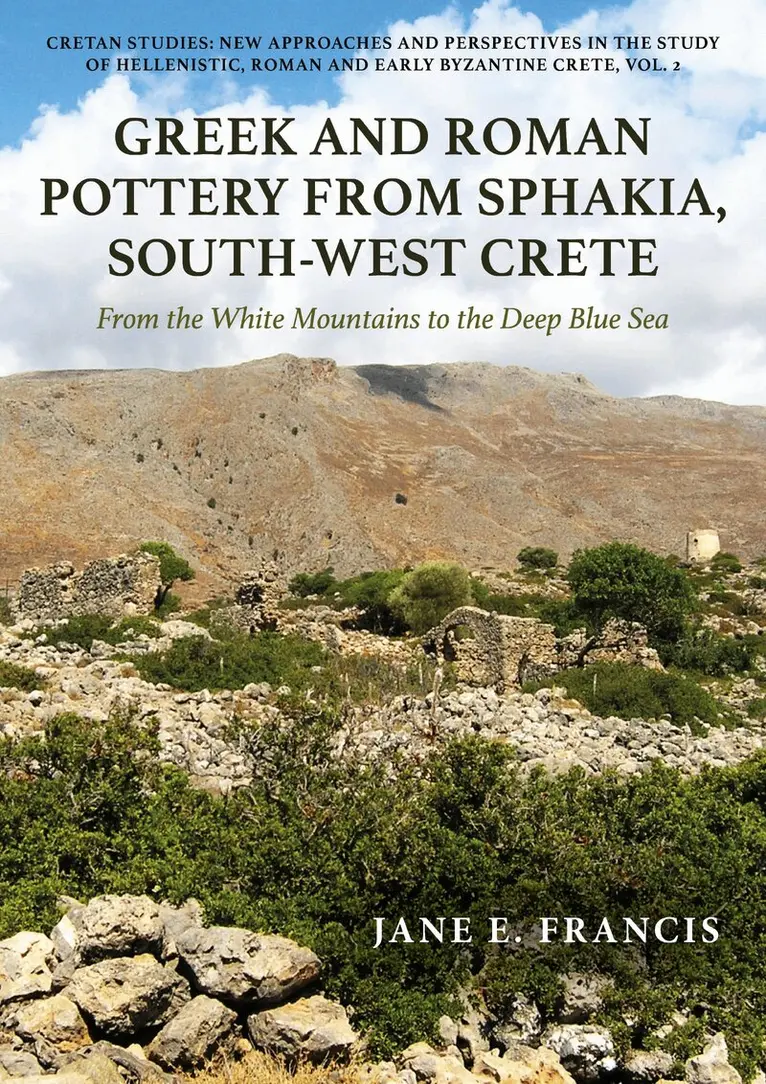
Greek and Roman Pottery from Sphakia, South-West Crete
From the White Mountains to the Deep Blue Sea
Inbunden, Engelska, 2025
889 kr
Skickas
This volume presents the Greek and Roman pottery collected and analyzed by the Sphakia Survey project and provides a ceramic model for a large section of western Crete, where ceramic traditions, both domestic and imported, are little known. This research integrates two approaches. It first presents a morphological and functional study of a body of pottery from a sizable part of Crete with little known archaeological evidence. Second, fabric analysis identifies and defines clays and clay mixtures, with macroscopic and petrographic analyses providing results from two perspectives. The rigorous application of fabric analysis, combined with the morphological examination, contribute to reconstructions of sites and areas within Sphakia. This data provides information about the history of individual sites, but then more broadly about that of Sphakia itself.Elements like site chronology, activities undertaken in particular areas, available landscape resources and their exploitation, and contact within the region, with other parts of Crete, and the wider Greek and Roman worlds are explored.