
Joris Larik - Böcker
Visar alla böcker från författaren Joris Larik. Handla med fri frakt och snabb leverans.
7 produkter
7 produkter
- Nyhet
780 kr
Skickas
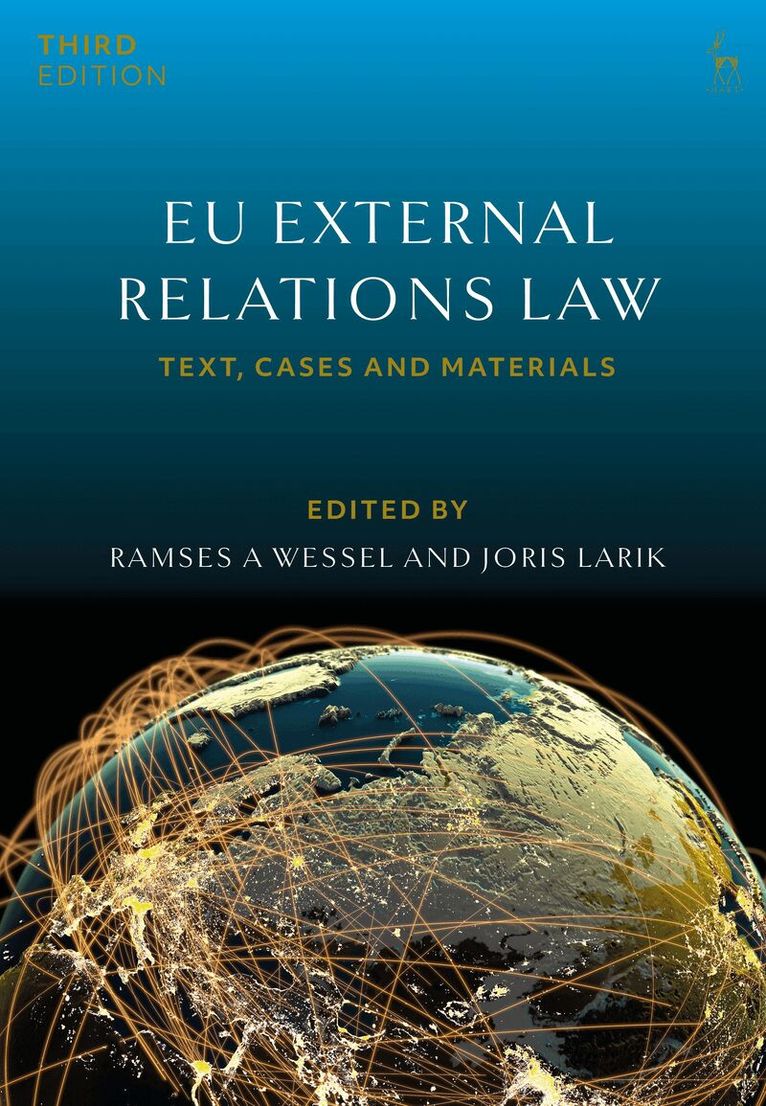
The first edition of this seminal textbook made a significant impact on the teaching of EU external relations law. This third edition continues to be the leading text in the field. It retains its hallmark dual perspective, looking at questions from an EU constitutional law perspective (the principles, powers, and the role of the institutions); and an international law perspective (the effects of international law within the EU, and the position of the EU in international organisations such as the WTO). It continues to explore key policy areas such as trade, security and defence, police and judicial cooperation, the environment, and human rights, drawing on the expertise of leading scholars in these fields. The book’s ‘text, cases, and materials’ approach provides students with a one-stop shop resource, allowing them to gain a thorough understanding of how the law has developed in this area, its judicial interpretation, and scholarly appraisal. Each chapter concludes with a section entitled ‘The Broader Picture of EU External Relations Law’, which weaves together the diverse and complex materials into a coherent whole and stimulates critical discussion of the topics covered. The fully revised third edition captures a wide range of new legislative instruments, international agreements, case law, and practice of EU external action developed over the past half decade in response to a geopolitically more challenging environment. Alongside the editors, contributors include Anne Thies, Andrea Ott, Jed Odermatt, Morten Broberg, Laurent Pech, Joelle Grogan, Gracia Marín Durán, and Claudio Matera. For this third edition, new contributors, including Marisa Cremona, Tamás Molnár, and Viktor Szép, provide additional expertise and fresh perspectives. The text has benefitted from the participation of student assistants who have advised on writing style and approach, ensuring ease of use and comprehension.
2 119 kr
Skickas inom 3-6 vardagar
Presenting the first comprehensive account of foreign policy objectives as a growing part of European constitutional law, Joris Larik confronts the trend of enshrining international ambitions in the highest laws of states and the European Union. Closely examining the provisions of foreign policy objectives, Larik differentiates their legal force and functions, situating them into the overall legal order of the state, the EU, and the composite 'European constitutional space'. He argues that the codification of foreign policy objectives suggests a progression in the evolution of the role of the constitution: from limiting public authority to guiding it towards certain goals, both at home and in the wider world. Advancing a comparative constitutional perspective for the study of EU external relations, this volume contributes a constitutional dimension to the 'normative power' debate in the study of EU foreign policy. Drawing on established national doctrines on constitutional objectives from Germany, France, and India, the book provides a common vocabulary for coming to terms with foreign policy objectives as legal norms across different jurisdictions. In the pluralist context and closely intertwined legal orders of the EU and its Member States, it shows how objectives help to channel the individual ambitions of the Member States through the Union framework towards a more coherent external action. Furthermore, the book connects its legal findings with the debate on the EU as an actor in international relations, exploring the role of these norms in inter-institutional struggles and processes of identity-shaping, legitimation, and socialization.
1 667 kr
Skickas inom 7-10 vardagar
Just Security in an Undergoverned World examines how humankind can manage global problems to achieve both security and justice in an age of antithesis. Global connectivity is increasing, visibly and invisiblyin trade, finance, culture, and informationhelping to spur economic growth, technological advance, and greater understanding and freedom, but global disconnects are growing as well. Ubiquitous electronics rely on high-value minerals scraped from the earth by miners kept poor by corruption and war. People abandon burning states for the often indifferent welcome of wealthier lands whose people, in turn, draw into themselves. Humanity's very success, underwritten in large part by lighting up gigatons of long-buried carbon for 200 years, now threatens humanity's future. The global governance institutions established after World War II to manage global threats, especially the twin scourges of war and poverty, have expanded in reach and impact, while paradoxically losing the political support of some of their wealthiest and most powerful members. Their problems mimic those of their members in struggling to adapt to new problems and maintain trust in norms and public bodies. This volume argues, however, that a properly mandated, managed, and modernized global architecture offers unparalleled potential to midwife solutions to intractable issuesfrom violent conflict and climate change to poverty and pandemic diseasethat transcend borders and the capacities of individual actors. It offers just security as a new framework for charing innovating solutions and strategies for effective and essential global governance.
Del 4 - Integration through Law The Role of Law and the Rule of Law in ASEAN Integration
ASEAN's External Agreements
Law, Practice and the Quest for Collective Action
Häftad, Engelska, 2015
724 kr
Skickas inom 7-10 vardagar
ASEAN is coming of age as an international actor and international treaty-maker. To date, more than two hundred external agreements and other instruments have been concluded in the name of ASEAN. This book provides the first systematic account of the legal framework governing ASEAN's burgeoning external relations practice. It focuses in depth on ASEAN's wide-ranging mandate to promote its values and principles in the wider region and beyond, as well as the highly intergovernmental, and at times haphazard, handling of the bloc's relations with the outside world. Furthermore, it reveals that there are two basic meanings of ASEAN in its international dealings, which have important implications under international law: ASEAN as an international organisation with its own legal personality and ASEAN as the collectivity of its member states. This timely and thoughtful book is a valuable resource for practitioners and scholars of international law, ASEAN law, international relations, regional integration and governance.
713 kr
Skickas
The first edition of this seminal textbook made a significant impact on the teaching of EU external relations law. This new edition retains the hallmarks of that success, while providing a fully revised and updated account of this burgeoning field. It offers a dual perspective, looking at questions from both the EU constitutional law perspective (the principles underpinning EU external action, the EU’s powers, and the role of the Court of Justice of the EU); and the international law perspective (the effect of international law in the EU legal order and the position of the EU in international organisations such as the WTO). A number of key substantive policy areas are explored, including trade, security and defence, police and judicial cooperation, the environment, human rights, and development cooperation. Taking a ‘text, cases and materials’ approach, it allows students to gain a thorough understanding of milestones in the evolution of EU law in this area, their judicial interpretation and scholarly appraisal. Linking these pieces together through the authors’ commentary and analysis ensures that students are given the necessary guidance to properly position and digest these materials. Lastly, each chapter concludes with a section entitled ‘The Big Picture of EU External Relations Law’, which weaves together the diverse and complex materials into a coherent whole and stimulates critical discussion of the topics covered.
- Nyhet
2 167 kr
Skickas inom 10-15 vardagar
The first edition of this seminal textbook made a significant impact on the teaching of EU external relations law. This third edition continues to be the leading text in the field. It retains its hallmark dual perspective, looking at questions from an EU constitutional law perspective (the principles, powers, and the role of the institutions); and an international law perspective (the effects of international law within the EU, and the position of the EU in international organisations such as the WTO). It continues to explore key policy areas such as trade, security and defence, police and judicial cooperation, the environment, and human rights, drawing on the expertise of leading scholars in these fields. The book’s ‘text, cases, and materials’ approach provides students with a one-stop shop resource, allowing them to gain a thorough understanding of how the law has developed in this area, its judicial interpretation, and scholarly appraisal. Each chapter concludes with a section entitled ‘The Broader Picture of EU External Relations Law’, which weaves together the diverse and complex materials into a coherent whole and stimulates critical discussion of the topics covered. The fully revised third edition captures a wide range of new legislative instruments, international agreements, case law, and practice of EU external action developed over the past half decade in response to a geopolitically more challenging environment. Alongside the editors, contributors include Anne Thies, Andrea Ott, Jed Odermatt, Morten Broberg, Laurent Pech, Joelle Grogan, Gracia Marín Durán, and Claudio Matera. For this third edition, new contributors, including Marisa Cremona, Tamás Molnár, and Viktor Szép, provide additional expertise and fresh perspectives. The text has benefitted from the participation of student assistants who have advised on writing style and approach, ensuring ease of use and comprehension.
Del 101 - Nijhoff Law Specials
Humanitarian Intervention and Political Support for Interstate Use of Force
Häftad, Engelska, 2020
1 478 kr
Skickas inom 5-8 vardagar
When can a state give political support to a military intervention in another state? The Government of the Netherlands commissioned an international Expert Group composed of eminent members from the fields of international law, international relations and diplomacy. The Expert Group’s objective was to examine this complex, topical and time-sensitive question and to consider whether the government should press for international acceptance of humanitarian intervention as a new legal basis for the use of force between states in exceptional circumstances. This volume is the result of those efforts. The Expert Group was led by Professor Cyrille Fijjnaut and consisted of Mr. Kristian Fischer, Professor Terry Gill, Professor Larissa van den Herik, Professor Martti Koskenniemi, Professor Claus Kreß, Mr. Robert Serry, Ms. Monika Sie Dhian Ho, Ms. Elizabeth Wilmshurst and Professor Rob de Wijk. Their thorough analysis and recommendations offer important insights that can aid governments in formulating a position on political support for the use of force between states and humanitarian intervention. The volume also constitutes a useful tool for scholars and practitioners in considering these difficult and important issues. From the Foreword by Stef Blok, Minister of Foreign Affairs of the Netherlands:"The Expert Group’s thorough analysis and recommendations on this complex subject offer important insights that can aid the government in formulating its position on political support for the use of force between states and humanitarian intervention. In drawing up this advisory report the Expert Group has helped the government develop a new, contemporary vision on these issues...."