
Magdalena Annersten Gershater - Böcker
Visar alla böcker från författaren Magdalena Annersten Gershater. Handla med fri frakt och snabb leverans.
3 produkter
3 produkter

1 419 kr
Redaktörsgruppen har med kunskap, lust och redaktionellt mod planerat två parallella publikationer inom ramen för ett gemensamt projekt. Tillsammans med 93 författare skapar de Omvårdnad & medicin samt Omvårdnad & kirurgi - ett pricksäkert grundverk som omfattar två av de största kärnämnena i sjuksköterskeutbildningen. Ett sådant helhetsgrepp har hittills saknats i svensk kurslitteratur. Ingen motsvarande lärobok har heller så medvetet förenat naturvetenskap och omvårdnadsvetenskap för att understryka den eftersträvansvärda teamsamverkan, mellan vårdens professioner, som studenten ska bli en del av i sin kliniska vardag. Böckerna tilldelades Kurslitteraturpriset 2014.

738 kr
Skickas
Böckerna Omvårdnad & kirurgi samt Omvårdnad & medicin är resultatet av ett gemensamt projekt som har lett fram till dessa två skräddarsydda publikationer för sjuksköterskeutbildningen. I den nya uppdaterade upplagan förser innehållet läsaren med aktuella heltäckande kunskaper inom två viktiga kärnämnen i utbildningen. På ett pricksäkert sätt möter böckerna dagens och morgondagens sjuksköterskestudenters kunskapsbehov – genom hela utbildningen och in i yrkeslivet.Verkets kapitel har med få undantag skrivits av en sjuksköterska och en läkare gemensamt för att återspegla det teamarbete som studenten så småningom ska bli en del av i sin kliniska vardag. De naturvetenskapliga och omvårdnadsvetenskapliga kunskapsfälten beskrivs parallellt och vävs samman på ett ändamålsenligt sätt för läsaren. Syftet är att studenten ska förstå de bakomliggande sjukdomsprocesserna till patientens omvårdnadsbehov och därigenom kunna vidta relevanta omvårdnadsåtgärder. Patientens symtom, tecken och möjliga behandlingsåtgärder beskrivs på ett pedagogiskt sätt i dessa rikt illustrerade böcker.Boken finns även i digitalt format. Den digitala boken aktiveras med hjälp av koden som finns på omslagets insida.
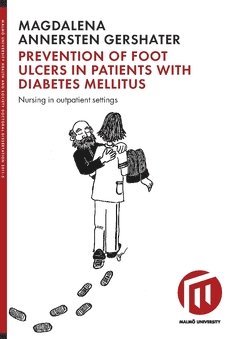
Prevention of foot ulcers in patients with Diabetes mellitus : nursing in outpatient settings
Häftad, Engelska, 2018
161 kr
Skickas inom 5-8 vardagar
Amputation in patients with diabetes mellitus preceded by a foot ulcer is a serious complication. Patients with the highest risk of developing a foot ulcer are often found in home nursing settings. The overall aim was to focus on how registered nurses are working with prevention of foot ulcers in patients with diabetes mellitus in outpatient settings: - to identify factors related to short term outcome of foot ul-cers in patients treated in a multi-disciplinary system until healing was achieved. - to assess what was documented by registered nurses regarding diabetes care in a Swed-ish municipality’s home nursing service; to what extent nursing actions were planned for, performed and evaluated according to the goals of metabolic control, treatment and prevention of complications.- to explore registered nurses’ professional work with foot ulcer prevention in home nursing settings. - to explore whether participant driven group information has an impact on ulceration in a patient group with previ-ous diabetes foot ulcer. Study I used logistic regression analysis to identify factors related to outcome in a cohort of 2480 consecutive patients with diabetic foot ulcer at a multidisciplinary foot clinic. Results: Healed primarily: 65% (n=1617), 9% (n=250) after minor am-putation, 8% (n=193) after major amputation and 17% (n=420) died unhealed. Primary healing was related to co- morbidity, duration of diabetes, extent of periph-eral vascular disease and type of ulcer. In neuropathic ulcers, deep foot infection, site of ulcer and co-morbidity was related to amputation. In neuro-ischemic/ischemic ul-cers amputation was related to co morbidity, peripheral arterial disease and type of ulcer. Study II was a cross sectional assessment of all nursing records of patients with dia-betes (N=172) in a municipality’s home nursing setting and analyzed with manifest content analysis. Results: The overall standard of nursing records was insufficient. Evaluation of blood glucose was documented in 61% (n=105) of the records, weight was documented in 6% (n=10), blood pressure in 10% (n=17) and ongoing foot ul-cers were documented in 21% (n=36). Study III was a qualitative interview study of 15 registered nurses from four munici-palities, analyzed with manifest content analysis. Results: Registered nurses in home nursing settings worked mainly through health care assistants. The nurses used lead-ership and education as the main tools to enable the nursing process. They mainly relied on experience based competence. Study IV was a randomized controlled trial comparing participant driven education in group with standard information, in patients with diabetes and previous foot ul-cers. An interim analysis was made 6 months after intervention of 131 included pa-tients. Results: After 6 months follow up, 58% (n=57) of the 98 evaluated patients had not developed a new foot ulcer. There was no statistical difference between the two interventions. The most common reasons for ulceration were plantar stress ulcer and minor external trauma. Five patients had deceased and 10 had withdrawn con-sent to participate. Conclusion: Patients with diabetes and high risk of developing foot ulcer constitute a fragile group that needs special foot protective attention. This requires a well edu-cated staff in the home nursing organization. In the future patient education should target low risk patients.