
Robert F. Hébert - Böcker
Visar alla böcker från författaren Robert F. Hébert. Handla med fri frakt och snabb leverans.
5 produkter
5 produkter
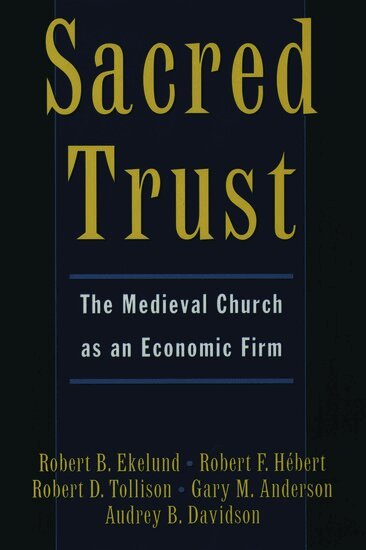
482 kr
Skickas inom 5-8 vardagar
The Church dominated society in the Middle Ages and functioned as a quasi-government, providing public and private goods. This book is the first to examine specific institutions in the Church in the Middle Ages in economic terms. Other books have argued generally that the Church either had a positive or negative effect on economic development. The authors of this book look more closely at the actual Church institutions and practices and describe how each functioned as a part of the larger economy of the time. They focus especially on marriage, usury, heresy, the crusades, and the monasteries. It is not their purpose to reject or impugn religious motives that may be advanced by theologians and historians. Their goal is to bring a fresh perspective to the role of institutions of the medieval Church in economic development.
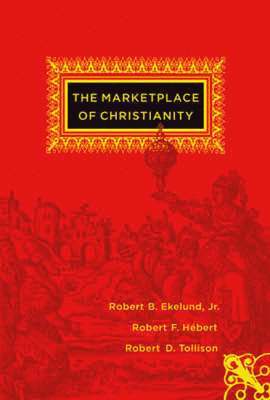
159 kr
Tillfälligt slut
831 kr
Skickas inom 10-15 vardagar
This book establishes a chronological trace of the entrepreneur as treated in economic literature in order to give a more wholesome perspective to contemporary writings and teachings on entrepreneurship. It focuses on the nature and role of the entrepreneur, and of entrepreneurship, as revealed in economic literature as early as the eighteenth century, when Richard Cantillon first coined the term 'entrepreneur'. The authors then trace how Joseph Schumpeter's perspective, among other’s, on entrepreneurship came to dominate the world's understanding of the term.Due to Schumpeter’s dominant influence, entrepreneurship has come to occupy a primary role in the theory of economic development. In this book Hébert and Link discuss various key topics including the German Tradition, the Austrian and the English School of thought as well as individuals such as Alfred Marshall and Jeremy Bentham. The historical survey also illustrates the tension that often exists between "theory" and "practice" and how it has been difficult for economic theory to assimilate a core concept that plays a vital role in social and economic change. Finally, the book exposes the many different facets of entrepreneurship as they have been perceived by some of the great economists throughout the ages.
2 220 kr
Skickas inom 10-15 vardagar
This book establishes a chronological trace of the entrepreneur as treated in economic literature in order to give a more wholesome perspective to contemporary writings and teachings on entrepreneurship. It focuses on the nature and role of the entrepreneur, and of entrepreneurship, as revealed in economic literature as early as the eighteenth century, when Richard Cantillon first coined the term 'entrepreneur'. The authors then trace how Joseph Schumpeter's perspective, among other’s, on entrepreneurship came to dominate the world's understanding of the term.Due to Schumpeter’s dominant influence, entrepreneurship has come to occupy a primary role in the theory of economic development. In this book Hébert and Link discuss various key topics including the German Tradition, the Austrian and the English School of thought as well as individuals such as Alfred Marshall and Jeremy Bentham. The historical survey also illustrates the tension that often exists between "theory" and "practice" and how it has been difficult for economic theory to assimilate a core concept that plays a vital role in social and economic change. Finally, the book exposes the many different facets of entrepreneurship as they have been perceived by some of the great economists throughout the ages.

Del 9 - Perspectives on the History of Economic Thought series
PERSPECTIVES ON THE HISTORY OF ECONOMIC THOUGHT
Volume IX: Themes on Economic Discourse, Method, Money and Trade�Selected Papers from the History of Economics Conference 1991�
Inbunden, Engelska, 1993
1 787 kr
Skickas inom 7-10 vardagar
This innovative book offers retrospective assessments of historical ideas and probes controversial issues in economic methodology. The essays are presented under five broad headings. Part I, Economic Discourse and Method consists of three essays that address timely topics in the methodology of economics. Part II, Philosophical/Analytical Issues in Classical Economics, contains two studies of Adam Smith and one of Thomas Malthus. Part III, Money and Banking Issues in the Nineteenth Century contains two essays that evaluate monetary controversies occurring more or less simultaneously on both sides of the Atlantic. Part IV, Equilibrium Models/Debates: Walras, Keynes, Pigou is loosely threaded around the theme of equilibrium models - their nature and significance in the works of Walras, Keynes and Pigou. Part V, the final section, The Discovery and Dissemination of Ideas, deals with the discovery and dissemination of ideas in economics.The volume presents some of the most important recent work in economic methodology and the history of economic thought and will be essential for both economists and libraries specializing in these areas.