
Robert G. Wright - Böcker
Visar alla böcker från författaren Robert G. Wright. Handla med fri frakt och snabb leverans.
2 produkter
2 produkter
928 kr
Skickas inom 10-15 vardagar
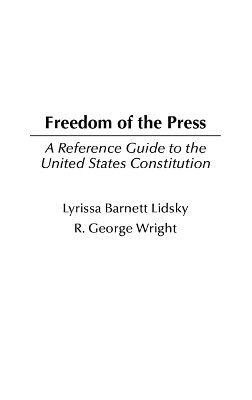
This work discusses the major court decisions that answer the important questions affecting freedom of the press, providing illustrations and examples that give insight into this complex body of law. The clear and concise style of the book makes it an essential guide for all those interested in freedom of the press.The book begins with an analysis of the text of the First Amendment and demonstrates how the seemingly simple text has given rise to complicated issues and interpretations. It also discusses the historical evolution of our current understanding of the justifications offered to protect freedom of expression. A number of important questions that have arisen in First Amendment law are discussed in detail.
928 kr
Skickas inom 10-15 vardagar
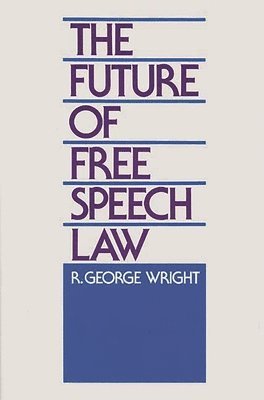
This provocative exploration of the issues surrounding free speech protection calls into question some important assumptions underlying much of contemporary free speech case law. The author considers the free speech issues associated with matters as diverse as the use of racial epithets, flag burning, obscenity, and speech by public school students, public school teachers, and public employees in general. He argues persuasively that free speech law has become unnecessarily complex and that free speech protection has been extended well beyond the bounds suggested by the various reasons for protecting speech in the first place. These developments, Professor Wright contends, risk an eventual weakening of the public commitment to free speech as a fundamental value.In a series of chapters--some broadly theoretical in character, others focused on concrete free speech cases--Wright develops his argument that the courts' tendency to gradually expand the scope of protection afforded by the free speech clause dilutes the essential seriousness of the clause and will eventually tend to erode public support for freedom of speech as a fundamental principal. On a more abstract level, Wright demonstrates that, increasingly, the case law of freedom of speech is grounded only in some form of relativist or subjectivist thought. The long-term risk, Wright suggests, is that our adoption of freedom of speech may come to be seen as an arbitrary preference without morally binding character in any traditional sense. Writing for students of constitutional law as well as practicing attorneys involved in free speech cases, this volume is an important counterweight to arguments in support of continual expansion of free speech protection.